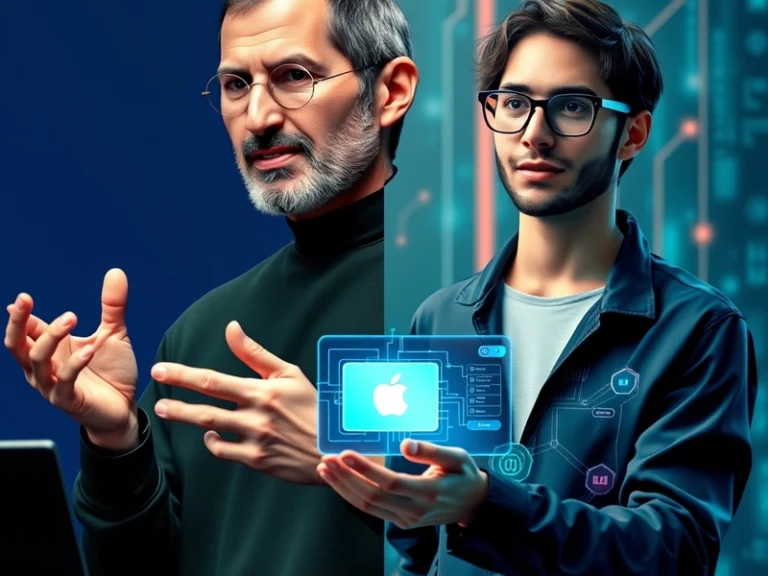
A retrospective look at Steve Jobs’ statements and philosophy from 1983 reveals a prescient, albeit unstated, understanding of many fundamental principles now driving modern artificial intelligence.
While the term “artificial intelligence” in 1983 often conjured images of expert systems running on specialized LISP machines or the nascent, highly theoretical work on neural networks, Jobs, then leading the Macintosh team at Apple, was articulating a vision for computing that laid conceptual groundwork remarkably prescient for today’s AI landscape. His focus was less on creating sentient machines and more on crafting tools that profoundly augmented human capability, a philosophy that resonates deeply with the practical applications of AI we see today.
The “Bicycle for the Mind” and Augmentation
One of Jobs’ most enduring analogies for the computer was as a “bicycle for the mind.” He believed that computers, by amplifying human intellect and creativity, could empower individuals to achieve far more than they could alone. This concept, articulated in the early 1980s, serves as a powerful metaphor for how many AI tools function in 2024.
- Generative AI as a creative amplifier: Tools like OpenAI’s DALL-E 3 or Midjourney allow artists and designers to rapidly prototype ideas, generating visual concepts that would take hours or days to create manually. Similarly, large language models (LLMs) like those powering ChatGPT assist writers, developers, and researchers in drafting content, brainstorming, and summarizing complex information. They don’t replace human creativity but accelerate its output.
- AI assistants for productivity: Applications such as Microsoft Copilot or Google Gemini integrate AI directly into everyday software, automating routine tasks, suggesting relevant information, and helping users navigate complex applications more efficiently. These act as intelligent co-pilots, making the user more productive.
- Knowledge navigation and synthesis: Jobs was fascinated by how people interacted with information. While he was focused on graphical user interfaces and early hypertext, the underlying goal was to make vast amounts of data accessible and useful. Modern AI, through advanced search algorithms, semantic understanding, and summarization capabilities, has taken this to an unprecedented level, allowing users to query and synthesize information from the entire web or proprietary datasets with ease.
These contemporary AI applications align perfectly with the “bicycle for the mind” ethos: they are not attempting to replicate human consciousness but rather to enhance human performance across a multitude of domains.
Intuitive Interfaces and Broad Accessibility
In 1983, Jobs was deeply immersed in the development of the Macintosh, a machine revolutionary for its graphical user interface (GUI) and mouse-driven interaction. His insistence on ease of use and intuitive design was a radical departure from the command-line interfaces prevalent at the time. This emphasis on making powerful technology accessible to the masses is another critical parallel to the successful deployment of AI today.
Early AI systems, particularly expert systems of the 1980s, were often complex, requiring specialized knowledge to operate and interpret. They were powerful but niche. Jobs’ vision, however, was about democratizing technology. For AI to truly augment humanity, it cannot be confined to laboratories or specialist users.
Today, the widespread adoption of AI is heavily dependent on user-friendly interfaces. Whether it’s the natural language prompts of ChatGPT, the integrated AI features in common productivity suites, or the voice interfaces of smart assistants, the success of modern AI hinges on abstracting away its underlying complexity, making it approachable for everyday users. This echoes Jobs’ foundational work with the Macintosh, which proved that sophisticated technology could be made simple and delightful to use.
The Unseen Intelligence Behind the Experience
While Jobs didn’t explicitly detail neural networks or large language models, his philosophical stance on computing hinted at an underlying intelligence that would make computers more responsive and helpful. He envisioned machines that could anticipate needs, understand context, and present information in a relevant way, much like a skilled human assistant. This “unseen intelligence” is precisely what drives many of today’s AI systems.
Consider the personalization algorithms that tailor content recommendations on streaming services or e-commerce sites. Or the predictive text capabilities on smartphones. These are forms of AI designed to make the user experience more seamless and intuitive, often operating quietly in the background, making the technology feel more like a natural extension of the user’s will rather than a rigid tool.
Jobs’ 1983 perspective, focused on empowering the individual through elegantly designed, powerful tools, inadvertently laid a conceptual framework for the integration of artificial intelligence into the fabric of daily life. His foresight wasn’t in predicting specific algorithms but in understanding the profound impact that intelligently designed technology, acting as an amplifier of human capability, would have on the world.