The landscape of scientific inquiry is rapidly evolving as artificial intelligence systems move beyond mere data analysis to actively participate in the full cycle of scientific research, from hypothesis generation to experimental execution and discovery. This shift marks the dawn of AI-driven research, promising to dramatically accelerate the pace of scientific breakthroughs across disciplines.
For years, AI has been an invaluable tool for processing vast datasets, identifying patterns, and assisting human researchers. However, recent advancements in large language models, reinforcement learning, and autonomous robotics are enabling AI to take on more proactive roles. This means AI systems are beginning to formulate their own hypotheses, design experiments to test them, perform those experiments, analyze the results, and iteratively refine their understanding—effectively closing the research loop with minimal human intervention.
The Research Loop: How AI Contributes
The integration of AI into the core stages of scientific research is multifaceted, with different AI paradigms contributing to distinct phases:
- Hypothesis Generation: Large Language Models (LLMs) can sift through millions of scientific papers, patents, and datasets to identify novel correlations, overlooked connections, or gaps in existing knowledge. By synthesizing information from disparate sources, AI can propose new theories or experimental directions that might elude human researchers due to the sheer volume of information.
- Experimental Design: AI can optimize experimental parameters, predict optimal conditions, and design more efficient and informative experiments. Machine learning models can simulate potential outcomes, reducing the need for costly and time-consuming physical trials, particularly in fields like materials science or drug discovery.
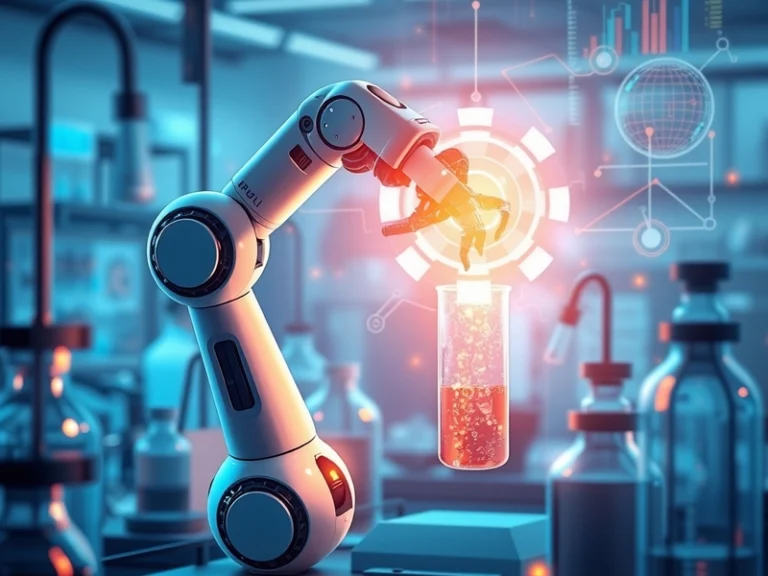
- Autonomous Execution: Coupled with robotics and automation, AI can physically carry out experiments. AI-controlled lab robots can precisely mix chemicals, grow cell cultures, or synthesize materials, generating new data autonomously. This capability not only accelerates data acquisition but also ensures high reproducibility and consistency.
- Data Analysis & Interpretation: AI excels at processing and interpreting complex, high-dimensional datasets generated from experiments. It can identify subtle trends, anomalies, and statistically significant findings that might be missed by human analysis, and even suggest further experiments based on the initial results.
- Knowledge Synthesis: Beyond individual experiments, AI can continuously integrate new findings into a broader knowledge graph, updating its understanding of a domain and using this updated knowledge to inform future research cycles.
Pioneering Examples in Action
This vision is already materializing in several high-profile projects. One prominent example is DeepMind’s Graph Networks for Materials Exploration (GNoME). Announced in late 2023, GNoME uses deep learning to predict the stability of novel inorganic compounds. This AI system has autonomously discovered hundreds of thousands of new stable materials, significantly expanding the database of known materials and accelerating the search for candidates with desirable properties for applications like superconductors or battery components. Human researchers then synthesize and validate these AI-predicted materials.
In the realm of biology and medicine, DeepMind’s AlphaFold, and its commercial arm Isomorphic Labs, exemplify AI’s impact on foundational research. While AlphaFold’s primary role has been predicting protein structures with unprecedented accuracy, this capability acts as a critical bottleneck remover in drug discovery. By providing insights into how proteins fold and interact, AI is indirectly guiding the design of new therapeutics, enabling researchers to identify potential drug targets and design molecules with specific binding characteristics more rapidly.
Beyond these well-known instances, AI-driven automation is increasingly prevalent in chemistry labs, where AI algorithms are designing new molecules and optimizing synthesis pathways. Robotic platforms, guided by AI, can autonomously execute chemical reactions, screen libraries of compounds, and even learn from failed experiments to refine their approach.
Accelerating the Pace of Discovery
The implications of AI conducting its own research are profound for the speed and scope of scientific discovery:
- Unprecedented Speed: AI can iterate through hypotheses, experimental designs, and data analysis cycles far faster than human teams, reducing discovery timelines from years to months or even weeks.
- Massive Scale: AI can explore vast search spaces—whether for new molecules, materials, or biological pathways—that are simply too large for human researchers to systematically investigate.
- Novelty and Serendipity: By identifying non-obvious connections and operating without human biases, AI can uncover entirely new paradigms or unexpected discoveries that might otherwise be missed.
- Enhanced Reproducibility: AI-controlled experiments can be precisely documented and replicated, addressing a long-standing challenge in scientific research by ensuring higher consistency and reliability of results.
Challenges and the Human Element
Despite the immense promise, the advent of AI-driven research also brings challenges. The “black box” nature of some AI models raises questions about interpretability and explainability: understanding *why* an AI made a particular discovery is often as important as the discovery itself. Furthermore, AI systems are only as good as the data they are trained on, meaning biases in existing scientific literature or datasets could be perpetuated or amplified.
Human oversight remains crucial. AI-generated hypotheses and experimental results still require rigorous validation by human scientists, who bring intuition, critical thinking, and ethical judgment to the process. The role of human researchers is shifting from performing repetitive tasks to overseeing AI systems, interpreting their findings, and guiding the overall research direction. This collaborative model—where AI acts as a powerful co-pilot and accelerator—is likely to be the prevailing paradigm for the foreseeable future, marrying AI’s computational prowess with human creativity and wisdom.