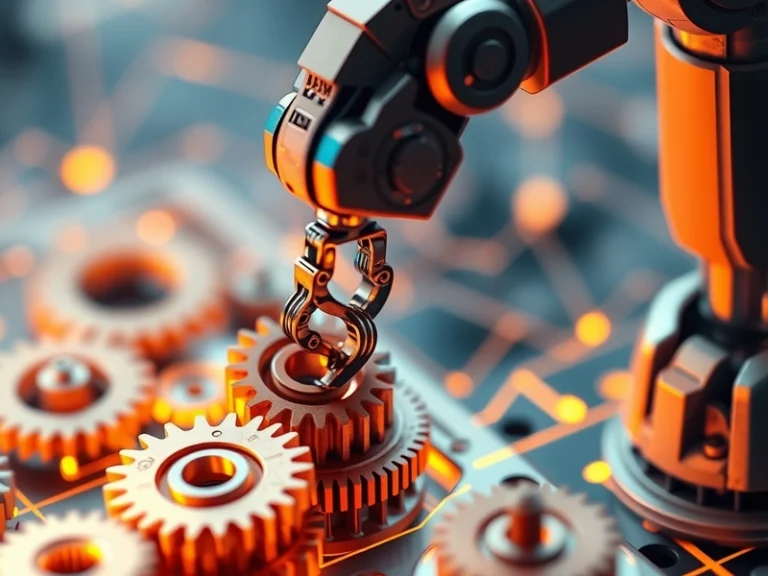
The concept of a “Matter Compiler,” a system capable of autonomously designing and assembling tiny machines from fundamental inputs, is rapidly gaining traction as a long-term vision in advanced manufacturing and AI research.
This ambitious vision posits a future where complex micro- and nano-scale devices could be fabricated with a level of automation and precision akin to how software compilers transform high-level code into executable programs. Instead of compiling code, a Matter Compiler would compile physical designs, turning raw materials into intricate functional components, from micro-electromechanical systems (MEMS) to advanced sensors and even microscopic robots.
AI’s Role in Generative Design
The journey towards such a compiler begins with AI’s increasing prowess in the design phase. Traditionally, designing micro-scale devices involves highly specialized expertise, iterative simulations, and lengthy optimization cycles. Generative AI, however, is beginning to fundamentally alter this process:
- Automated Topologies: AI algorithms can explore vast design spaces far more efficiently than human engineers, generating novel topologies for components that meet specific performance criteria, such as strength-to-weight ratios or fluid dynamics, at microscopic scales. Tools like Autodesk Fusion 360, for example, already incorporate generative design features for macroscopic parts, hinting at the potential for similar applications in micro-fabrication.
- Material Science Integration: AI can accelerate the discovery and selection of suitable materials by simulating their properties under various conditions. This is crucial for tiny machines where material behavior at the micro- and nano-scale can differ significantly from bulk properties. Machine learning models can predict how novel material compositions might perform, reducing the need for extensive physical experimentation.
- Simulation and Optimization: AI-powered simulation tools can rapidly evaluate the performance of generated designs, identifying potential flaws or areas for improvement before fabrication begins. Reinforcement learning, in particular, can be used to iteratively refine designs based on simulated performance metrics, leading to highly optimized structures for specific functions.
This generative capability moves beyond mere optimization, enabling the creation of designs that human engineers might not conceive, pushing the boundaries of what is mechanically or electrically possible at small scales.
Precision Assembly and Fabrication with AI
Beyond design, the “Matter Compiler” vision hinges on AI’s ability to control and automate the physical fabrication and assembly processes. Manufacturing at the micro- and nano-scale presents unique challenges, requiring extreme precision and often novel techniques.
Micro-Scale Manufacturing Techniques Benefiting from AI:
- Advanced Additive Manufacturing: Techniques like two-photon polymerization allow for 3D printing of intricate structures with features down to the sub-micrometer level. AI can optimize print paths, predict material deformation, and control laser parameters to ensure high fidelity and minimize defects.
- Robotic Micro-Assembly: As robotic manipulators become increasingly precise, AI can orchestrate their movements for the assembly of micro-components. This includes vision systems for precise component recognition and placement, and reinforcement learning for adapting to variations in parts or environmental conditions. Research labs are exploring micro-robots controlled by AI for delicate tasks, demonstrating the feasibility of automated manipulation at these scales.
- Self-Assembly Guidance: At the nanoscale, processes often rely on self-assembly principles, where components spontaneously arrange themselves due to chemical or physical forces. AI can be used to design the components themselves, dictating their interaction properties to guide them towards desired final structures, similar to how DNA origami techniques produce complex 3D nanostructures.
- Quality Control and Metrology: AI-driven vision systems and sensor fusion can perform real-time quality inspection during fabrication, identifying anomalies and making immediate adjustments to the manufacturing process. This reduces waste and increases throughput, critical for the high-volume production of tiny devices.
The integration of AI into these fabrication steps transforms them from manual, error-prone processes into highly automated, adaptive systems, bringing us closer to the seamless materialization envisioned by the Matter Compiler concept.
The Integrated Vision: From Concept to Physical Reality
The true power of a Matter Compiler would lie in its ability to bridge the gap between digital design and physical fabrication, creating an integrated pipeline. An engineer or designer could specify the desired function and high-level parameters for a tiny machine, and the AI system would handle the rest:
- Design Generation: AI autonomously generates optimal designs for the required functionality, considering material properties and manufacturing constraints.
- Process Planning: The system devises the most efficient and precise fabrication and assembly sequence, selecting appropriate micro-manufacturing techniques.
- Automated Execution: AI-controlled robotic systems and advanced printers execute the fabrication plan, potentially even adapting in real-time to unforeseen variations.
- Quality Assurance: Integrated AI monitoring ensures that the final product meets specifications, with immediate feedback loops for process correction.
Such a system promises to dramatically reduce development cycles, lower manufacturing costs for highly customized micro-devices, and enable the rapid prototyping of novel technologies. It could democratize access to advanced micro-fabrication, moving beyond specialized cleanrooms to more flexible, on-demand production.
Challenges and the Road Ahead
While the vision is compelling, significant challenges remain. Scaling current AI capabilities to manage the extreme complexity and quantum-level physics often at play at the nano-scale is a formidable task. Material science also needs to advance further, providing new building blocks and a deeper understanding of their behavior at these dimensions.
Moreover, the cost of developing and maintaining such highly integrated, precise systems is substantial, requiring significant investment in research and infrastructure. However, ongoing advancements in computational power, AI algorithms, and micro- and nano-engineering continue to push the boundaries, making the Matter Compiler an increasingly tangible, albeit still distant, long-term goal for the future of manufacturing.