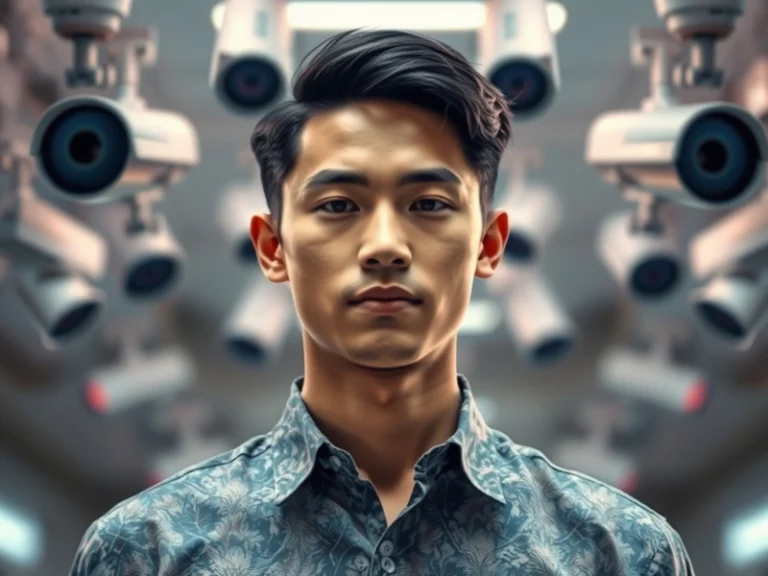
A novel design concept for apparel has emerged, demonstrating patterns that actively challenge the perception of AI-powered cameras, highlighting inherent limitations in current computer vision technologies.
While details of specific commercial products remain nascent, the underlying principle leverages research into adversarial examples, where subtle perturbations or specific patterns can cause deep neural networks to misclassify or fail to detect objects they are trained to identify. In the context of a “shirt,” this translates to garments featuring patterns designed to disrupt the feature extraction process fundamental to many AI camera systems, including those used for facial recognition, person detection, and activity monitoring.
How AI Perception is Challenged
Modern AI camera systems, particularly those employing deep learning, work by analyzing visual inputs to identify patterns, shapes, and textures associated with specific objects or individuals. They learn hierarchical features, from simple edges and corners at lower layers to complex object parts and entire objects at higher layers. The “undetectable shirt” concept exploits vulnerabilities in this learned perception:
- Adversarial Patterns: These are meticulously crafted visual noise or specific textures that are often imperceptible or appear as abstract art to the human eye, but are highly disruptive to a neural network. They can cause the network to output a confident but incorrect classification, or, in this case, fail to output any classification for a human subject.
- Feature Map Confusion: By introducing specific patterns, the shirt aims to confuse the intermediate feature maps within the convolutional neural network. Instead of activating neurons associated with “human form” or “clothing,” the patterns might activate unrelated features or suppress the correct ones, effectively making the wearer “invisible” to the AI.
- Robustness Limitations: Many current AI models, while highly accurate on clean, expected data, exhibit a lack of robustness when faced with out-of-distribution inputs or adversarial attacks. This design concept directly probes these robustness limitations in real-world scenarios.
Such designs are a direct descendent of academic research into adversarial patches and garments, which have demonstrated the ability to fool object detectors like YOLO (You Only Look Once) or Mask R-CNN. For instance, researchers have shown how printed patterns worn on a person’s body can prevent a system from detecting them, or even misclassify them as an entirely different object, like a toaster or a car.
Implications for Privacy and Surveillance
The emergence of designs that bypass AI camera detection carries significant implications, particularly concerning privacy and the widespread deployment of surveillance technologies:
- Enhanced Personal Privacy: For individuals concerned about pervasive surveillance in public spaces, such clothing could offer a novel method for maintaining anonymity. In an era where facial recognition and person tracking are increasingly common, this technology presents a potential countermeasure for those wishing to opt out of automated identification.
- Challenge to Security Systems: Conversely, the same technology could pose challenges for security systems reliant on AI vision. Retail loss prevention, public safety monitoring, and access control systems could all be impacted if individuals can reliably evade detection.
- Ethical Debates: The development sparks renewed debate about the ethics of AI surveillance and the right to privacy in digitally monitored environments. It highlights an ongoing technological arms race between those developing surveillance tools and those seeking to circumvent them.
The concept serves as a tangible demonstration of how physical objects can interact with and exploit the digital vulnerabilities of artificial intelligence. It moves the conversation from purely theoretical adversarial attacks in lab settings to potential real-world applications.
The Path Forward for AI Development
For AI developers and researchers, this breakthrough underscores the urgent need for more robust and resilient computer vision models. Addressing these vulnerabilities will likely involve several approaches:
- Adversarial Training: Integrating adversarial examples into training datasets to make models more resistant to such attacks.
- Certified Robustness: Developing methods to mathematically guarantee a model’s performance against certain types of adversarial perturbations.
- Novel Architectures: Exploring new neural network architectures that are inherently more robust to subtle input changes.
- Multi-Modal Fusion: Combining visual data with other sensor inputs (e.g., thermal, radar) to create more comprehensive and harder-to-fool detection systems.
While the “undetectable shirt” represents a significant conceptual challenge to current AI perception, it also serves as a powerful catalyst for innovation. It forces a re-evaluation of how AI systems are designed, trained, and deployed, pushing the field towards more secure and reliable solutions capable of operating effectively in an increasingly complex and adversarial world.