The pervasive ambition to deploy sophisticated artificial intelligence directly onto pocket-sized devices is rapidly solidifying into practical implementations, fundamentally reshaping how we interact with technology. This ongoing shift, often conceptualized as a “pocket-sized supercomputer,” represents a significant leap in AI development, moving powerful capabilities from distant cloud servers to the immediate, private confines of personal devices.
The notion of a “Tiiny AI” — an AI model with substantial processing power and complexity that operates locally on a smartphone, wearable, or other compact edge device — tackles critical limitations of cloud-dependent AI. While cloud AI offers immense scale and computational resources, it introduces inherent challenges related to latency, privacy, and connectivity. On-device AI, by contrast, processes data directly where it’s generated, offering instantaneous responses and keeping sensitive user data local.
Engineering the “Pocket-Sized Supercomputer”
Achieving this level of on-device intelligence requires a dual approach: optimizing AI models for efficiency and developing specialized hardware to accelerate their execution. The confluence of these two areas is driving the current wave of edge AI innovation.
Model Optimization Techniques
- Quantization: This technique reduces the precision of the numbers used to represent neural network weights and activations. Instead of using 32-bit floating-point numbers, models can be quantized to 16-bit or even 8-bit integers, significantly shrinking model size and accelerating inference without substantial loss in accuracy.
- Pruning: Many neural networks, particularly larger ones, contain redundant connections or neurons. Pruning identifies and removes these less critical components, resulting in a sparser, smaller network that performs similarly to its larger counterpart but requires less computation.
- Knowledge Distillation: A smaller, “student” model is trained to mimic the behavior of a larger, more complex “teacher” model. The student learns to generalize and perform well, often achieving near-teacher performance with a fraction of the parameters.
- Efficient Architectures: Researchers have designed entire families of neural networks specifically for mobile and edge deployment. Architectures like MobileNet and EfficientNet, for instance, utilize depthwise separable convolutions and compound scaling to achieve high accuracy with significantly fewer parameters and operations than traditional large-scale models.
Specialized Hardware Acceleration
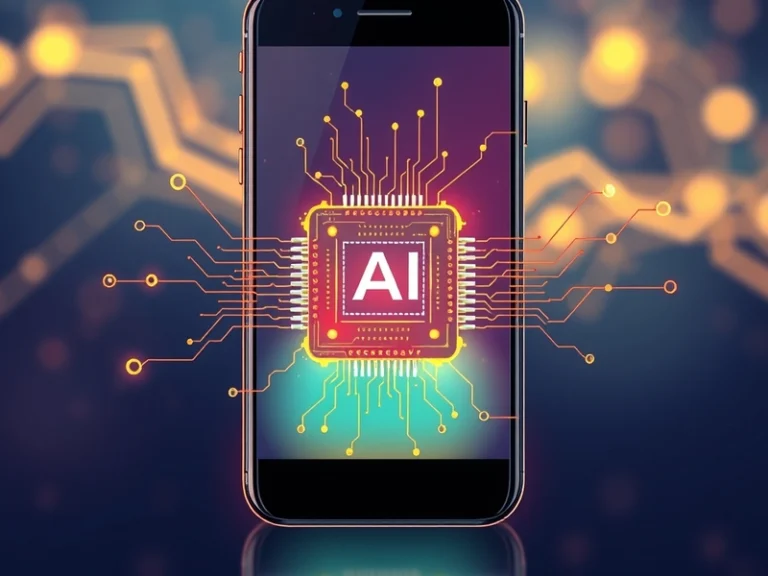
Software optimizations alone are often insufficient for truly powerful on-device AI. Dedicated hardware, frequently referred to as Neural Processing Units (NPUs) or AI Accelerators, plays a crucial role. These components are designed from the ground up to efficiently perform the matrix multiplications and activation functions that are the bedrock of neural network operations.
Modern System-on-Chips (SoCs) from manufacturers like Qualcomm (with its Snapdragon AI Engine), Apple (with its Neural Engine), and Google (with its Tensor Processing Units, and its Coral Edge TPU for embedded devices) integrate powerful NPUs directly into mobile processors. These accelerators can execute complex AI models with remarkable speed and energy efficiency, far surpassing what general-purpose CPUs or even integrated GPUs can achieve for AI workloads. This hardware-software co-design is fundamental to enabling sophisticated tasks like real-time image recognition, natural language processing, and personalized recommendations directly on a device without draining its battery prematurely.
Impact and Applications
The rise of powerful on-device AI brings several transformative benefits and opens doors to new applications:
- Enhanced Privacy: Processing sensitive data like biometric information, voice commands, or personal photos locally means this data never leaves the device, mitigating privacy concerns associated with cloud uploads.
- Lower Latency: Eliminating the round trip to a cloud server means AI responses are virtually instantaneous. This is critical for real-time applications such as augmented reality, autonomous drone navigation, or immediate voice assistant feedback.
- Offline Capability: On-device AI functions even without an internet connection, making it reliable in remote areas or during connectivity outages. This is crucial for applications ranging from offline translation to emergency response systems.
- Reduced Cost and Bandwidth: Less reliance on cloud infrastructure can reduce operational costs for developers and decrease the amount of data transferred over networks, benefiting both users and service providers.
Practical applications are already abundant. Smartphones routinely perform on-device face unlock, object recognition in cameras, and real-time transcription of speech. Wearable devices leverage compact AI models for activity tracking, health monitoring, and gesture recognition. Automotive systems use edge AI for driver assistance features and predictive maintenance. The ability to run generative AI models, albeit smaller ones, directly on a device for tasks like intelligent content summarization or personalized content creation is also emerging.
Challenges and the Road Ahead
While the progress is substantial, challenges remain. The balance between model size, accuracy, and computational efficiency is a continuous optimization problem. Developers must weigh the benefits of a smaller, faster model against potential decreases in performance or generalization capabilities. Furthermore, ensuring robust security for AI models deployed on devices, particularly against adversarial attacks, is an ongoing area of research.
The future of “Tiiny AI” points towards even more capable and efficient models, supported by increasingly powerful and specialized edge hardware. As research in areas like sparse neural networks, efficient transformer variants, and novel NPU architectures continues, the line between what’s possible on a cloud supercomputer and what’s achievable in a pocket-sized device will continue to blur, ushering in an era of ubiquitous, intelligent, and highly personalized computing.