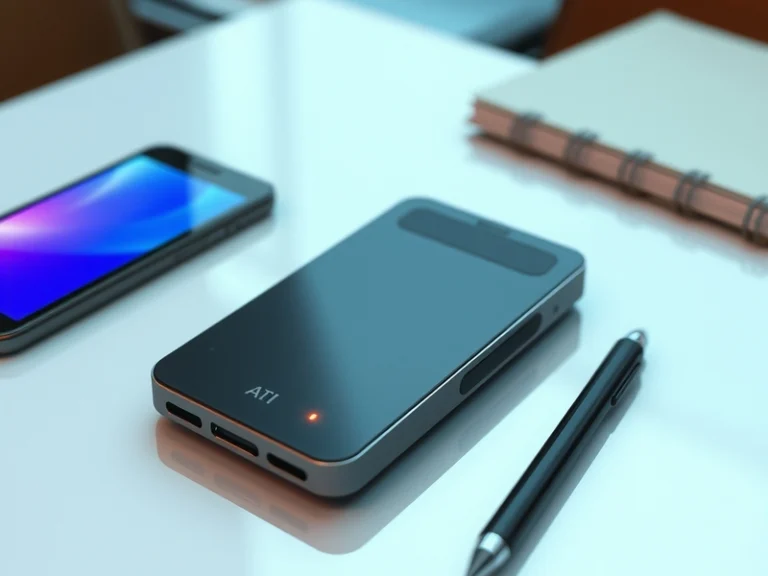
A new class of AI-powered personal recorders, designed for extreme portability and capable of automating complex follow-up tasks, is emerging, poised to redefine professional note-taking and task management. These devices, often no larger than a credit card, integrate advanced audio capture with sophisticated artificial intelligence to transform spoken conversations into structured data and actionable items.
At its core, such an AI recorder functions by continuously capturing ambient audio from meetings, brainstorming sessions, or casual discussions. Unlike traditional voice recorders, the intelligence lies in its immediate and automated processing pipeline. Once a recording is initiated, the device leverages on-device or cloud-based AI models for several key functions:
- High-Fidelity Audio Capture: Employing multi-microphone arrays and noise reduction algorithms to isolate speaker voices and minimize background interference, crucial for accurate transcription in varied environments.
- Real-time Speech-to-Text Transcription: Advanced automatic speech recognition (ASR) models, often fine-tuned for conversational speech, convert spoken words into text. Modern ASR systems from companies like Google, Amazon (AWS Transcribe), and OpenAI (Whisper) have achieved remarkable accuracy, even differentiating between multiple speakers.
- Semantic Summarization and Key Point Extraction: After transcription, large language models (LLMs) process the text. These models are adept at identifying main topics, summarizing lengthy discussions, and extracting critical information such as decisions made, action items, and assigned owners. This moves beyond simple keyword spotting to understanding the context and intent of the conversation.
- Automated Follow-up Generation: Perhaps the most transformative feature, these devices can leverage natural language generation (NLG) to draft follow-up emails, create calendar events, or populate task management systems. For instance, if a meeting concludes with “John will send the updated proposal by Friday,” the AI can automatically draft an email to John with a reminder, or create a task for him in a connected project management tool like Asana or Trello.
The miniaturization required for a “wallet-sized” form factor is enabled by advancements in low-power System-on-Chip (SoC) designs and efficient edge AI processing. While some heavy-lifting AI tasks might offload to the cloud, initial processing, like wake-word detection or basic noise filtering, can occur on the device, ensuring responsiveness and reducing latency. Connectivity, typically via Bluetooth to a smartphone or directly over Wi-Fi, facilitates seamless data transfer and synchronization with personal productivity suites.
Transforming Productivity Workflows
The implications for individual and team productivity are substantial. Professionals often spend significant time post-meeting, deciphering handwritten notes or attempting to recall discussions to formulate action plans. This manual effort is prone to error and consumes valuable time. An AI recorder streamlines this process by:
- Reducing Cognitive Load: Users can fully engage in conversations without the distraction of meticulous note-taking.
- Ensuring Accuracy: A transcribed and summarized record provides an objective account of discussions, minimizing misinterpretations or forgotten details.
- Accelerating Action: Automated follow-ups mean less delay between decision and execution, improving project velocity.
- Creating a Searchable Knowledge Base: All recorded and processed conversations become a searchable repository of information, making it easy to revisit past discussions or find specific details.
Consider a sales professional conducting multiple client calls daily. Instead of manually logging CRM entries or drafting follow-up emails, the AI recorder could automatically generate call summaries, identify next steps, and even pre-fill CRM fields, freeing the professional to focus on client engagement.
Navigating Ethical and Practical Challenges
While the technological promise is significant, the widespread adoption of such pervasive recording devices brings critical ethical and practical considerations to the forefront:
- Privacy and Consent: The legality and ethics of recording conversations without explicit consent are paramount. Jurisdictions vary, with “one-party consent” being common in some areas, while “all-party consent” is required in others. Device manufacturers and users must navigate these regulations carefully, potentially through clear indicators (e.g., LED lights) when recording is active, or mandatory verbal prompts.
- Data Security: The sensitive nature of captured conversations necessitates robust encryption, secure storage, and clear policies regarding data access and retention. Users must trust that their confidential discussions remain private.
- Accuracy and Bias: While ASR and LLMs are powerful, they are not infallible. Transcription errors, misinterpretations by summarization models, or biases embedded in training data could lead to incorrect action items or skewed records. Human oversight remains crucial.
- Integration Ecosystem: The true value of automated follow-ups depends on seamless integration with a user’s existing suite of tools—email clients (Outlook, Gmail), calendar apps, CRM systems (Salesforce), and project management platforms (Jira, Monday.com).
- Battery Life and Storage: Continuous audio capture and AI processing demand significant power. Balancing a compact form factor with sufficient battery life and local storage for offline operation is a key engineering challenge.
The evolution of AI recorders represents a convergence of advanced audio engineering, sophisticated language models, and miniaturized hardware. As these devices mature, addressing the critical balance between enhanced productivity and stringent ethical considerations will be key to their success and integration into our daily professional lives.