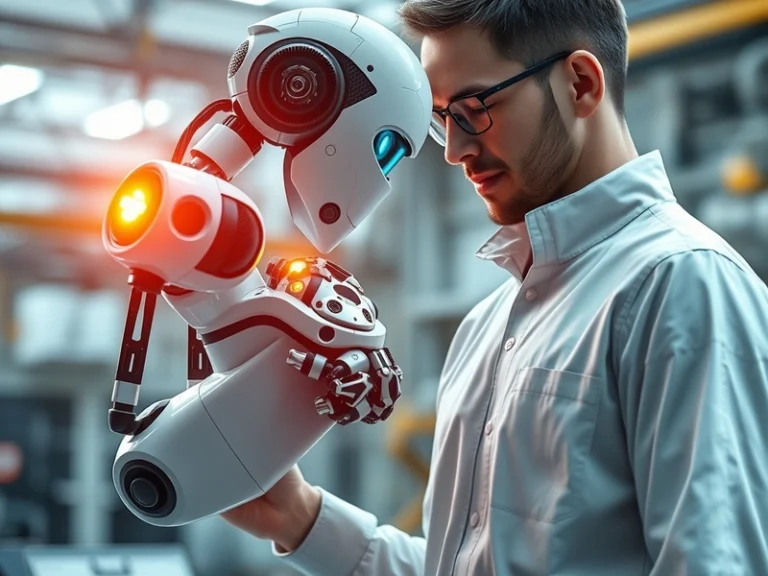
Recent discussions and reports within the robotics community have underscored persistent concerns regarding safety in AI-driven robotic deployments, highlighting the critical need for rigorous testing and robust safety protocols before any system interacts with the real world.
As artificial intelligence permeates an ever-wider array of physical systems, from autonomous vehicles to industrial manipulators and service robots, the potential for unintended consequences grows. While the promise of increased efficiency, productivity, and safety (by removing humans from hazardous tasks) is compelling, the complex interplay of hardware, software, and human factors presents significant challenges. Incidents, ranging from minor malfunctions to more serious events involving property damage or human injury, serve as stark reminders that the ‘attack’ in “When Robots Attack” is often less malicious intent and more a failure of prediction, perception, or control in highly dynamic environments.
The Expanding Robotic Footprint and Its Risks
Robots are no longer confined to the caged-off areas of traditional manufacturing plants. Modern robotics, particularly collaborative robots (cobots) and mobile autonomous robots, are increasingly designed to operate in shared spaces with humans. This shift introduces a new spectrum of safety considerations:
- Industrial Robotics: While traditionally highly segregated, advancements mean even heavy-duty industrial arms from manufacturers like KUKA, ABB, and Fanuc are being integrated into more flexible production lines, requiring more sophisticated safety measures beyond simple physical barriers.
- Collaborative Robotics: Cobots, exemplified by Universal Robots and Rethink Robotics (before its acquisition), are designed specifically to work alongside humans without caging. Their safety relies on features like force/torque limiting, speed and separation monitoring, and hand guiding. Failures in these systems can lead to direct human contact at potentially unsafe forces.
- Service and Logistics Robots: Autonomous mobile robots (AMRs) in warehouses (e.g., Amazon Robotics, Locus Robotics) and service robots in hospitals or hotels navigate complex, often unpredictable human environments. Their safety depends on robust navigation, obstacle avoidance, and dynamic path planning, all powered by AI.
The core challenge lies in the inherent unpredictability of real-world environments compared to the controlled conditions of a lab or factory floor. AI systems, particularly those based on machine learning, excel at pattern recognition but can struggle with novel situations or “edge cases” not present in their training data. When these systems control physical hardware, such failures can manifest as unexpected movements, collisions, or incorrect task execution.
Root Causes of Robotic Safety Incidents
Attributing a robotic incident to a single cause is often an oversimplification. Typically, a confluence of factors contributes to a safety lapse:
- Software Bugs and Logic Errors: Even with extensive testing, complex codebases can harbor latent bugs. These can lead to incorrect decisions, unexpected movements, or failures to respond to safety triggers. For AI-driven systems, the opaque nature of some neural networks (the “black box” problem) can make debugging and verifying behavior particularly challenging.
- Sensor Failures or Limitations: Robots rely heavily on sensors (cameras, LiDAR, ultrasonic, force sensors) to perceive their environment. Malfunctions, environmental interference (e.g., glare, dust, fog), or fundamental limitations in sensor range/accuracy can lead to an incomplete or incorrect understanding of the surroundings, causing collisions or near-misses.
- Human-Robot Interaction (HRI) Design Flaws: Poorly designed interfaces, unclear communication protocols between human and machine, or inadequate training for human operators can create hazardous situations. Humans might misinterpret a robot’s intent or inadvertently place themselves in a dangerous zone.
- Insufficient Testing and Validation: Pressure to deploy new technologies can sometimes lead to shortcuts in the rigorous testing needed to expose vulnerabilities across a wide range of scenarios, especially edge cases. Simulation is helpful, but real-world testing, including adversarial testing, is indispensable.
- Lack of Robust Safety Standards or Adherence: While international standards exist (e.g., ISO 10218 for industrial robots, ISO/TS 15066 for collaborative robots), their application can vary, and new AI paradigms constantly push beyond existing frameworks. Furthermore, mere compliance does not always equate to absolute safety in every conceivable scenario.
Mitigating Risks: A Multi-faceted Approach
Addressing these safety concerns requires a holistic strategy encompassing technical, procedural, and ethical dimensions:
1. Rigorous Engineering and Testing
- Fail-Safe Design: Implementing redundant safety systems, emergency stop mechanisms (E-stops), and clear physical barriers or safety zones that activate upon intrusion.
- Software Verification and Validation: Employing formal methods, extensive unit and integration testing, and continuous monitoring. For AI, this includes robust data validation, model explainability techniques, and adversarial training to make models more resilient to unexpected inputs.
- Simulation and Real-World Testing: Utilizing high-fidelity simulations to test millions of scenarios, complemented by extensive real-world testing in controlled environments, gradually escalating to more complex, dynamic settings. “Red teaming” approaches, where dedicated teams try to find vulnerabilities, are crucial.
2. Standardisation and Regulation
International bodies and national agencies are continually developing and updating standards to guide safe robot design and deployment. Adherence to these standards, such as those from the International Organization for Standardization (ISO) and the Occupational Safety and Health Administration (OSHA) in the US, provides a baseline for safety. However, the rapid pace of AI innovation often outstrips regulatory development, necessitating a proactive approach from developers.
3. Ethical AI Development
Beyond technical compliance, a strong ethical framework is paramount. This includes:
- “Safety-First” Design Principles: Prioritizing human safety above all other objectives, even performance or efficiency, in the design process.
- Transparency and Explainability: Designing AI systems that can explain their decisions, especially in safety-critical situations, allows for better auditing and understanding of potential failure modes.
- Human Oversight and Intervention: Ensuring that humans retain the ultimate authority and ability to intervene or override autonomous systems when necessary.
The ongoing integration of AI into physical robots is a transformative development, but it carries inherent risks that demand serious attention. The goal is not to halt progress but to ensure it proceeds responsibly, with safety ingrained at every stage of design, development, and deployment. As incidents continue to occur, they serve as crucial learning opportunities, driving the industry towards more robust, reliable, and ultimately safer autonomous systems.