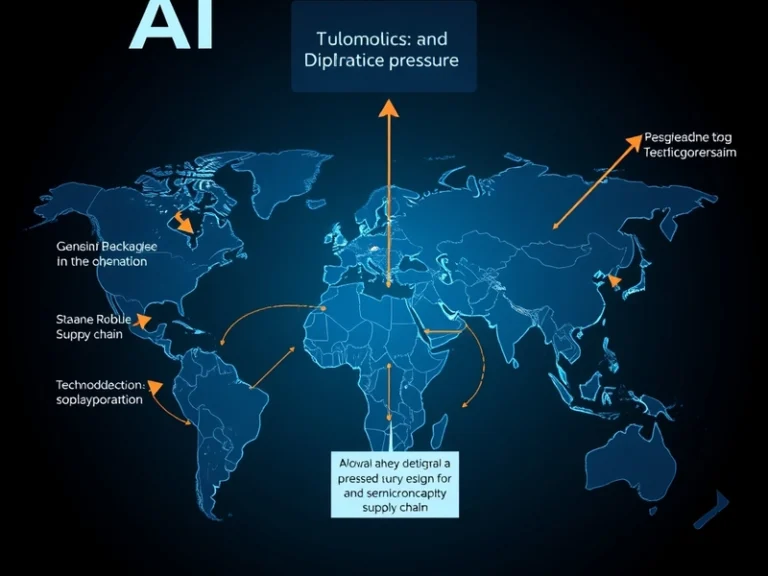
The United States is actively pressing its allies to align on policies governing artificial intelligence and critical semiconductor technologies, intensifying a global technological competition that reshapes international relations.
This push is not a formal declaration of an “AI Coalition” but rather a strategic effort by the Biden administration to establish a shared technological front, primarily aimed at limiting the advancement of specific geopolitical rivals, notably China, in foundational AI capabilities. The strategy involves a multifaceted approach, blending export controls, investment screening, and diplomatic engagement to create a de facto alignment among key partners in the global technology supply chain.
The Strategic Imperative: National Security and Technological Primacy
At the core of the US initiative is a dual concern: national security and maintaining technological leadership. Advanced AI, particularly large language models and sophisticated image recognition systems, relies heavily on high-performance computing hardware. The most critical components for training these models are advanced graphics processing units (GPUs), such as those produced by NVIDIA, and the cutting-edge semiconductor manufacturing equipment required to produce them.
US policymakers view unrestricted access to these technologies by potential adversaries as a direct threat. The concern stems from the dual-use nature of AI; capabilities developed for civilian applications can often be repurposed for military, surveillance, or intelligence purposes. By limiting access to advanced chips and the tools to make them, the US aims to slow the development of military AI applications and maintain a strategic advantage.
Economically, the US seeks to preserve its lead in next-generation technologies. The AI sector is projected to be a significant driver of economic growth and innovation. Washington’s strategy reflects a desire to ensure that the economic benefits and strategic influence derived from AI leadership accrue primarily to the US and its allies.
Mechanisms of Alignment: Controls, Screening, and Diplomacy
The US government employs several key mechanisms to encourage this alignment:
- Export Controls: The US Department of Commerce’s Bureau of Industry and Security (BIS) has implemented stringent export controls, notably in October 2022 and expanded in October 2023, targeting the sale of advanced semiconductors and semiconductor manufacturing equipment to specific entities and regions. These controls not only directly restrict US companies but also include “foreign direct product rules” that can prevent foreign companies from selling products made with US technology or software to sanctioned entities. This puts pressure on allied nations with critical roles in the semiconductor supply chain.
- Investment Screening: The Committee on Foreign Investment in the United States (CFIUS) scrutinizes foreign investments in US companies, particularly those involved in critical technologies like AI, semiconductors, and quantum computing. Similar mechanisms are being encouraged or developed in allied nations to prevent adversarial capital from acquiring sensitive technological assets.
- Diplomatic Pressure and Multilateral Engagement: Through bilateral discussions and multilateral forums, the US urges allies like Japan, South Korea, the Netherlands, and Germany – nations home to critical players like ASML (Netherlands) for lithography equipment and TSMC (Taiwan) for advanced foundry services – to adopt similar restrictive policies. Initiatives like the Indo-Pacific Economic Framework for Prosperity (IPEF) also serve as platforms to build consensus on technology standards and supply chain resilience among like-minded nations.
The Allies’ Dilemma: Balancing Economics and Strategy
For US allies, this push for alignment presents a complex dilemma. While many share concerns about national security and the long-term strategic implications of AI, they also maintain significant economic ties with the very nations targeted by US restrictions. For example:
- European Nations: Companies like ASML in the Netherlands face pressure to comply with US export controls, impacting their ability to sell advanced EUV lithography systems globally. Germany, a major exporter of industrial technology, also navigates this landscape.
- East Asian Partners: South Korea’s Samsung and SK Hynix, and Taiwan’s TSMC, are crucial to the global memory and foundry markets. Their significant production capacities and customer bases include entities now under US scrutiny. Japan, with its strong position in semiconductor materials and equipment, also faces strategic choices.
These countries must weigh the economic benefits of open trade against the strategic imperative of aligning with their primary security partner. This often leads to delicate balancing acts, with some allies implementing their own versions of export controls or investment screening, sometimes mirroring US policies, sometimes with subtle differences reflecting their specific economic and political contexts.
Implications for the Global AI Landscape
The intensifying pressure for technological alignment carries profound implications for the future of AI and international relations:
- Technological Bifurcation: The most significant long-term consequence is the potential for a bifurcated global technology ecosystem. This could lead to two distinct AI development pathways, with different hardware architectures, software stacks, data governance standards, and ethical frameworks. Such a split could hinder global collaboration on pressing AI challenges and create interoperability issues.
- Supply Chain Reshaping: Nations are actively seeking to de-risk and diversify their supply chains, particularly for semiconductors. This involves significant investments in domestic manufacturing capabilities, such as Intel’s planned fabs in the US and Europe, and TSMC’s investments in Japan and Germany.
- Standard-Setting Competition: The geopolitical competition extends to the realm of international standards for AI. Different blocs will likely push for their own technical and ethical norms, potentially fragmenting global governance efforts.
- Accelerated Innovation in Specific Areas: While restrictive policies aim to slow adversaries, they can also spur indigenous innovation in targeted regions, leading to the development of alternative technologies and supply chains.
The US drive to coalesce its allies around a shared technological strategy marks a new era of geopolitical competition. AI, once primarily a domain of scientific and commercial innovation, is now undeniably a central pillar of national power and a critical battleground in the ongoing contest for global influence.