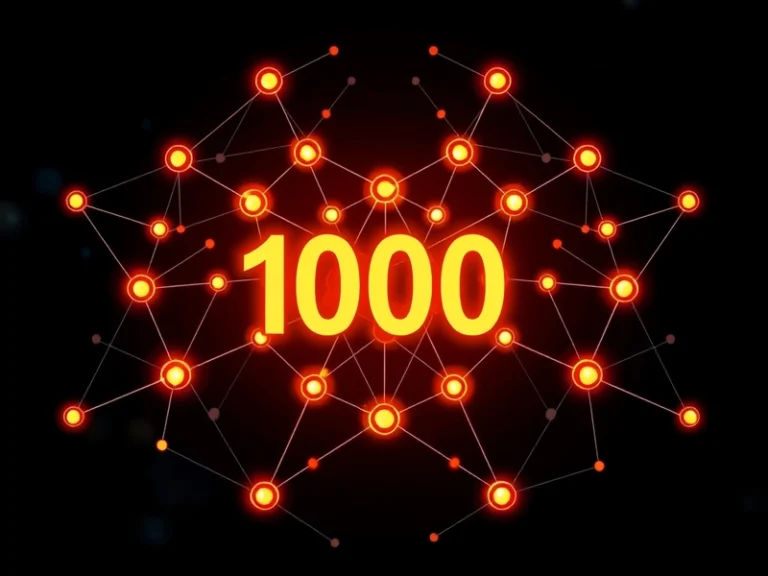
A recent study has demonstrated a notable achievement in multi-agent artificial intelligence, where 1,000 AI agents successfully reached consensus without any external direction, highlighting the potential for highly decentralized and self-organizing AI systems.
This development underscores a significant step forward in the field of distributed AI and swarm intelligence. For artificial intelligence systems to operate effectively in complex, dynamic environments, the ability for multiple independent agents to coordinate their actions, share information, and arrive at a collective agreement is paramount. Historically, achieving robust consensus among a large number of autonomous entities has been a substantial challenge, often requiring centralized control or extensive pre-programming of interaction rules.
The Challenge of Coordination at Scale
The inherent difficulties in coordinating a thousand independent AI agents are considerable. Each agent must process its local information, communicate with others, and adjust its behavior in pursuit of a common goal or shared understanding. Without a central orchestrator, agents face the risk of conflicting actions, communication bottlenecks, or diverging states that prevent collective decision-making. Traditional approaches to multi-agent coordination often involve explicit communication protocols, shared global states, or hierarchical control structures. However, these methods can introduce single points of failure, limit scalability, or incur significant computational overhead as the number of agents grows.
The breakthrough in this study lies in the agents’ capacity for emergent agreement. Rather than being explicitly programmed to follow a leader or adhere to a rigid communication schedule, the agents likely employed mechanisms that allowed consensus to arise from their local interactions and adaptive behaviors. This mirrors natural systems, such as ant colonies or bird flocks, where complex collective behaviors emerge from simple rules followed by individual entities.
Mechanisms for Emergent Agreement
While the specifics of the study’s methodology are not detailed, multi-agent systems typically achieve such emergent consensus through a combination of techniques:
- Peer-to-Peer Communication: Agents exchange information directly with their neighbors or a subset of other agents, propagating insights across the network without relying on a central server. Gossip protocols, where agents randomly share their state with others, are a common example.
- Local Rules and Adaptive Behavior: Each agent follows a set of relatively simple rules that dictate its actions based on its current state and the information received from its immediate vicinity. Over time, these local interactions can lead to global patterns and collective agreement.
- Reinforcement Learning: Agents may learn optimal strategies for interaction and decision-making through trial and error, adjusting their policies based on feedback from their environment and the actions of other agents. This allows them to converge on behaviors that contribute to collective success.
- Implicit Coordination: In some cases, agents may achieve consensus not through explicit communication, but by observing each other’s actions and inferring intentions or states, leading to a de facto alignment.
The ability of agents to self-organize and reach agreement without external direction significantly enhances the robustness and autonomy of AI systems. It implies a greater resilience to individual agent failures and a more flexible adaptation to changing conditions, as the system does not depend on any single component for its overall coherence.
Potential Real-World Applications
The implications of enabling decentralized consensus among a large number of AI agents are far-reaching, promising to unlock new capabilities across various sectors:
- Autonomous Vehicle Fleets: Self-driving cars could coordinate traffic flow, optimize routes, and respond to incidents collectively, reducing congestion and improving safety without central command.
- Swarm Robotics: Robots could collaboratively explore unknown environments, perform complex construction tasks, or conduct search and rescue operations, adapting their strategies on the fly.
- Distributed Resource Management: Smart grids could optimize energy distribution, and logistics networks could dynamically reconfigure supply chains based on real-time demand and availability.
- Decentralized Finance (DeFi): Autonomous agents could manage aspects of decentralized autonomous organizations (DAOs) or execute complex smart contracts, making collective decisions on governance or asset allocation.
- Environmental Monitoring: Networks of sensor-equipped drones or IoT devices could collaboratively process data and identify anomalies across vast areas, coordinating their efforts for more comprehensive coverage.
Future Directions and Open Questions
While this research marks an exciting milestone, several areas warrant further exploration. Scaling these systems beyond 1,000 agents, ensuring their robustness in the face of adversarial agents or communication noise, and understanding the ethical implications of fully autonomous collective decision-making are critical next steps. Furthermore, moving from simulated environments, where much of this research is conducted, to real-world deployment presents challenges related to hardware constraints, environmental unpredictability, and safety validation.
The demonstration of 1,000 AI agents achieving consensus without external direction is a testament to the ongoing advancements in multi-agent AI. It pushes the boundaries of what is possible in decentralized AI, paving the way for more resilient, scalable, and adaptable intelligent systems.