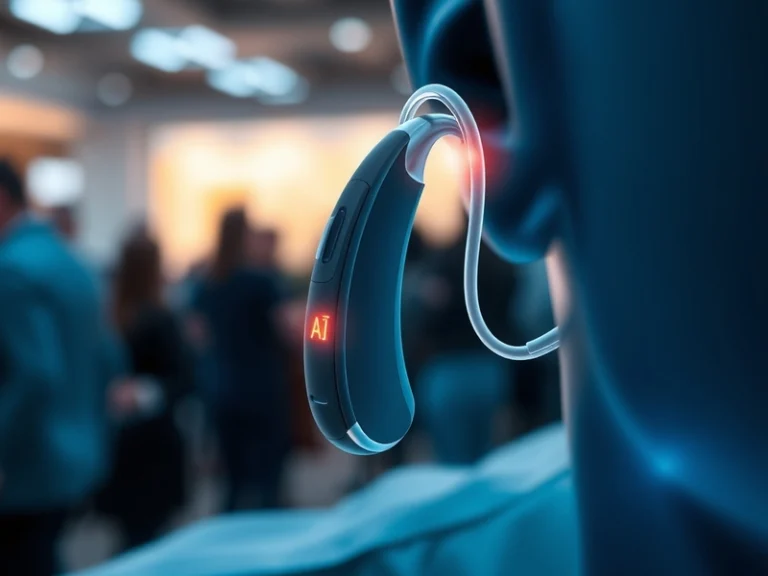
Advancements in artificial intelligence are significantly enhancing the capabilities of modern hearing aids, particularly in their ability to improve speech recognition amidst complex sound environments. This integration marks a pivotal shift from traditional digital signal processing (DSP) to more adaptive, intelligent sound management, offering users unprecedented clarity and reducing listening effort.
For decades, hearing aid technology has strived to overcome the fundamental challenge of distinguishing speech from background noise, often referred to as the “cocktail party effect.” Traditional DSP methods, while effective at amplifying sound and applying static noise reduction algorithms, struggled with the dynamic, unpredictable nature of real-world soundscapes. They often amplified all sounds indiscriminately or applied aggressive noise filters that distorted speech, leading to a fatiguing listening experience for users.
AI’s Multi-faceted Approach to Sound Clarity
The introduction of AI, primarily through deep neural networks (DNNs) and machine learning algorithms, has provided a more sophisticated solution to these long-standing problems. AI-powered hearing aids are trained on vast datasets containing millions of sound samples, including diverse types of speech, various forms of noise (e.g., traffic, restaurant chatter, music), and different acoustic environments. This training allows the AI to learn intricate patterns and relationships within sound, enabling it to perform highly nuanced processing in real-time.
Several key areas demonstrate how AI is revolutionizing hearing aid functionality:
- Enhanced Noise Reduction and Suppression: Unlike static filters, AI algorithms can identify and separate speech from noise with remarkable precision. By understanding the acoustic characteristics of human speech and different noise types, the AI can selectively attenuate noise components while preserving the integrity of speech signals. This results in a cleaner, less cluttered soundscape for the wearer. For example, some devices leverage DNNs to analyze the incoming sound 500 times per second, dynamically adjusting noise suppression based on the detected environment.
- Superior Speech Enhancement: Beyond merely reducing noise, AI can actively enhance speech. Algorithms can analyze speech patterns, predict missing phonemes, and reconstruct degraded speech signals, making voices sound clearer and more distinct. This is particularly beneficial in situations where speech is muffled or spoken softly.
- Dynamic Environmental Adaptation: Modern AI-enabled hearing aids can automatically classify the acoustic environment – whether it’s a quiet office, a bustling restaurant, a windy outdoor setting, or a concert hall. Based on this classification, the AI can then apply optimized sound processing strategies tailored to that specific environment, without requiring manual adjustments from the user. This continuous, seamless adaptation significantly improves the listening experience across diverse situations.
- Advanced Directionality and Spatial Awareness: Many hearing aids incorporate multiple microphones that work in conjunction with AI. This allows for sophisticated beamforming, where the hearing aid can focus its pickup pattern towards a specific sound source, typically the person the user is facing, while simultaneously reducing sounds coming from other directions. AI algorithms further refine this by intelligently determining which direction to prioritize based on speech detection and user intent. This helps users localize sounds and participate more effectively in group conversations.
- Personalized Sound Profiles and Learning: Machine learning in hearing aids can learn from the user’s preferences over time. As users make adjustments via companion smartphone apps, the AI can gradually build a personalized sound profile, adapting its processing to match individual listening comfort and clarity preferences. This ongoing learning process ensures the hearing aid continuously optimizes its performance for the specific user.
Major manufacturers have been at the forefront of integrating these AI capabilities. Companies like Starkey with its Genesis AI line, Oticon with its More series utilizing a Deep Neural Network, Phonak with its Lumity platform featuring SmartSpeech Technology, and ReSound with its OMNIA hearing aids, have all showcased products that leverage artificial intelligence for improved sound processing and speech recognition. These devices often feature powerful onboard processors capable of executing complex AI models at the edge, ensuring minimal latency and real-time performance.
The impact on users is profound. Individuals with hearing loss report reduced listening fatigue, improved comprehension in challenging environments, and greater confidence in social situations. The ability of AI to intelligently process complex soundscapes means less effort spent trying to decipher conversations, leading to a richer and more engaged daily life.
As AI technology continues to evolve, future advancements in hearing aids are expected to include even more sophisticated environmental understanding, seamless integration with other smart devices, and further personalization options. The trajectory points towards hearing aids that are not just amplifiers, but intelligent, adaptive companions that proactively manage sound to deliver optimal clarity and comfort.