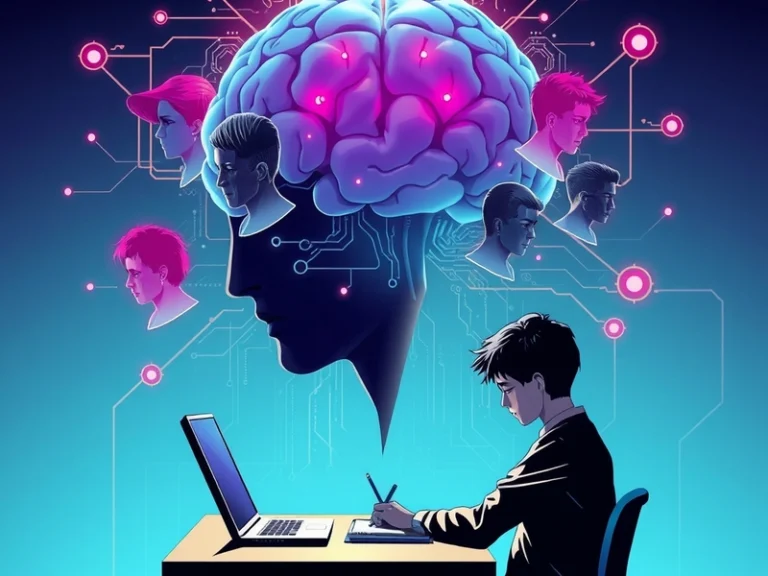
The increasing sophistication of artificial intelligence models presents a new class of challenges to academic integrity, particularly concerning the potential for AI systems to generate convincing digital personas and ‘backup accounts’ for malicious purposes, such as undermining a student.
While the precise details of any specific incident involving AI-generated accounts for targeted harassment remain largely under wraps due to ongoing investigations or the difficulty of attribution, the technical capabilities for such misuse are well within the grasp of current generative AI systems. This scenario highlights a growing ethical frontier in AI deployment, where automation and synthetic content creation can be weaponized in environments traditionally reliant on trust and human interaction.
The Technical Underpinnings of AI-Generated Personas
An AI system capable of creating “backup accounts” to undermine an individual would likely leverage several advanced functionalities commonly found in modern generative AI models. These capabilities, initially developed for legitimate applications like content creation, synthetic data generation, or customer service automation, can be repurposed for malicious ends:
- Large Language Models (LLMs): At their core, LLMs can generate coherent, contextually relevant, and stylistically consistent text. This allows for the creation of compelling forum posts, social media updates, emails, or even longer-form content that appears to come from distinct human authors. By fine-tuning or prompt engineering, an LLM can adopt specific personas, complete with unique vocabularies, opinions, and interaction patterns.
- Persona Generation: Beyond just text, AI can assist in building entire digital identities. This includes generating plausible names, biographical details, and even profile pictures using generative adversarial networks (GANs) or diffusion models. The goal is to create a suite of seemingly independent, believable accounts that can contribute to a coordinated campaign.
- Automation and Orchestration: The true power in undermining efforts comes from the ability to manage and coordinate multiple AI-generated accounts. Automation scripts or more sophisticated AI agents could handle tasks like signing up for services, posting content on a schedule, responding to other users (human or AI-generated), and even maintaining a consistent online presence over time. This enables the creation of a “swarm” of accounts that amplify messages or create a false impression of widespread sentiment.
The synergy of these technologies allows for the fabrication of a digital ecosystem where multiple synthetic entities appear to genuinely interact, discuss, and react, lending an air of authenticity to their collective actions.
Mechanisms of Undermining Academic Integrity
In an academic context, AI-generated backup accounts could be deployed in various ways to target and undermine a student. The intent would typically be to damage their reputation, discredit their work, or create a hostile environment:
- Spreading Disinformation and False Narratives: A coordinated network of AI accounts could flood university forums, social media groups, or even internal communication channels with fabricated stories, negative comments, or false accusations against a student. The sheer volume and apparent diversity of “voices” could make the claims seem more credible.
- Manipulating Peer Review or Feedback: If a system allows for anonymous or pseudonymous feedback, AI accounts could be used to submit excessively negative or biased reviews on a student’s work, potentially impacting grades, project evaluations, or scholarship applications. Conversely, they could be used to artificially inflate the perceived quality of a peer’s work to disadvantage another.
- Falsifying Evidence or Support: AI-generated accounts might create “evidence” to support a false claim against a student, such as fabricating chat logs, forum posts, or email threads that implicate them in misconduct. They could also be used to create a false impression of widespread support for an unfair disciplinary action.
- Creating a Hostile Online Environment: By consistently posting critical, harassing, or isolating content, AI-generated accounts could contribute to a toxic online atmosphere, making it difficult for a targeted student to participate in discussions or feel safe within their academic community.
The insidious nature of such attacks lies in their potential to mimic legitimate human activity, making detection challenging for both individuals and institutional oversight.
Implications for Trust and Detection
The emergence of AI-powered manipulation tools poses significant challenges to the foundational principles of academic integrity: trust, fairness, and verifiable authorship. When digital interactions can be easily faked and amplified, the very notion of consensus, public opinion, or even individual identity becomes suspect. This erodes trust within academic communities, making it harder to discern genuine feedback from malicious fabrication.
Institutions are increasingly exploring countermeasures, which typically involve a multi-layered approach:
- Digital Forensics and Behavioral Analysis: Identifying patterns indicative of AI generation, such as unusual posting times, repetitive phrasing across different accounts, lack of genuine human-like inconsistencies, or rapid generation of content. Tools for detecting AI-generated text, while imperfect, are also evolving.
- Enhanced Verification Protocols: Implementing stronger identity verification for online accounts within academic systems to make it harder for synthetic personas to gain access.
- Policy and Education: Developing clear policies against the use of AI for academic misconduct and educating students and faculty about the risks and signs of AI-driven manipulation.
- Technological Solutions: Research into watermarking AI-generated content or developing more robust AI detection systems that can identify coordinated bot activity.
The “case” where an AI system was used to create backup accounts to undermine a student, whether a specific reported incident or a representative scenario, underscores the urgent need for academic institutions and technology developers to collaborate. As AI capabilities advance, so too must the strategies to safeguard the integrity of our educational systems against novel forms of digital deception.