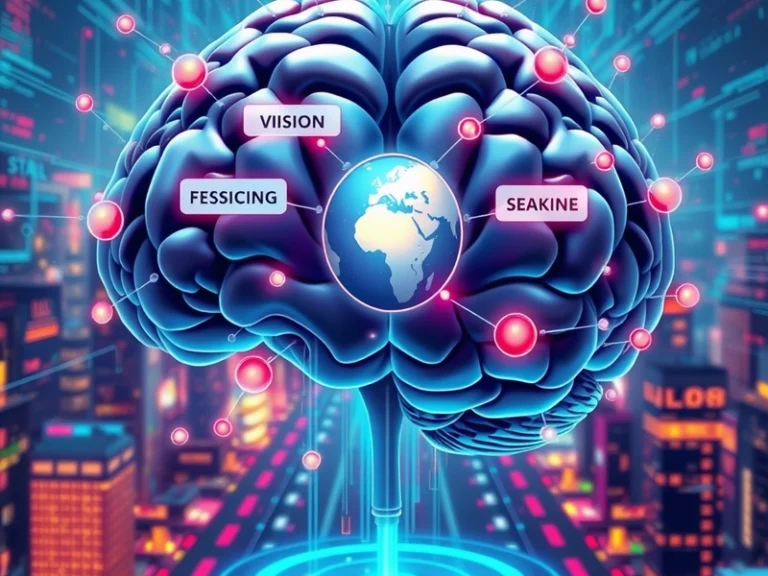
Fei-Fei Li, co-director of Stanford University’s Institute for Human-Centered AI (HAI) and a pivotal figure in the field of computer vision, has recently articulated a vision for artificial intelligence that extends significantly beyond the current generation of large language models (LLMs) like ChatGPT, emphasizing the critical role of “world models” in achieving more robust and intelligent AI systems.
Li’s perspective is particularly impactful given her extensive contributions to AI, most notably her leadership in the creation of ImageNet, a massive image database that played a foundational role in the deep learning revolution for computer vision. Her work has consistently focused on enabling AI to understand and interact with the physical world, often from a human-centered vantage point that prioritizes both capability and ethical deployment.
Beyond the Textual Paradigm of LLMs
While acknowledging the remarkable capabilities of LLMs in processing and generating human-like text, Li’s argument underscores their inherent limitations. Current LLMs excel at pattern recognition within vast datasets of text and code, demonstrating impressive fluency, summarization, and creative writing abilities. However, their intelligence is primarily statistical and linguistic. They operate in a symbolic, textual domain, often without a true understanding of the underlying physical reality or cause-and-effect relationships that govern the world.
This limitation becomes apparent when LLMs are confronted with tasks requiring genuine common sense, physical reasoning, or interaction with dynamic environments. Their knowledge is derived from correlations in data, not from an embodied experience of the world. As a result, they can sometimes produce plausible-sounding but factually incorrect or physically impossible outputs, a phenomenon often referred to as “hallucination.”
The Imperative of World Models
Li advocates for the development of AI systems equipped with “world models”—internal representations of the environment that allow an AI to predict how actions will change the state of the world, understand physical properties, and reason about cause and effect. This concept is not new in AI research, with roots in cognitive science and reinforcement learning, but it is gaining renewed urgency as AI systems move beyond purely digital tasks into embodied applications like robotics.
A world model allows an AI to simulate potential futures, plan sequences of actions, and learn from imagined outcomes without needing to perform every action in the real world. This capability is fundamental to human intelligence, enabling us to navigate complex situations, understand novel scenarios, and develop robust common sense.
Key Advantages of AI with World Models:
- Embodied Intelligence: For AI to effectively operate in the physical world—whether in robotics, autonomous vehicles, or assistive technologies—it needs to understand spatial relationships, object permanence, physics, and the consequences of its actions. World models provide this grounding.
- Robust Common Sense: Rather than merely inferring relationships from text, an AI with a world model can develop a deeper, more intuitive understanding of how the world works, leading to more reliable and adaptable common sense reasoning.
- Efficient Learning: By simulating scenarios internally, AI systems can learn more efficiently, requiring less real-world trial and error, which is particularly crucial in domains where real-world experimentation is costly or dangerous.
- Generalization and Adaptation: A true understanding of underlying principles, rather than just pattern matching, enables AI to generalize more effectively to novel situations and adapt to changes in its environment.
- Improved Safety and Explainability: An AI that can articulate its understanding of the world and predict outcomes based on its internal model could potentially offer greater transparency and safety guarantees.
The Road Ahead: Building Holistic AI
The development of sophisticated world models presents significant research challenges. It requires integrating information from multiple modalities—vision, language, touch, proprioception—into a coherent, dynamic internal representation. This often involves combining techniques from computer vision, natural language processing, reinforcement learning, and cognitive AI.
Fei-Fei Li’s call for world models is a testament to a broader push within the AI community to move towards more holistic, embodied, and truly intelligent systems. While LLMs have demonstrated the power of scale and data, the next frontier for AI may lie in enabling machines to not just process information, but to genuinely comprehend and interact with the complex, dynamic world we inhabit.
Her vision underscores that achieving human-level intelligence in AI will likely require more than just scaling up existing textual models; it demands a fundamental shift towards models that build an internal understanding of reality, much like a child learns about the world through interaction and observation.