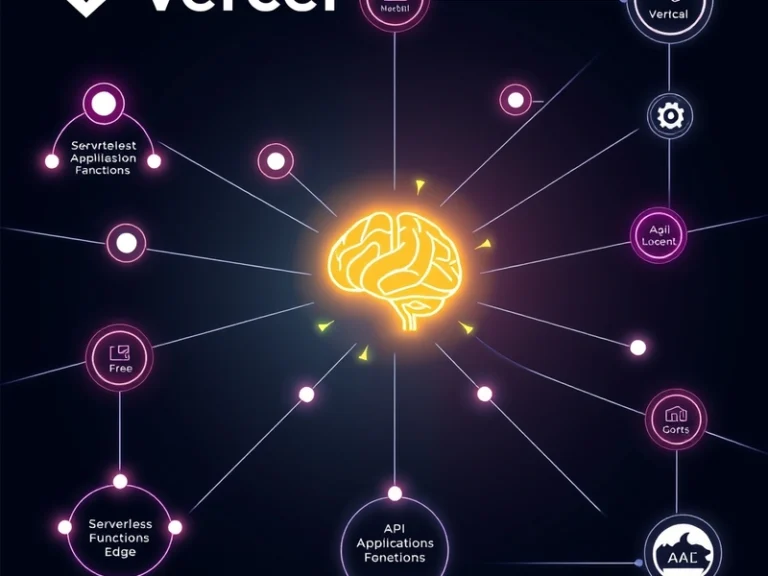
Vercel is actively positioning its platform and flagship framework, Next.js, as a premier environment for building and scaling AI-powered applications, strategically adapting its multi-product ecosystem for the demands of artificial intelligence development.
Known for its focus on developer experience, performance, and the seamless deployment of modern web applications, Vercel’s playbook for the AI era centers on leveraging its existing strengths: the Next.js framework, its global Edge Network, and its serverless functions. The company aims to abstract away much of the complexity associated with deploying AI capabilities, allowing developers to concentrate on the application logic and user interface.
The Developer Experience Imperative in AI
Vercel’s core philosophy has always been to simplify the development and deployment workflow. In the context of AI, this translates to making it straightforward for developers to integrate machine learning models and AI APIs into their web applications. This is particularly relevant for frontend developers who might not have deep machine learning expertise but need to build AI-powered features like chatbots, personalized content, or intelligent search.
- Next.js as an AI Application Foundation: The Next.js framework, especially with its App Router, provides a robust structure for building full-stack applications. This architecture facilitates the integration of AI models, whether through direct API calls to services like OpenAI, Anthropic, or Hugging Face, or by running smaller, optimized models directly within serverless functions. Data fetching, API routes, and server components in Next.js offer natural points for interacting with AI services and processing their outputs.
- Serverless Functions for AI Inference: Vercel Functions, built on serverless technology, are well-suited for running AI inference tasks. These functions can handle API requests, process data, and interact with external AI models or even run lightweight on-device models efficiently. The pay-per-use model aligns with the often bursty nature of AI inference workloads, where demand can fluctuate.
- Edge Computing for Latency-Sensitive AI: The Vercel Edge Network is a critical component for delivering low-latency AI experiences. By executing serverless functions and routing requests closer to the user, Vercel helps reduce the round-trip time for AI model inferences, enhancing the responsiveness of AI-powered features. This is particularly beneficial for applications requiring real-time interactions, such as conversational AI or dynamic content generation.
Scaling a Multi-Product Ecosystem for AI
Vercel is not merely adding AI features to individual products; it is evolving its entire platform to be AI-ready. This involves ensuring that its build system, deployment pipeline, and monitoring tools are optimized for the unique requirements of AI applications, which often involve larger dependencies, more intensive computation during builds, and different runtime characteristics.
The company’s strategy for scaling in the AI era involves several interconnected elements:
The company is fostering an ecosystem where developers can easily discover and integrate AI tools and libraries. This includes ensuring compatibility with popular JavaScript-based AI frameworks and libraries, as well as providing clear pathways for connecting to leading AI API providers. By maintaining an open and extensible platform, Vercel encourages innovation from its vast developer community, many of whom are eager to experiment with and deploy AI technologies.
The integration of AI capabilities into web applications is no longer a niche requirement; it’s rapidly becoming an expectation. Vercel’s focus on developer experience and performance positions it uniquely to empower developers to build these next-generation applications without getting bogged down by infrastructure complexities.
Furthermore, Vercel’s emphasis on infrastructure-as-code and Git-based workflows extends naturally to AI development. Developers can version control their AI application code alongside their frontend logic, enabling consistent deployment, collaboration, and rollbacks. This unified approach simplifies the entire development lifecycle, from initial prototyping to large-scale production deployments.
As the AI landscape continues to evolve, Vercel’s commitment to developer productivity and performance, combined with its robust platform capabilities, positions it as a significant enabler for companies aiming to integrate artificial intelligence seamlessly into their web presence.