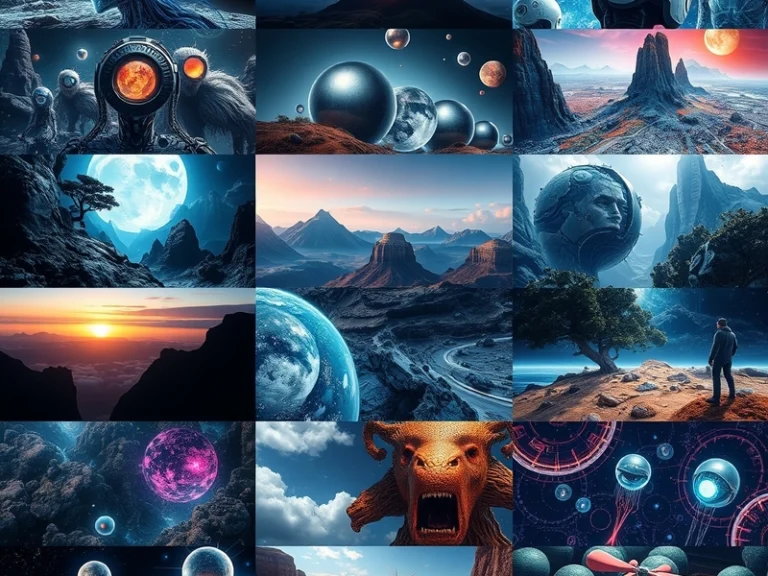
A comprehensive gallery showcasing the creative prompts behind some of the most shared AI-generated images has been unveiled, offering a unique resource for enthusiasts and professional artists alike to explore the mechanics of viral AI art.
This collection, comprising over 540 distinct prompts, provides a window into the techniques and linguistic choices that have propelled AI-generated visuals to widespread attention across social media and digital platforms. For many working with generative AI models like Midjourney, Stable Diffusion, or DALL-E, understanding the nuances of prompt engineering is key to achieving desired artistic outcomes. This new compilation aims to demystify the process by revealing the specific instructions that led to notable successes.
The Art of Prompt Engineering Unpacked
Prompt engineering has rapidly evolved from a niche skill into a critical discipline within the AI art community. It involves crafting precise textual descriptions that guide a generative AI model to produce a specific image. While the underlying algorithms of these models are complex, the interface for human interaction is often a simple text box. The effectiveness of a prompt hinges on several factors:
- Specificity: Detailed descriptions of subjects, settings, and actions.
- Artistic Style: References to art movements, famous artists, photographic styles, or rendering techniques (e.g., “oil painting,” “cinematic,” “pixel art”).
- Composition and Lighting: Instructions regarding camera angles, lighting conditions, and scene arrangement.
- Emotional Tone: Evoking a particular mood or atmosphere.
- Negative Prompts: Explicitly telling the AI what not to include, which is particularly common in models like Stable Diffusion to refine outputs and avoid common artifacts.
- Parameters: Model-specific commands for aspect ratios, stylization levels, or seed values.
The newly compiled gallery is significant because it moves beyond theoretical discussions of prompt engineering. By presenting concrete, successful examples, it provides a practical learning tool. Users can analyze how specific combinations of keywords, stylistic cues, and technical parameters were employed to achieve images that resonated broadly.
Implications for the AI Art Community
The release of such a comprehensive prompt gallery carries several important implications for the AI art ecosystem:
Lowering the Barrier to Entry
For newcomers to AI art, prompt engineering can be a daunting challenge. Experimenting with countless combinations of words to achieve a compelling result is time-consuming. A curated collection of viral prompts offers a shortcut, allowing beginners to learn from proven examples, understand common patterns, and rapidly iterate on successful formulas. This can accelerate their learning curve and foster greater participation in AI art creation.
Inspiring New Creations
Experienced prompt engineers can also benefit by dissecting successful prompts. Understanding what makes an image “viral” goes beyond technical execution; it often involves a unique conceptual hook, a striking aesthetic, or a connection to current cultural trends. The gallery can serve as a source of inspiration, prompting artists to experiment with new stylistic blends, narrative approaches, or compositional ideas that have demonstrated broad appeal.
Fostering Education and Collaboration
By making these prompts accessible, the gallery promotes a more open and collaborative learning environment. It encourages discussions around prompt optimization, the specific interpretations of different AI models, and the evolving language of human-AI artistic partnership. Educators and workshop facilitators could use such a resource to teach prompt engineering principles in a highly practical context.
Navigating the Nuances of “Viral” Prompts
While invaluable, leveraging a gallery of viral prompts also requires careful consideration. The term “viral” often implies widespread sharing and recognition, but it doesn’t necessarily equate to artistic originality or technical perfection in every instance. Users of the gallery should consider:
- Model Dependency: A prompt optimized for Midjourney V5.2 might yield different results on Stable Diffusion XL or DALL-E 3, due to variations in training data and architectural design. Understanding these differences is crucial for adapting prompts effectively.
- Evolution of Models: Generative AI models are constantly updated. Prompts that were highly effective on older versions may produce suboptimal or different results on newer iterations. The gallery serves as a snapshot of successful prompts at a particular time.
- Originality vs. Replication: The primary value of such a gallery is educational and inspirational. While it allows for replication, the true artistic challenge lies in modifying, combining, and evolving these prompts to create genuinely novel works rather than simply reproducing existing aesthetics.
- Attribution and Ethics: When drawing heavy inspiration from or directly adapting prompts, artists should consider the ethical implications, particularly regarding attribution if the original prompt creator is known and has shared their work openly.
Ultimately, the unveiling of this extensive gallery of viral AI image prompts marks a significant moment for the AI art community. It underscores the growing importance of prompt engineering as a creative skill and provides a rich, practical resource for anyone looking to understand, learn from, and contribute to the rapidly expanding world of AI-generated visual content.