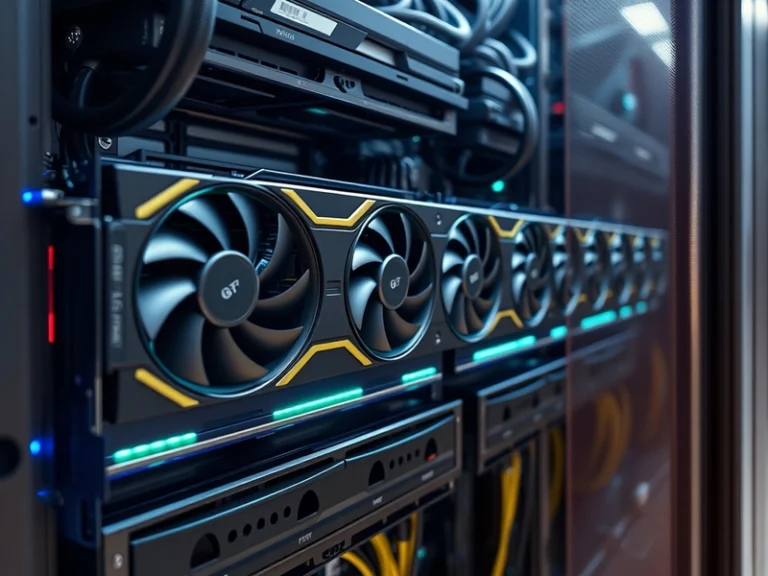
As the operational costs for advanced AI workloads within public cloud environments continue their upward trajectory, a growing number of enterprises and research institutions are actively exploring the development of their own on-premise AI infrastructure as a strategic alternative.
The motivation behind building a personalized AI data center often stems from a desire for greater control, enhanced data sovereignty, and, critically, the potential for significant long-term cost savings compared to the ongoing expenses of hyperscale cloud providers. While the initial capital outlay can be substantial, particularly for high-performance Graphics Processing Units (GPUs), the total cost of ownership can become more favorable over several years for organizations with consistent, high-intensity AI demands.
Why Consider On-Premise AI Infrastructure?
Moving AI workloads from the cloud to a dedicated, self-managed environment offers several compelling advantages:
- Cost Predictability and Reduction: After the initial investment in hardware, ongoing operational costs primarily involve power, cooling, and maintenance, which can be more predictable than variable cloud billing. For sustained, heavy training or inference, on-premise can become more economical over time.
- Data Sovereignty and Security: Keeping sensitive data within an organization’s physical and logical control can be crucial for regulatory compliance (e.g., GDPR, HIPAA) and proprietary intellectual property protection.
- Performance Optimization: A dedicated infrastructure can be precisely tuned for specific workloads, avoiding network latency or resource contention issues sometimes experienced in multi-tenant cloud environments. Direct access to hardware allows for deeper optimization.
- Customization and Control: Organizations have complete autonomy over hardware selection, software stacks, and network configuration, enabling a tailored environment that perfectly matches their unique AI development and deployment needs.
Core Components of an AI Data Center
Constructing a robust AI infrastructure requires careful planning across several key areas:
Hardware Foundation
- GPUs: These are the undisputed workhorses of modern AI. Enterprise-grade options from NVIDIA, such as the A100 or H100 Tensor Core GPUs, offer unparalleled performance for large-scale training. For smaller-scale projects or inference, consumer-grade NVIDIA RTX series GPUs can provide a more budget-friendly entry point. The choice depends heavily on the specific workload and performance requirements.
- CPUs: While GPUs handle the heavy lifting of tensor operations, powerful CPUs (e.g., AMD EPYC or Intel Xeon processors) are essential for data preprocessing, general system management, and running non-GPU-accelerated tasks.
- High-Speed Networking: Interconnecting GPUs and servers with high-bandwidth, low-latency networking is critical for distributed training and data transfer. InfiniBand or 100 Gigabit Ethernet (GbE) are common choices.
- Storage: Fast storage is vital to avoid I/O bottlenecks. NVMe Solid State Drives (SSDs) are standard for local data, complemented by Network Attached Storage (NAS) or Storage Area Network (SAN) solutions for larger datasets and shared access.
- Memory (RAM): Sufficient system RAM is necessary to feed data to GPUs efficiently and to manage large datasets in memory for certain operations.
Infrastructure and Environment
- Power and Cooling: High-density GPU servers consume significant power and generate substantial heat. Adequate power delivery and robust cooling solutions (e.g., liquid cooling, CRAC units) are non-negotiable to maintain operational stability and hardware longevity.
- Physical Space and Racks: Secure server racks within a controlled environment (data center or dedicated server room) are needed to house the equipment, ensuring proper airflow and physical security.
Software Stack
- Operating System: Linux distributions like Ubuntu Server or CentOS are standard choices due to their stability, open-source nature, and extensive support for AI tools.
- GPU Drivers and CUDA Toolkit: NVIDIA’s CUDA platform and corresponding drivers are essential for enabling GPU acceleration for most AI frameworks.
- Containerization: Technologies like Docker allow for packaging AI applications and their dependencies into portable containers, simplifying deployment and ensuring environment consistency.
- Orchestration: Kubernetes has become the de facto standard for managing and orchestrating containerized workloads, enabling scalable deployment, resource allocation, and fault tolerance across a cluster of AI servers.
- ML Frameworks: Popular frameworks such as PyTorch, TensorFlow, and JAX form the core of AI development, providing libraries and tools for building and training models.
- Monitoring and Management Tools: Solutions for monitoring hardware health, resource utilization, and application performance are crucial for proactive maintenance and optimization.
Steps to Building Your AI Infrastructure
-
Define Your Workload and Scale
Before purchasing any hardware, thoroughly assess your AI needs. What types of models will you train? What are the typical dataset sizes? What are your inference requirements? How frequently will you train or fine-tune models? This analysis will dictate the necessary GPU compute power, memory, storage, and networking bandwidth.
-
Budget Allocation and Procurement Strategy
Establish a clear budget. GPUs represent the largest single cost. Consider whether new, top-tier enterprise GPUs are strictly necessary or if slightly older generations, refurbished units, or even a cluster of consumer-grade GPUs could meet your performance targets more cost-effectively for specific tasks. Explore vendor relationships for bulk purchases or specialized AI hardware providers.
-
Hardware Selection and Integration
Based on your workload analysis and budget, select specific GPUs, CPUs, motherboards, RAM modules, and storage devices. Pay close attention to compatibility, especially between GPUs and motherboards (PCIe slot availability and bandwidth). Ensure your chosen servers can accommodate the required number of GPUs and have adequate power supplies.
-
Environmental Setup: Power, Cooling, and Networking
This is often the most overlooked yet critical step. Consult with electrical engineers and HVAC specialists to ensure your chosen location can provide sufficient, stable power and effective cooling for the heat generated by AI hardware. Install high-speed network infrastructure, including switches and cabling, to support inter-server communication and external connectivity.
-
Software Environment Configuration
Install your chosen Linux distribution. Then, meticulously install the correct GPU drivers and the NVIDIA CUDA Toolkit. Set up containerization tools like Docker and, if planning for a multi-node cluster, deploy Kubernetes. Finally, install your preferred machine learning frameworks and any necessary libraries.
-
Orchestration and Management Implementation
For multi-GPU or multi-server setups, configure Kubernetes to manage your AI workloads. This involves setting up worker nodes, defining resource quotas, and deploying containerized AI applications. Implement monitoring tools to track GPU utilization, temperature, power consumption, and network performance.
-
Security and Maintenance Protocols
Establish physical security for your hardware. Implement robust cybersecurity measures for your network and software stack, including firewalls, intrusion detection, and regular patching. Develop a maintenance schedule for hardware checks, software updates, and environmental system servicing.
While the journey to building a personalized AI data center demands significant upfront investment in capital and expertise, for organizations with persistent, high-demand AI workloads, the long-term benefits of cost control, enhanced security, and tailored performance can make it a highly strategic and rewarding endeavor.