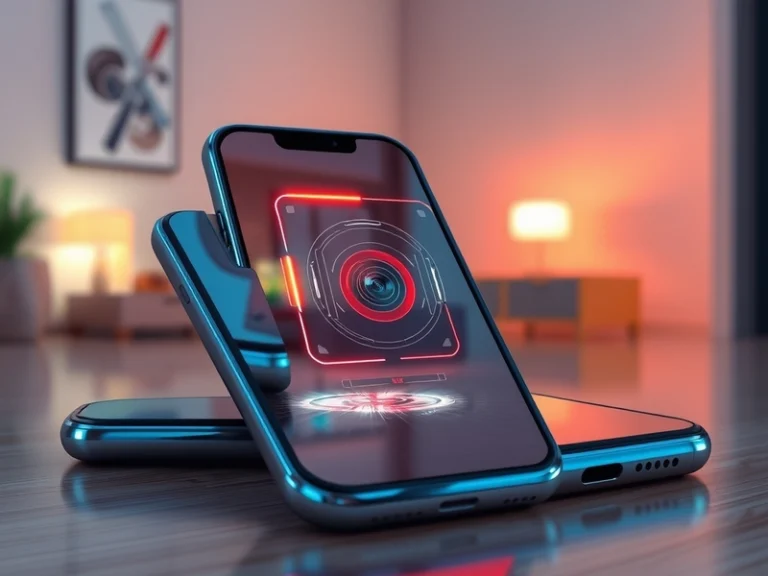
A new category of AI-powered phone cases is emerging, designed to enhance personal privacy by detecting hidden cameras in various environments.
These innovative accessories aim to address growing concerns over surreptitious surveillance, providing individuals with a portable tool to scan for devices that might compromise their personal space. By integrating specialized hardware with on-device artificial intelligence, these cases promise a more sophisticated approach to detection than traditional manual methods.
How AI Augments Hidden Camera Detection
The fundamental principle behind detecting hidden cameras often relies on identifying their lenses. Camera lenses, even tiny pinhole ones, are typically made of glass and reflect light. Many dedicated hidden camera detectors work by emitting a bright light (often red or infrared) and then allowing the user to look through a filter to spot reflections from lenses.
Where AI introduces a significant advancement is in the interpretation and automation of this process. Instead of relying solely on a human eye to spot a glint, an AI-powered system can:
- Automate Scanning: The case can continuously scan an area without constant user interaction, analyzing visual data for characteristic lens reflections.
- Pattern Recognition: AI models, particularly those leveraging computer vision, can be trained on vast datasets of camera lens reflections under various lighting conditions and angles. This enables them to differentiate genuine lens reflections from random glints off other surfaces like glass, metal, or decorative items, significantly reducing false positives.
- Enhanced Sensitivity: By processing minute visual cues, AI can potentially detect smaller or more subtly placed lenses that might be missed by human observation or simpler optical detectors.
- Environmental Adaptability: AI can adapt to different lighting scenarios, adjusting its detection algorithms to maintain accuracy whether in bright daylight or dimly lit rooms.
The typical hardware setup for such a case might include an array of infrared (IR) emitters and a specialized sensor or camera module that feeds data to an on-board AI chip or the smartphone’s processor. The AI then processes this data, looking for the unique spectral signatures and reflection patterns indicative of a camera lens.
Addressing a Growing Privacy Concern
The proliferation of miniaturized cameras, coupled with their increasing affordability and ease of concealment, has led to a rise in privacy breaches. Reports of hidden cameras found in rental accommodations, changing rooms, and public restrooms highlight a tangible threat to personal security. Existing solutions often involve manual detection methods, such as sweeping a room with a flashlight and looking for reflections, or using dedicated RF (radio frequency) detectors to find transmitting cameras.
While effective to a degree, these methods can be time-consuming, require a degree of user expertise, and are prone to human error or limitations. An AI-powered phone case offers the promise of a more user-friendly, consistent, and potentially more accurate solution, integrating seamlessly into a device many people carry constantly.
Technical Considerations and Challenges
Developing an effective AI phone case for hidden camera detection involves several technical hurdles:
Accuracy and False Positives
The primary challenge is achieving high accuracy while minimizing false positives. AI models must be robust enough to distinguish camera lenses from other reflective surfaces like mirrors, glass panes, or polished metal. This requires extensive training data covering a wide array of environments and camera types.
Processing Power and Battery Life
On-device AI processing, especially for real-time video analysis, can be computationally intensive. Integrating an AI chip into a phone case requires careful optimization for power consumption to avoid significantly draining the smartphone’s battery or requiring frequent recharging of the case itself.
Integration and User Experience
The case must seamlessly integrate with the smartphone, likely through a companion application that displays detection results, provides alerts, and allows for settings adjustments. The user interface needs to be intuitive, clearly indicating detected threats without causing undue alarm for non-threats.
Detection Range and Camera Types
The effective detection range of such a device will be crucial. Pinhole cameras, often used for covert surveillance, present a particular challenge due to their minuscule lens size. The system must also be versatile enough to detect various lens types, from standard CCTV lenses to highly specialized miniature optics.
The Broader Trend of Edge AI and Specialized Peripherals
The emergence of AI-powered phone cases for privacy protection fits into a broader trend of “edge AI” or “on-device AI,” where artificial intelligence processing occurs locally on a device rather than relying on cloud servers. This approach offers benefits such as reduced latency, enhanced privacy (as data doesn’t leave the device), and the ability to function offline.
Furthermore, these cases represent a category of specialized smartphone peripherals that leverage AI to extend the phone’s capabilities beyond its core functions. As smartphones become increasingly powerful and modular, we may see more such accessories designed for specific tasks, from environmental monitoring to advanced health diagnostics, all powered by compact AI modules.
While these AI-powered phone cases are still an evolving technology, they represent a significant step towards empowering individuals with accessible, intelligent tools to safeguard their privacy in an increasingly surveilled world.