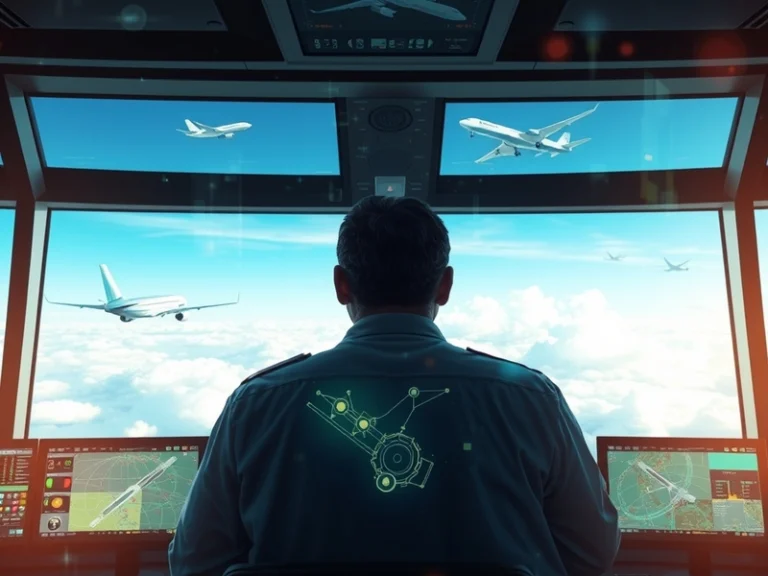
Artificial intelligence is poised to significantly enhance air traffic management (ATM), moving beyond traditional systems to optimize flight planning and improve overall efficiency in the world’s increasingly congested skies.
The current global air traffic system, while robust and incredibly safe, faces inherent limitations. It largely operates on a foundation of pre-defined flight corridors, ground-based radar surveillance, and human-intensive communication. This framework, developed over decades, struggles with the escalating volume of air traffic, unpredictable weather patterns, and the demand for greater fuel efficiency and reduced environmental impact. Controllers constantly manage complex, dynamic situations, making critical decisions under pressure to ensure safety and maintain flow. The static nature of many current flight plans often means aircraft fly sub-optimal routes, leading to longer flight times, increased fuel burn, and greater emissions.
AI offers a paradigm shift by enabling more dynamic, data-driven decision-making across the entire ATM ecosystem. Its core strength lies in processing vast quantities of real-time and historical data—including weather forecasts, aircraft performance metrics, radar data, flight plans, and airspace restrictions—to identify patterns and predict outcomes that are beyond human cognitive capacity or traditional algorithmic limits.
Optimizing Flight Paths and Resource Allocation
One of the most immediate and impactful applications of AI in ATM is the optimization of flight planning and execution. Instead of static, pre-determined routes, AI systems can facilitate highly dynamic, adaptive flight paths. This capability allows for:
- Dynamic Route Optimization: AI algorithms, particularly those employing reinforcement learning, can continuously analyze real-time conditions to suggest optimal routes that minimize fuel consumption, flight time, or a combination of factors. This includes dynamically adjusting for adverse weather, congestion in specific airspace sectors, or even turbulence, guiding aircraft through the most efficient path available.
- Predictive Congestion Management: By analyzing historical and real-time traffic data, AI can predict future congestion hotspots well in advance. This allows controllers to proactively reroute aircraft or adjust departure times, preventing bottlenecks before they occur and maintaining a smoother flow of traffic.
- Gate and Runway Optimization: Beyond air routes, AI can optimize ground operations. Systems can predict arrival and departure times with greater accuracy, enabling more efficient allocation of gates, runways, and ground personnel, thereby reducing taxi times and ground delays.
The potential for efficiency gains is substantial. By enabling aircraft to fly closer to their optimal trajectory, AI can contribute to significant reductions in fuel consumption and associated carbon emissions. Furthermore, by minimizing delays both in the air and on the ground, AI can enhance passenger experience and improve the overall capacity of existing airspace infrastructure without requiring costly physical expansion.
Decision Support and Enhanced Safety
AI is not intended to replace air traffic controllers but rather to augment their capabilities, transforming their role from reactive problem-solvers to strategic decision-makers supported by advanced tools. AI-powered decision support systems can provide controllers with real-time insights and recommendations, highlighting potential conflicts or inefficiencies before they become critical. For instance, an AI system could alert a controller to a developing congestion issue hours in advance, along with several potential mitigation strategies, allowing for a more considered and less rushed response.
Furthermore, AI can enhance safety by acting as an additional layer of vigilance. By continuously monitoring all aspects of air traffic, AI systems can detect subtle anomalies or deviations from planned trajectories that might indicate a developing issue, potentially flagging risks even before human controllers perceive them. This proactive identification of potential hazards strengthens the safety net that underpins air travel.
Challenges and the Path Forward
Implementing AI in such a safety-critical domain like ATM comes with significant challenges. Regulatory bodies, such as the Federal Aviation Administration (FAA) in the United States and the European Union Aviation Safety Agency (EASA), require rigorous testing and certification processes to ensure the absolute reliability and safety of any new technology. Trust in autonomous decision-making systems among human operators is also paramount, necessitating careful design of human-AI interfaces and extensive training.
Initiatives like the Single European Sky ATM Research (SESAR) program in Europe and the FAA’s NextGen program in the US are actively exploring and integrating advanced technologies, including AI, into future ATM architectures. These programs involve collaborations between government agencies, research institutions, and major aerospace and defense contractors to develop, test, and validate AI-driven solutions. The integration requires overcoming hurdles related to data standardization, interoperability between diverse systems, and cybersecurity.
As these challenges are addressed, AI is set to become an indispensable tool for managing the complexity of modern air traffic. Its ability to optimize, predict, and assist will be crucial in building a safer, more efficient, and environmentally sustainable future for air travel.