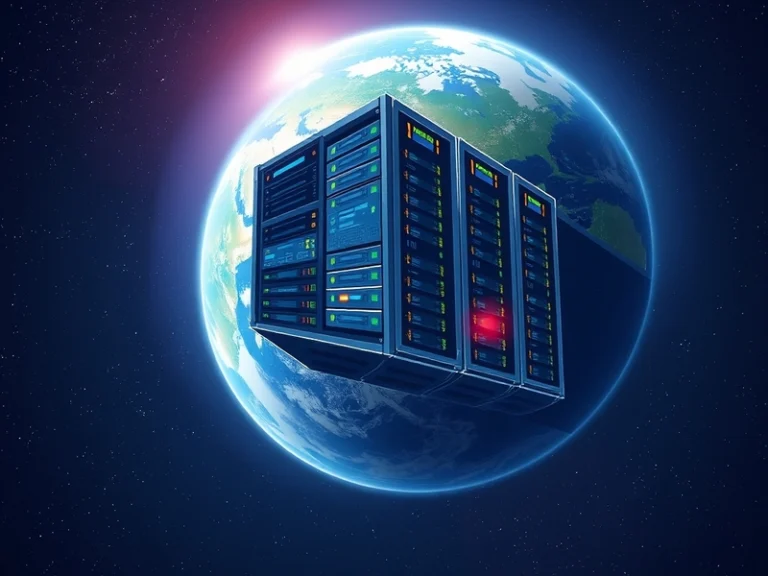
Google’s Tensor Processing Units (TPUs), specialized accelerators for artificial intelligence workloads, embody a design philosophy that could pave the way for a new frontier in computing: space-based data centers. While the concept of orbital data centers remains largely theoretical, the characteristics and evolution of Google’s custom AI silicon offer a compelling lens through which to explore the implications of deploying advanced AI technology beyond Earth’s atmosphere.
Understanding Google’s TPUs
Google developed TPUs as Application-Specific Integrated Circuits (ASICs) meticulously optimized for machine learning tasks, particularly matrix multiplication, which forms the computational core of deep learning algorithms. Initially deployed for internal use within Google’s vast data centers to power services like Google Search, Google Photos, and Google Assistant, TPUs have since been made available to external developers via Google Cloud.
Key attributes of TPUs include:
- High performance for AI workloads: They are designed to accelerate specific neural network operations far more efficiently than general-purpose CPUs or GPUs for certain tasks.
- Energy efficiency: Custom design allows for significant computational power within a power-constrained envelope, a critical factor for large-scale deployments and, hypothetically, off-world operations.
- Scalability: TPUs are designed to work in arrays, forming “pods” that can scale to handle massive AI models and training datasets.
This focus on specialized, efficient acceleration has positioned TPUs as a cornerstone of Google’s AI infrastructure, influencing the broader industry’s embrace of custom silicon for machine learning.
The Allure of Space-Based Data Centers
The idea of placing data centers in orbit might seem like science fiction, but it addresses several fundamental challenges and offers unique advantages for high-performance computing.
Potential Advantages
- Environmental Control: The vacuum of space offers a natural environment for passive radiative cooling, potentially simplifying thermal management for power-intensive hardware.
- Power Generation: Uninterrupted solar power availability in Low Earth Orbit (LEO) or geosynchronous orbit could provide a consistent, renewable energy source, reducing reliance on terrestrial grids.
- Reduced Latency for Space Assets: For applications like Earth observation, planetary science, or deep-space communication, processing data closer to its source in orbit can drastically reduce the need to downlink massive raw datasets, enabling real-time insights.
- Physical Security and Isolation: A data center in space would be physically isolated from many terrestrial threats, offering a unique level of security and resilience.
- Unique Research Environments: Microgravity and radiation exposure could provide novel environments for materials science, quantum computing research, or biological experiments that leverage AI.
Significant Challenges
Despite the theoretical benefits, the hurdles to deploying and operating data centers in space are substantial:
- Launch Costs: The expense of lifting heavy computing infrastructure into orbit remains a primary barrier.
- Radiation Hardening: Space is rife with ionizing radiation that can damage electronics. Components would require extensive hardening or sophisticated error correction mechanisms.
- Thermal Extremes: While vacuum aids radiative cooling, direct solar exposure and the absence of convective cooling present extreme temperature gradients that require robust active thermal management systems.
- Maintenance and Repair: Servicing or upgrading hardware in orbit is prohibitively complex and expensive, if not impossible, requiring systems designed for extreme longevity and autonomy.
- Communication Latency to Earth: While processing data closer to space assets reduces latency for those assets, communication back to Earth for human interaction or broader integration still faces inherent light-speed delays.
TPUs in Orbit: A Potential Synergy?
Considering the characteristics of Google’s TPUs in light of the space data center concept reveals intriguing possibilities. The emphasis on high performance per watt in TPU design is particularly attractive for power-constrained orbital environments where every watt must be generated and managed carefully. A specialized architecture, unlike general-purpose processors, could potentially be designed from the ground up with radiation tolerance in mind, integrating radiation-hardened components or redundant logic more effectively.
If TPUs or similar specialized AI accelerators were to be deployed in space, the implications for various applications would be profound:
- On-Orbit Earth Observation: Satellites could perform real-time analysis of imagery for disaster response, environmental monitoring, or agricultural insights, sending only processed information rather than raw data, significantly reducing downlink bandwidth requirements.
- Autonomous Satellite Operations: AI running on orbital TPUs could enable more sophisticated autonomy for satellite constellations, enhancing navigation, fault detection, resource management, and mission planning without constant human intervention.
- Space Science Data Analysis: Scientific instruments on telescopes or planetary probes could process vast amounts of sensor data on board, identifying anomalies or features of interest before transmission, optimizing scientific return.
- Distributed AI for Space Exploration: Future deep-space missions could leverage distributed AI models across multiple spacecraft, enabling collaborative decision-making and advanced data processing far from Earth.
While no specific Google announcement details plans for orbital TPU deployment, the continuous evolution of their custom AI silicon pushes the boundaries of performance and efficiency. This ongoing innovation contributes to the technological foundation that, combined with advancements in launch capabilities, radiation-hardened electronics, and autonomous systems, could eventually make space-based AI computing a tangible reality. The vision remains ambitious, but the trajectory of AI hardware development suggests that processing power may not always be confined to Earth.