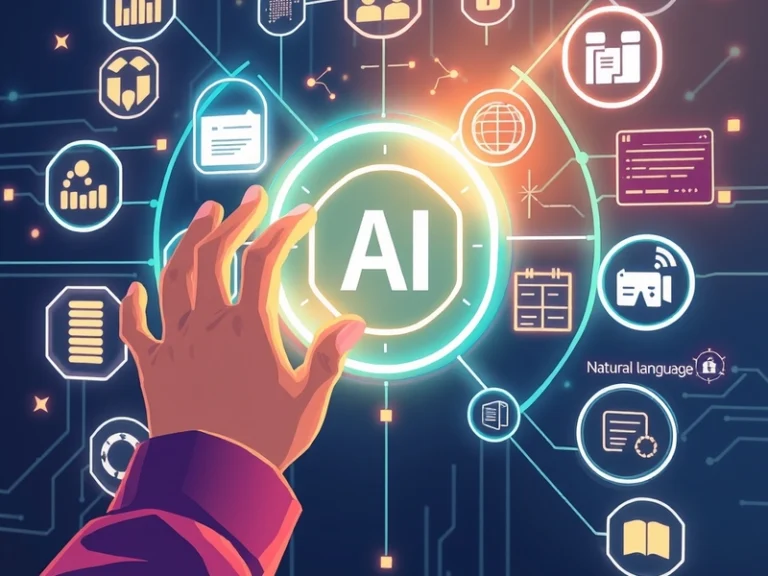
In 2026, the queries directed at AI chatbots like OpenAI’s ChatGPT increasingly reflect a profound shift beyond simple text generation, moving towards sophisticated analytical, multimodal, and interactive tasks that leverage their expanding capabilities.
While generating articles, emails, or creative prose remains a common application, the underlying technological advancements in large language models (LLMs) and their integrations have fundamentally broadened the scope of user interaction. Users are no longer just asking “write me a blog post about X”; they’re engaging these models as dynamic assistants for complex problem-solving, data interpretation, software development, and even real-world orchestration.
Enhanced Data Interaction and Analysis
One of the most significant evolutions lies in how users interact with data. Chatbots are now routinely asked to process and interpret structured and unstructured data beyond mere summarization. Users upload datasets—from sales figures in a CSV to sensor readings in a JSON file—and expect the AI to derive insights.
- Data Query and Visualization: Instead of crafting complex database queries or wrestling with spreadsheet functions, users ask, “Analyze this quarterly sales data, identify the top three performing regions, and show me the growth trend over the last year.” The chatbot can then generate natural language summaries, perform statistical analyses, and even produce basic charts or graphs directly within the interface or via integrated tools.
- Pattern Recognition and Anomaly Detection: Companies leverage these tools to sift through logs or operational data, prompting, “Review these server logs for unusual activity patterns last night,” or “Identify any anomalies in customer support ticket volumes related to product X.”
- Predictive Insights: While not a replacement for dedicated data scientists, users frequently ask for basic predictive insights: “Based on this historical stock data, what are the potential short-term trends?”
Advanced Software Development and Debugging
The role of AI in software development has matured from merely generating code snippets. By 2026, developers are utilizing chatbots as powerful coding copilots, capable of understanding broader architectural contexts and performing more intricate tasks.
- Complex Debugging: Developers now paste entire code blocks or error logs, asking, “This Python script is throwing a ‘KeyError’ during runtime; can you pinpoint the exact line and explain why?” The AI can often identify subtle logical errors, suggest optimizations, or even refactor problematic sections.
- Code Refactoring and Optimization: Teams use chatbots to improve existing codebases. Queries like, “Refactor this legacy Java module to be more efficient and adhere to modern best practices,” are common, with the AI providing detailed suggestions and improved code.
- Architectural Guidance: For new projects, developers might ask, “I’m building a scalable e-commerce backend; what are the pros and cons of using a microservices architecture versus a monolithic approach for my specific requirements?” The AI can provide comparative analyses and design patterns.
Multimodal Engagement and Creative Production
The integration of robust multimodal capabilities has transformed how users interact with AI. Beyond text, users input images, audio, and even video, expecting intelligent processing and generation.
- Image and Video Analysis: Users upload photographs or video clips, asking, “Describe the main subjects in this image and their likely emotional state,” or “Summarize the key events in this 30-second video clip.” This extends to accessibility, where visually impaired users receive detailed descriptions of their surroundings.
- Creative Asset Generation: The demand for generating visual and auditory content directly from text prompts has surged. “Generate a photorealistic image of a futuristic city at sunset with flying cars,” or “Create a short ambient soundscape suitable for a meditation app.” These models are often integrated with specialized generative AI platforms, acting as intuitive front-ends.
- Interactive Design Iteration: Designers use chatbots to quickly iterate on concepts. “Take this rough sketch of a UI layout and generate three polished variations in a dark mode theme.”
Personalized Learning and Knowledge Synthesis
Chatbots have become sophisticated personalized tutors and knowledge managers, adapting to individual learning styles and synthesizing vast amounts of information.
- Adaptive Tutoring: Students and professionals engage in dynamic learning sessions. “Explain the principles of quantum computing to me, assuming I have a basic understanding of classical physics, and then give me three conceptual problems to solve.” The AI adjusts its explanations and difficulty based on user responses.
- Research and Synthesis: Researchers and business analysts upload collections of documents, asking, “Summarize the key arguments from these five research papers on climate change mitigation strategies and identify any conflicting viewpoints.” The AI can rapidly distill complex information from a provided corpus.
Real-World Orchestration through Integrations
Through robust API integrations, chatbots are increasingly serving as intelligent command centers, connecting with external services and automating multi-step workflows.
- Workflow Automation: Users might ask, “Schedule a meeting with John and Sarah next Tuesday at 2 PM, send them a calendar invite, and draft a preliminary agenda based on our last project update.” The AI interacts with calendar applications, email clients, and project management tools.
- Service Interaction: Tasks like “Find me a highly-rated Italian restaurant within 5 miles that has open reservations for two tonight at 7 PM” are common, with the AI interfacing directly with booking platforms.
The shift in how people use AI chatbots by 2026 underscores a maturation of the technology from a novel text generator to a versatile, intelligent agent capable of understanding, analyzing, and acting upon a diverse range of inputs and tasks. These tools are increasingly becoming indispensable for augmenting human capabilities across professional and personal domains.