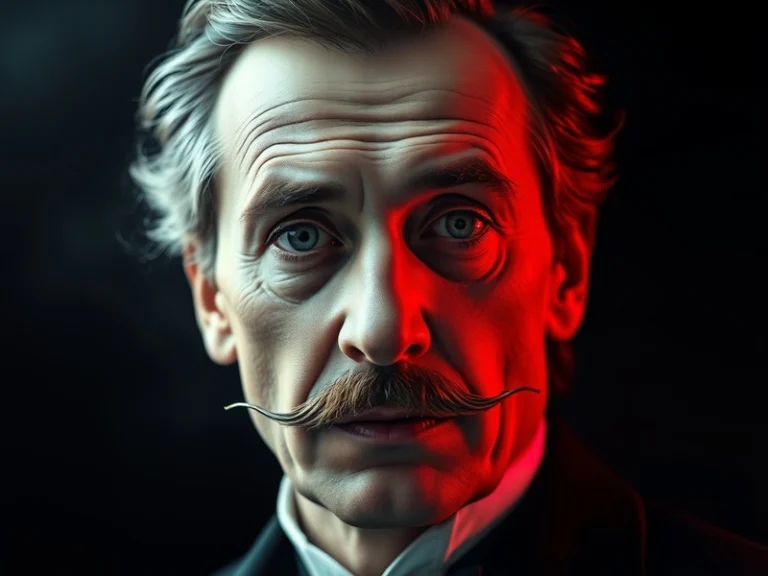
A new television series is reportedly employing advanced artificial intelligence techniques to bring historical figures, such as the legendary escape artist Harry Houdini, back to the screen in novel ways for modern storytelling.
This innovative approach signals a growing trend in entertainment, where AI is leveraged not just for visual effects, but for creating fully realized digital likenesses and performances of individuals long deceased. The ambition is to move beyond traditional biographical portrayals, offering audiences a more immersive and potentially authentic experience of historical personalities by reconstructing their appearance, mannerisms, and even vocal patterns.
The Imperative for Digital Reanimation
The motivation behind using AI for historical recreation stems from several factors:
- Unprecedented Accuracy: While actors can embody historical figures, AI offers the potential to recreate precise facial features, body language, and even subtle expressions based on available historical documentation like photographs, films, and written accounts.
- Access to the Inaccessible: Some historical figures have limited visual or audio records, making traditional portrayal challenging. AI can synthesize plausible representations where direct footage is scarce.
- New Narrative Possibilities: By digitally reanimating figures like Houdini, creators can explore “what if” scenarios or present historical events from unique perspectives, pushing the boundaries of documentary and historical drama.
- Avoiding the “Uncanny Valley”: Modern AI models are becoming increasingly sophisticated at generating photorealistic human faces and movements, aiming to overcome the phenomenon where digital characters appear almost human but provoke a sense of unease.
AI Techniques at Play
Bringing a historical figure like Houdini to life through AI involves a complex interplay of several sophisticated technologies:
Generative Adversarial Networks (GANs) and Deep Learning for Visuals
At the core of visual recreation are deep learning models, particularly those related to generative AI. These systems are trained on vast datasets of images and videos of the historical figure, if available, or on collections of period-appropriate faces and body types. For someone like Harry Houdini, who was extensively photographed and filmed during his career, these models can learn:
- Facial Synthesis: Recreating his exact facial structure, skin texture, and expressions. This often involves mapping the generated face onto a performance actor or a 3D digital model.
- Body and Movement Reconstruction: Analyzing existing footage to understand his posture, gait, and signature movements, crucial for someone known for his physical prowess.
- De-aging or Re-aging: AI can adjust the apparent age of the digital likeness, allowing the character to appear at different stages of their life without needing multiple actors or extensive makeup.
The output is often a photorealistic digital double that can be integrated seamlessly into live-action footage or fully rendered in a virtual environment.
Voice Synthesis and Cloning
Recreating a historical figure extends beyond visuals to their voice. While high-quality audio recordings of Houdini are rare, AI can still contribute:
- Voice Reconstruction: If any short audio clips exist, AI models can be trained to synthesize new speech in that voice.
- Era-Appropriate Voice Generation: In the absence of direct audio, AI can generate a plausible voice based on linguistic patterns, regional accents, and speech characteristics common to the period and background of the individual. This might involve using a voice actor’s performance as a base and then modifying it with AI.
Performance Capture and Transfer
To imbue the digital likeness with realistic performance, production teams typically employ advanced motion capture and performance capture techniques. An actor performs the role, and their movements, facial expressions, and even eye gaze are recorded digitally. AI then plays a critical role in transferring this performance onto the generated digital Houdini, ensuring that the subtle nuances of human emotion and physical action are accurately reflected in the AI-generated character.
Ethical Considerations and Challenges
While the technological capabilities are impressive, the use of AI to recreate historical figures raises significant ethical and practical questions:
- Authenticity vs. Interpretation: How much creative license is acceptable when digitally reanimating a person? The line between respectful portrayal and potential misrepresentation can be blurry.
- Posthumous Rights and Consent: The legal and ethical frameworks for using the likeness and voice of deceased individuals, particularly without their explicit consent, are still evolving. This becomes especially complex for figures whose descendants or estates might have varying views.
- The “Deepfake” Dilemma: The same technologies used for historical recreation are also used to create deceptive content. Ensuring transparency and distinguishing AI-generated content from reality is paramount to maintaining trust with audiences.
- Data Scarcity: For many historical figures, the available visual and audio data is limited or of poor quality, posing a significant challenge for training robust AI models.
- Computational Resources: Generating high-fidelity, feature-film-quality digital humans and their performances requires substantial computational power and specialized expertise, making it a costly endeavor.
For a figure like Houdini, whose life was marked by spectacle and an almost mythical persona, the use of AI presents a unique opportunity. His public image was carefully cultivated, and his performances were meticulously documented. This rich historical data provides a solid foundation for AI models to learn from, potentially allowing for a recreation that captures not just his appearance, but the very essence of his showmanship and mystique.
The application of AI in this new series represents a significant step forward in how stories about the past can be told. It pushes the boundaries of visual effects and character portrayal, opening doors to new forms of historical narratives while simultaneously prompting critical discussions about ethics, authenticity, and the future of digital representation.