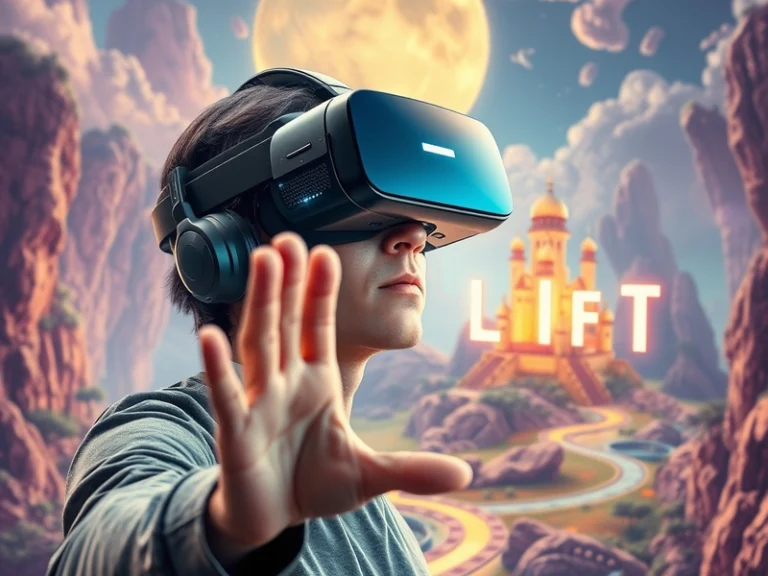
AI-driven world models are rapidly transforming how users interact with and create virtual environments, enabling the generation of immersive digital spaces that dynamically respond to natural language prompts and user actions.
This evolving paradigm moves beyond static, pre-rendered worlds or even traditional procedural generation, leveraging sophisticated artificial intelligence to construct and maintain coherent, interactive realities. The core idea is to empower users to “type a world” – describing a scene, a setting, or a narrative premise – and then “walk around in it,” experiencing a responsive environment that adapts to their presence and choices.
How AI World Models Function
At the heart of these systems are complex AI architectures that combine several distinct capabilities to simulate a persistent and believable virtual space. These capabilities can be broadly categorized:
- Generative Foundation Models: Large Language Models (LLMs) interpret user text prompts, translating high-level descriptions into actionable parameters for world construction. For instance, a prompt like “a bustling cyberpunk market at dusk” is broken down into thematic elements, architectural styles, lighting conditions, and potential non-player character (NPC) behaviors. Concurrently, generative image models, often based on diffusion architectures, create the visual assets—textures, 3D models, environmental details—that populate the scene, ensuring visual consistency with the textual description.
- Predictive Models: These models give the virtual world its dynamic and interactive properties. They learn the “physics” and “rules” of the environment, predicting how objects will behave, how NPCs will react to user input, and how the environment itself might evolve over time. This includes understanding spatial relationships, material properties, and even the emotional states of virtual inhabitants. Early research by organizations like OpenAI on “world models” demonstrated how an agent could learn to predict future frames in a simulated environment, effectively building an internal representation of the world’s dynamics.
- Reinforcement Learning for Coherence and Interaction: AI agents within these worlds, whether NPCs or environmental systems, are often trained using reinforcement learning. This allows them to develop behaviors that are contextually appropriate and contribute to the world’s overall coherence. For example, an NPC in a virtual market might learn to haggle realistically or direct users based on their queries, while environmental systems might learn to generate dynamic weather patterns or respond to player-induced changes in the landscape.
- Real-time Adaptation and Persistence: Unlike pre-rendered scenes, these AI models operate in real time, continuously generating and refining the environment based on user input and ongoing interactions. The world isn’t merely generated once; it evolves. Changes made by a user, or events triggered by AI, persist and influence subsequent interactions, fostering a sense of continuous narrative and environmental state.
Applications and Emerging Examples
The implications of AI-driven world models span various sectors, with significant potential in entertainment, simulation, and creative industries.
- Gaming: The most immediate and apparent application is in video games. Imagine games where every quest is dynamically generated based on player actions and AI-driven narrative agents, where NPCs remember past interactions, and where the game world itself reshapes in response to player choices. Instead of designers hand-crafting every detail, AI could procedurally generate vast, coherent worlds with dynamic storylines, reducing development costs and increasing replayability. While fully realized examples are still emerging, developers are actively integrating generative AI for asset creation, dialogue generation, and dynamic quest design.
- Virtual Reality (VR) and Metaverse Platforms: For true metaverse experiences, where users expect to build, interact, and persist in shared digital spaces, AI world models are crucial. They could enable users to verbally describe a desired virtual space – a meeting room, a fantastical landscape, a historical city – and have it instantly generated, ready for exploration and interaction. This dramatically lowers the barrier to content creation within these platforms.
- Simulation and Training: Industries requiring high-fidelity simulations, such as architecture, urban planning, or defense, can benefit immensely. AI can generate diverse scenarios, test environmental impacts, or train personnel in highly dynamic and unpredictable virtual settings, adapting the simulation on the fly to specific training objectives.
- Creative Tools: Artists, designers, and storytellers can leverage these tools to rapidly prototype environments, visualize concepts, or even co-create narratives with intelligent AI systems, pushing the boundaries of digital content creation.
While the vision of truly limitless, dynamically generated worlds is still maturing, the foundational AI technologies are advancing rapidly. Projects experimenting with neural radiance fields (NeRFs) for realistic 3D scene reconstruction from 2D images, and various generative AI platforms for text-to-3D asset creation, are paving the way for more sophisticated and immersive virtual environments. The ability to “type a world and walk around in it” is moving from science fiction to an increasingly tangible reality, promising a new era of personalized and dynamic digital experiences.