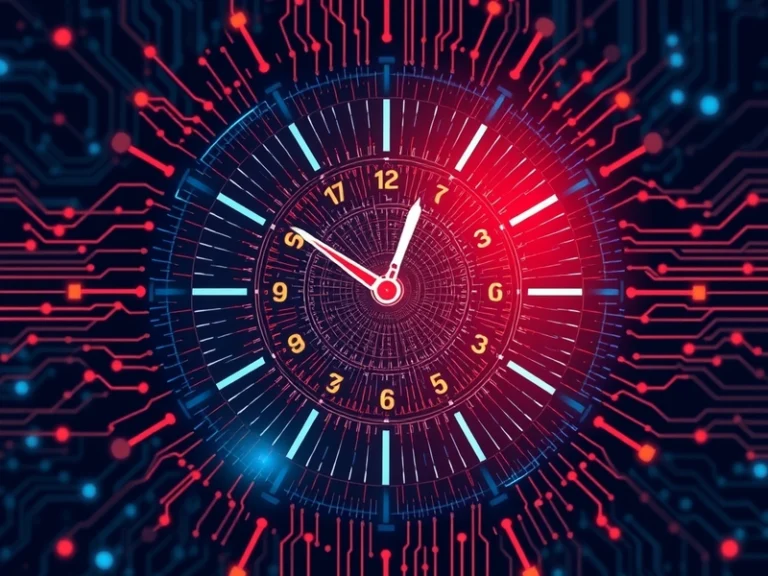
An artificial intelligence system has reportedly solved a 25-year-old cryptographic enigma, revealing that the complex encryption was, in fact, a sophisticated clock mechanism. This breakthrough highlights AI’s advanced capabilities in pattern recognition and its potential role in both strengthening and challenging data security paradigms.
For a quarter-century, the output of this particular system had baffled cryptanalysts. It generated sequences that appeared statistically random, resisting all conventional attempts at decryption or pattern identification. Unlike standard ciphers based on well-understood mathematical problems like integer factorization or discrete logarithms, this system’s nature remained elusive, leading many to believe it was either an exceptionally robust custom algorithm or a true random number generator with an unknown bias.
How AI Unlocked the Temporal Code
The AI’s success stemmed from its ability to process vast quantities of data and identify subtle, long-range correlations that human analysis, even with computational assistance, had overlooked. Rather than brute-forcing keys or attempting differential cryptanalysis, the AI system approached the problem as a pattern recognition challenge.
Details regarding the specific AI architecture remain largely proprietary, but experts suggest a combination of techniques likely contributed:
- Recurrent Neural Networks (RNNs) or Transformers: These architectures excel at identifying patterns and dependencies in sequential data, even across very long sequences. Given the “clock” revelation, it’s plausible the AI identified extremely long periods or subtle shifts in the data stream that correlated with real-world time.
- Advanced Statistical Analysis: Beyond standard statistical tests, the AI likely employed novel techniques to detect minute biases, periodicities, or state transitions in the output that were too complex or too low-amplitude for traditional methods to flag as non-random.
- Anomaly Detection: The system might have been trained on vast datasets of truly random sequences and then tasked with identifying any deviation in the enigmatic output, however small, that hinted at an underlying deterministic process.
The “clock” aspect implies that the system’s “encrypted” output was not truly random, but rather a deterministic function of an internal state that advanced predictably over time. This could have been a very complex pseudo-random number generator (PRNG) with an incredibly long cycle, or a system whose internal parameters were subtly influenced by an external time source, or even an internal timer that advanced in a non-obvious way. The AI’s triumph was in discerning this hidden temporal rhythm within what appeared to be pure noise.
Implications for Cryptography and Data Security
This revelation carries significant implications, though it’s crucial to distinguish its impact from that on established, mathematically-grounded cryptographic standards. Modern encryption algorithms like AES-256 or RSA rely on computational hardness problems that are not based on hidden “clock” mechanisms, but rather on the current inability of even the fastest supercomputers to perform specific mathematical operations in a reasonable timeframe.
However, the AI’s success serves as a stark warning in several areas:
- Custom and Proprietary Encryption: Organizations that rely on self-designed or proprietary encryption schemes, often without public scrutiny or rigorous peer review, face increased risk. The “security through obscurity” principle is once again proven fragile when confronted with advanced analytical tools.
- Pseudo-Random Number Generators (PRNGs): Many cryptographic systems and protocols depend on high-quality PRNGs. If a PRNG has subtle, time-dependent biases or predictable cycles, even very long ones, an AI could potentially exploit these weaknesses. This underscores the need for continuous research into and rigorous testing of PRNG designs.
- The Role of AI in Cryptanalysis: This achievement demonstrates AI’s growing power as a tool for cryptanalysis. While it hasn’t broken AES or RSA, it shows that AI can uncover deeply embedded patterns in complex data that elude human experts. Future AI advancements could potentially accelerate the discovery of weaknesses in existing cryptographic primitives or even new attack vectors.
- Supply Chain Security: If hardware or software components contain subtle, time-dependent “backdoors” or vulnerabilities, AI could be used to detect these anomalies in their output or behavior.
The cracking of this 25-year mystery is not a sign of the imminent collapse of all encryption. Instead, it underscores the need for cryptographic systems to be founded on provable mathematical hardness, subjected to open scrutiny, and continuously evaluated against the backdrop of rapidly advancing computational and AI capabilities. As AI becomes more sophisticated, its ability to find order in apparent chaos will only grow, demanding greater rigor and transparency in the design and implementation of secure systems.