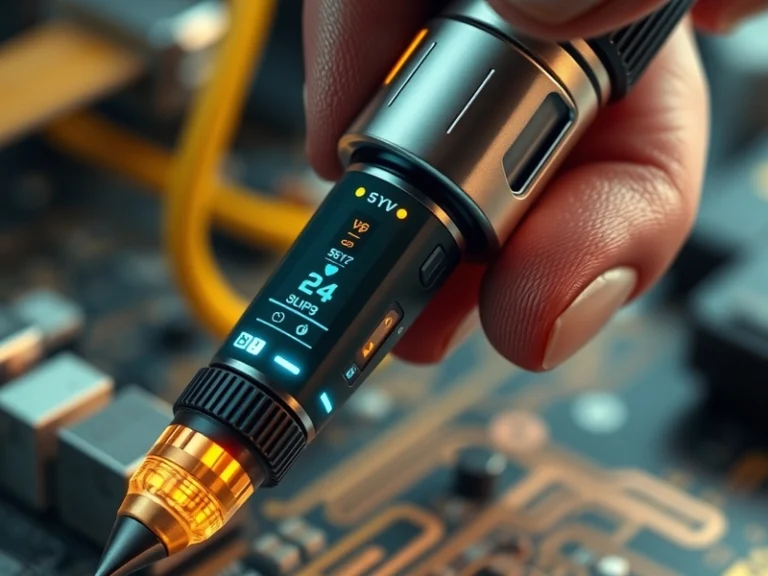
The intriguing proposition of ‘the world’s first AI screwdriver,’ a concept gaining traction with brands exploring advanced tool technologies like Arrowmax, signals a significant technological leap in the realm of smart tools. Moving beyond simple automation, this new class of intelligent devices promises to incorporate genuine AI-driven assistance, fundamentally redefining precision, efficiency, and user experience in tasks ranging from professional assembly to everyday home repairs. The very idea of an AI-powered screwdriver challenges traditional notions of manual labor, suggesting a future where our tools don’t just perform actions, but actively assist in decision-making and execution.
What Constitutes “AI” in a Hand Tool?
Unlike conventional electric screwdrivers that offer adjustable torque settings or impact functions, an AI-powered variant would integrate computational intelligence to dynamically adapt to the task at hand. This would involve processing real-time data from various sensors to make informed decisions. Key AI capabilities in such a tool might include:
- Material Recognition: Using embedded sensors and potentially a small camera, the tool could identify the type of material being fastened into (e.g., wood, plastic, metal) and the screw type. This data would inform optimal torque and speed settings, preventing common issues like cam-out or stripping.
- Adaptive Torque Control: Beyond pre-set limits, AI could continuously monitor resistance and feedback from the fastening process. It would adjust torque in real-time to prevent stripping screw heads, damaging work surfaces, or overtightening, ensuring optimal fastener security without causing material fatigue. This represents a significant advancement over traditional clutch mechanisms.
- User Guidance Systems: Integrated displays or haptic feedback could guide the user on correct angle, pressure, and depth. This real-time assistance would be particularly useful for intricate tasks, assembly instructions, or for novices learning proper technique, potentially displaying visual cues or vibrating to indicate correct application.
- Task Learning and Personalization: Over time, the AI could learn user preferences, common materials encountered, and frequently performed tasks. By analyzing past operations, it could optimize settings for recurring projects, improving efficiency and consistency across similar applications.
- Data Logging and Analytics: For professional applications, the tool could log every fastening operation, including torque applied, time taken, and successful completion status. This data could provide invaluable insights for quality control, compliance with industry standards, and process optimization in manufacturing or maintenance environments.
Beyond Basic Functionality: Real-World Impact
The integration of AI into a tool as fundamental as a screwdriver extends its utility far beyond simple fastening. For the average homeowner, it transforms daunting repair tasks into manageable projects. Imagine eliminating the frustration of stripped screws, damaged furniture, or improperly secured fixtures – the AI would proactively prevent these common mishaps by guiding the user to optimal application. For flat-pack furniture assembly, the tool could potentially guide users through each step, ensuring correct component alignment and optimal fastening for structural integrity.
In professional settings, the benefits escalate, offering tangible improvements in productivity and quality. Manufacturing lines, field service technicians, and maintenance crews could leverage AI screwdrivers for:
- Enhanced Quality Control: Ensuring consistent, precise fastening across thousands of units, significantly reducing defects, rework, and associated costs.
- Improved Training and Skill Transfer: Novice technicians could achieve expert-level precision and efficiency faster with real-time guidance and adaptive assistance, shortening the learning curve.
- Compliance and Traceability: Documented fastening data provides irrefutable evidence of adherence to specifications, which is critical in highly regulated industries such as aerospace, automotive, or medical device manufacturing.
- Reduced Material Waste: Fewer damaged components due to overtightening, incorrect screw selection, or improper application directly translates to cost savings and environmental benefits.
This shift represents not just an incremental improvement, but a fundamental rethinking of the human-tool interface, where the tool acts as an intelligent assistant rather than a mere extension of the hand.
Challenges and the Path Forward
While the promise of AI-powered tools is compelling, bringing them to market involves significant challenges. The integration of complex sensors, powerful microprocessors, and sophisticated AI models into a compact, durable, and affordable form factor is no small feat. Power consumption for these advanced electronics also needs to be managed effectively to ensure practical battery life that meets the demands of extended use.
Furthermore, user adoption will heavily depend on a clear demonstration of value that outweighs potential increases in cost and complexity. Intuitive interfaces, robust software, and reliable performance will be crucial for these tools to gain widespread acceptance among both DIY enthusiasts and seasoned professionals. As companies like Arrowmax continue to innovate in this space, the focus will likely be on striking a delicate balance between cutting-edge AI capabilities and practical, user-friendly design.
The “AI screwdriver” could serve as a bellwether for a broader trend of intelligent augmentation across the entire spectrum of hand and power tools. From wrenches that detect material stresses to saws that optimize cutting paths based on material density, the foundational principles of adaptive AI could soon become ubiquitous, transforming manual labor into intelligently assisted work across countless applications.
Conclusion
The concept of an AI screwdriver, as championed by forward-thinking brands, represents a pivotal moment in tool evolution. By embedding artificial intelligence directly into the hands of users, these tools promise to deliver unprecedented levels of precision, safety, and efficiency. While the journey from concept to widespread adoption involves overcoming technological and economic hurdles, the vision of tools that think, adapt, and assist is rapidly moving from speculation to a tangible reality. The ultimate impact will be a more intelligent, less error-prone, and ultimately more satisfying experience for anyone undertaking a fastening task, whether at home or on the job.