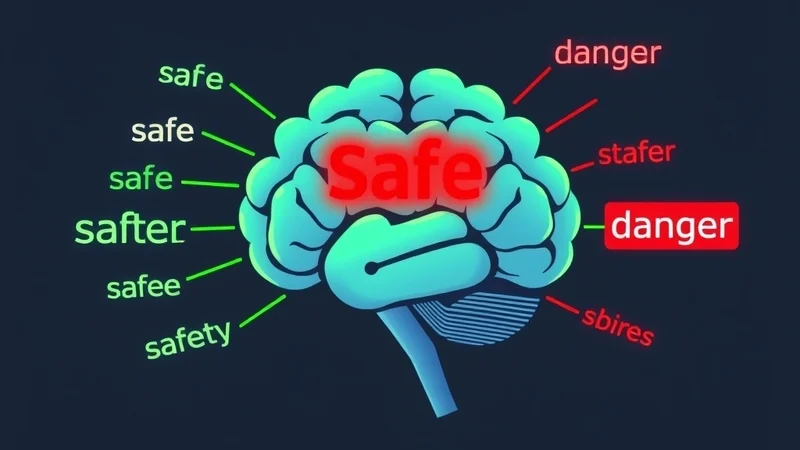
A new framework for understanding language models is gaining traction in AI safety circles, advocating for a shift from reactive, danger-focused mitigation to proactive, intrinsically safety-focused design to improve AI interpretation.
For years, the primary approach to AI safety, particularly with large language models (LLMs), has largely been reactive. This ‘danger-focused’ paradigm identifies potential harms—such as generating toxic content, perpetuating biases, hallucinating false information, or enabling misuse—and then implements safeguards to prevent or mitigate them. Techniques like extensive content filtering, post-training fine-tuning, and reinforcement learning from human feedback (RLHF) have been instrumental in making models like OpenAI’s ChatGPT and Google’s Gemini more robust against explicit harms. These methods act as critical guardrails, preventing models from straying into undesirable territories after their initial, broad training.
While essential, this reactive approach often resembles a game of ‘whack-a-mole.’ It requires constant vigilance to identify new failure modes, can be computationally expensive, and may lead to models that are overly conservative or ‘lobotomized’ in their responses to avoid any perceived risk. Furthermore, such external filters don’t necessarily address the root causes of unsafe behavior within the model’s core understanding of language; they often act as a layer on top of a potentially misaligned internal representation.
The emerging ‘safety-focused’ framework proposes a more fundamental reorientation. Instead of primarily detecting and blocking unsafe outputs, this approach aims to instill safety principles deep within the model’s foundational understanding of language itself. The goal is to build models whose very interpretation and generation processes are inherently aligned with principles of helpfulness, honesty, and harmlessness, leading to more reliable and trustworthy AI systems.
Pillars of an Inherently Safe AI
- Proactive Data Curation: Rather than merely filtering out problematic content from training datasets, this framework emphasizes curating datasets that intrinsically promote beneficial language understanding. This means focusing on diverse, factual, and ethically sound sources, actively reducing the prevalence of biases and misinformation from the outset.
- Intrinsic Objective Functions: A core shift involves integrating safety and trustworthiness directly into the model’s training objectives. Beyond predicting the next token accurately, models would be optimized to prioritize factual correctness, logical coherence, and ethical considerations. This could involve new loss functions or reward signals that penalize not just incorrect predictions, but also interpretations that are ambiguous, misleading, or potentially harmful.
- Architectural and Algorithmic Design: The framework suggests exploring model architectures and learning algorithms that are inherently more interpretable and controllable. By designing models that allow for greater transparency into their decision-making processes, developers can better understand and assure their safety properties, rather than treating the model as a black box.
- Holistic Evaluation Metrics: Current safety evaluations often focus on identifying specific failure modes. A safety-focused approach would broaden this to include metrics that actively measure a model’s capacity for beneficial interpretation—its ability to reason ethically, understand nuanced human intent, and consistently provide accurate and helpful information across diverse contexts.
This intrinsic approach promises significant benefits for AI interpretation. When safety is woven into the fabric of a model’s understanding, it is expected to:
- Enhance Contextual Awareness: Models would be better equipped to interpret nuanced human instructions and complex contexts, distinguishing between benign and potentially risky prompts with greater accuracy, even when the language is subtle or indirect.
- Improve Factual Reliability: By prioritizing honesty and truthfulness in its core objectives, a safety-focused model would likely produce more consistently factual and less speculative interpretations, reducing hallucinations and misinformation.
- Increase Robustness to Adversarial Prompts: A deeper, safety-aligned understanding of language could make models more resilient against prompt injection attacks or other adversarial attempts to elicit harmful or incorrect outputs, as their foundational reasoning would prioritize beneficial outcomes.
- Foster Trust and Adoption: Ultimately, models that inherently interpret and respond safely and reliably are more likely to earn public trust, accelerating their beneficial integration into various applications, from education to critical infrastructure.
Implementing such a paradigm shift is not without its challenges. Defining ‘safety’ comprehensively and universally remains a complex philosophical and technical hurdle. Translating these abstract principles into concrete, measurable objective functions and scalable training methodologies requires significant research and engineering effort. Furthermore, balancing intrinsic safety with other desirable model qualities, such as creativity, generality, and efficiency, will be a delicate act.
Despite these complexities, the move towards intrinsically safety-focused language models represents a pivotal evolution in AI development. It signals a maturation of the field, moving beyond reactive problem-solving to a more proactive, principled approach to building AI systems that are not just powerful, but also fundamentally trustworthy and aligned with human values. As research progresses, this framework could lay the groundwork for a new generation of AI that interprets the world not just intelligently, but also with an inherent commitment to safety and beneficial outcomes.