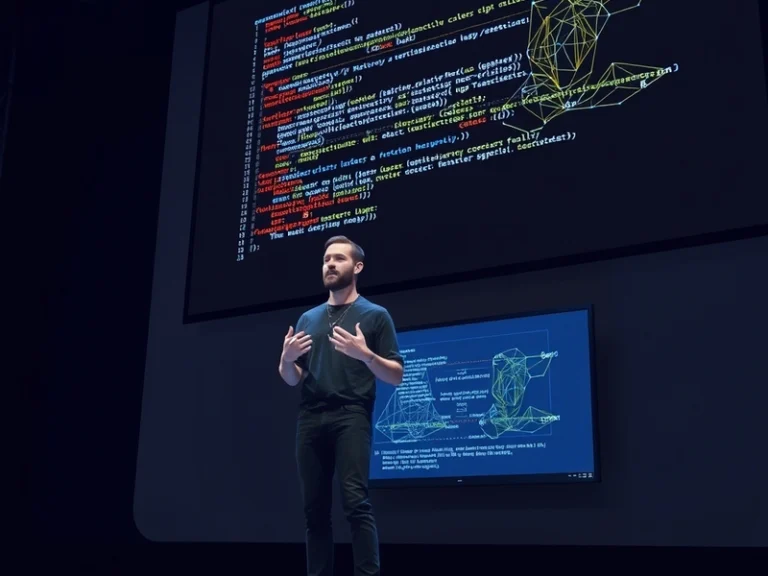
The concept of rapidly developing sophisticated AI systems, often highlighted by prominent AI researcher Andrej Karpathy, has recently sparked discussions about the potential to create complex platforms, such as a personalized video recommendation engine akin to YouTube’s core functionality, in remarkably short timeframes. While the idea of a complete “YouTube rebuild” in just two hours serves more as a powerful thought experiment than a literal full-scale deployment, it underscores the profound advancements in AI development tools and methodologies that Karpathy frequently champions.
Andrej Karpathy, a former head of AI at Tesla and a founding member of OpenAI, is renowned not only for his deep technical expertise but also for his ability to demystify complex AI concepts. His educational initiatives, such as the “makemore” series, demonstrate how to build neural networks from fundamental principles with surprising speed. This pedagogical approach emphasizes understanding the underlying mechanics and leveraging modern libraries to iterate rapidly, making even seemingly daunting projects approachable.
The allure of building a sophisticated AI system quickly stems from several converging factors in today’s machine learning landscape:
- High-Level Frameworks: Libraries like PyTorch and TensorFlow abstract away much of the low-level numerical computation, allowing developers to focus on model architecture and data flow. Karpathy himself is a strong proponent of understanding these frameworks deeply.
- Pre-trained Models and Embeddings: Instead of training models from scratch, developers can leverage powerful pre-trained models (e.g., for natural language processing or computer vision) and their generated embeddings. For a video recommendation system, this could involve using pre-trained models to extract semantic features from video titles, descriptions, and even visual content, turning them into numerical vectors.
- Cloud Computing and APIs: Access to scalable cloud infrastructure (AWS, Azure, GCP) and specialized AI services means developers don’t need to manage hardware or build every component. APIs for tasks like vector databases (e.g., Pinecone, Weaviate) or large language models (e.g., OpenAI’s API) can be integrated with minimal code.
- Modular System Design: Modern AI development often involves piecing together existing components and services. A recommendation system, for instance, can be broken down into distinct modules: data ingestion, feature extraction, similarity search, and ranking.
Deconstructing a Personalized Recommendation Engine
At its core, a personalized video recommendation platform involves understanding both the users and the videos, then matching them effectively. The process typically looks something like this:
- Content Understanding: Each video needs to be represented in a machine-readable format. AI models can process video titles, descriptions, tags, and even transcripts or visual frames to generate numerical embeddings—vectors that capture the semantic meaning of the video. Videos with similar themes or content will have embeddings that are close to each other in a high-dimensional space.
- User Profiling: Similarly, user behavior (videos watched, liked, skipped, search queries) can be used to build a user profile, also represented as an embedding. This embedding reflects the user’s preferences and interests.
- Similarity Search: The heart of the recommendation engine is finding videos whose embeddings are “similar” to a user’s profile embedding. Fast approximate nearest neighbor (ANN) search algorithms, often implemented in specialized vector databases, can quickly identify candidate videos from a vast library.
- Ranking and Personalization: A final ranking layer can then refine these candidates based on additional factors like recency, popularity, or explicit user feedback, presenting the most relevant videos to the user.
While building a production-ready system with YouTube’s scale, robustness, and vast feature set would take immense resources and time, constructing a functional prototype of its core recommendation logic is far more achievable. The “two hours” concept, in this context, highlights the efficiency gains from not having to build everything from scratch, but rather connecting powerful, off-the-shelf AI components and frameworks.
The Karpathy Effect: Efficiency and Clarity
Karpathy’s influence lies not just in his technical contributions but in his ability to articulate a clear, efficient path to building AI systems. He consistently demonstrates how a deep understanding of neural network fundamentals, combined with judicious use of modern tools, can compress development cycles dramatically. The hypothetical challenge of building a “YouTube recommendation engine” in two hours serves as a testament to this philosophy: it’s about leveraging the abstraction layers of modern AI, focusing on the core problem, and executing with clarity.
This rapid prototyping capability is transformative for AI development. It allows researchers and engineers to test hypotheses quickly, iterate on designs, and demonstrate value without prohibitive upfront investment. While the full complexity of platforms like YouTube extends far beyond a recommendation engine, the ability to spin up such a sophisticated core component so rapidly signifies a new era of agile AI engineering.