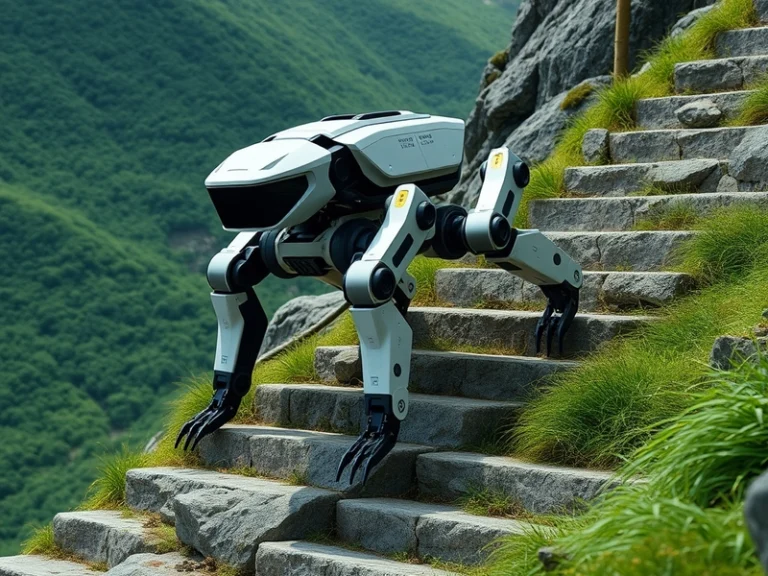
Robots are increasingly being deployed into extreme natural environments, from rugged mountain trails to disaster zones, to push the boundaries of AI mobility and autonomy. This trend underscores a critical phase in robotics development, where real-world performance in unpredictable conditions is paramount for advancing practical applications. Locations like China’s Mount Tai, renowned for its thousands of steep stone steps and varied natural paths, exemplify the kind of challenging terrain researchers are leveraging to rigorously test the next generation of autonomous systems.
The motivation behind these demanding field tests is clear: laboratory environments, no matter how sophisticated, cannot fully replicate the dynamism and unpredictability of the natural world. Mountains like Mount Tai present a unique confluence of challenges:
- Varied Terrain: From smooth paved sections to worn, uneven stone steps, loose gravel, and natural rock formations, robots must navigate a constantly changing ground surface.
- Steep Inclines and Declines: Sustained climbs and descents test a robot’s power systems, stability algorithms, and ability to maintain traction and balance under high stress.
- Environmental Factors: Weather conditions such as rain, wind, fluctuating temperatures, and varying light levels (impacting vision systems) add layers of complexity.
- Obstacle Density: Crowds, natural debris, and narrow passages require sophisticated perception and path planning.
Success in such environments demands a sophisticated interplay between advanced mechanical design and cutting-edge artificial intelligence. Legged robots, in particular, are proving adept at traversing terrain that would be impassable for wheeled or tracked vehicles. Companies like Boston Dynamics, with its quadruped Spot and biped Atlas, or Agility Robotics, known for its bipedal Digit, have demonstrated remarkable capabilities in dynamic balance and locomotion. Similarly, Unitree Robotics has made strides with its consumer and industrial quadruped robots, showcasing agile movement across diverse surfaces.
AI’s Role in Extreme Mobility
The core of a robot’s ability to “race” or even simply traverse such challenging environments lies in its AI-driven perception, control, and navigation systems. These systems are constantly processing vast amounts of data to make real-time decisions:
- Perception and Mapping: Robots utilize an array of sensors—Lidar, stereo cameras, depth sensors, and inertial measurement units (IMUs)—to build a 3D understanding of their surroundings. AI algorithms, including Simultaneous Localization and Mapping (SLAM), interpret this data to identify traversable paths, detect obstacles, and continuously update the robot’s position within the environment. Computer vision models are trained on extensive datasets to classify terrain types, differentiate between stable ground and slippery surfaces, and even recognize potential hazards.
- Locomotion Control: For legged robots, dynamic balance and gait adaptation are paramount. Reinforcement learning (RL) has emerged as a powerful technique, allowing robots to learn optimal walking, running, or climbing gaits through trial and error in simulated environments, then transfer that knowledge to the physical world. This enables them to dynamically adjust leg placement, body posture, and force distribution to maintain stability on uneven, slippery, or inclined surfaces without explicit programming for every possible scenario.
- Navigation and Path Planning: Beyond simply avoiding obstacles, robots must plan efficient and safe routes. AI-powered navigation systems consider not only the immediate terrain but also the robot’s kinematic limits, energy consumption, and mission objectives. This involves complex algorithms that can evaluate multiple potential paths, predict outcomes, and adapt plans on the fly as conditions change or new information becomes available.
- Autonomy and Decision-Making: The ultimate goal is to minimize human intervention. AI is crucial for enabling robots to make autonomous decisions, such as choosing alternative routes when a path is blocked, prioritizing tasks, or even identifying when to pause and reassess a situation. This level of autonomy is vital for deployment in remote or hazardous locations where constant human supervision is impractical or impossible.
Real-World Impact and Applications
The insights gained from testing robots in environments like Mount Tai have direct implications for a wide range of real-world applications. The challenges overcome in navigating natural trails translate directly to improved performance in:
- Disaster Response: Robots capable of traversing rubble, collapsed structures, and uneven terrain can assist in search and rescue operations, delivering supplies, and conducting damage assessments in areas too dangerous for humans.
- Industrial Inspection: Autonomous robots can inspect critical infrastructure such as power lines, pipelines, bridges, and remote industrial sites, often in hazardous or inaccessible locations, reducing risk to human workers.
- Exploration: From planetary exploration on Mars to subterranean mapping on Earth, robots equipped with robust mobility and AI can gather data from environments that are hostile or distant.
- Logistics and Delivery: “Last-mile” delivery in challenging urban or rural landscapes, where traditional vehicles struggle, could be revolutionized by agile, autonomous robots.
- Defense and Security: Unmanned ground vehicles for reconnaissance, surveillance, and patrol in complex operational theaters.
While the “race” up Mount Tai may be a metaphorical representation of the ongoing drive for robotic advancement, the underlying scientific and engineering efforts are very real. Each step a robot takes on challenging terrain pushes the limits of what AI-powered machines can achieve, paving the way for a future where robots are indispensable partners in navigating our complex world.