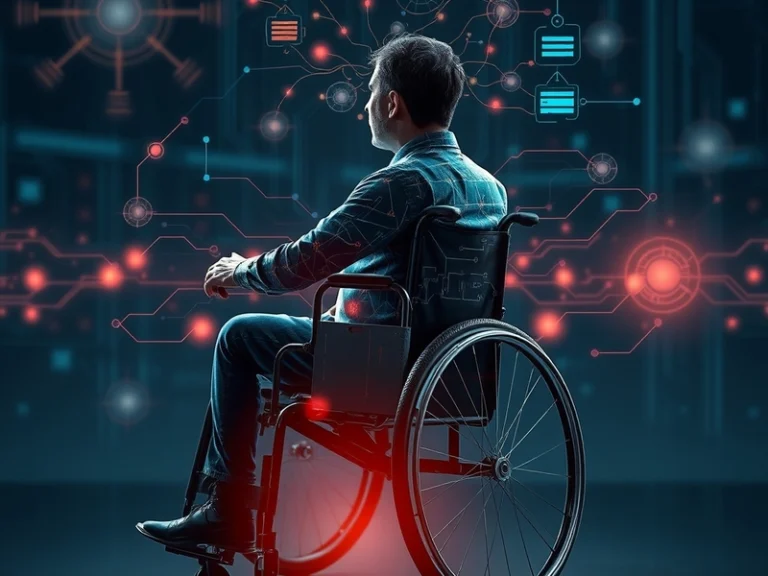
AI-driven brain-computer interface (BCI) technology is increasingly enabling individuals with severe paralysis, particularly those living with Amyotrophic Lateral Sclerosis (ALS), to regain a degree of mobility and autonomy by controlling wheelchairs directly through their thoughts.
This transformative advancement leverages sophisticated neural implants and advanced machine learning algorithms to interpret brain signals, translating them into precise commands for powered wheelchairs. For patients whose conditions have progressed to the point where they can no longer use conventional input methods like joysticks or even eye-tracking devices, thought-controlled mobility represents a profound restoration of independence.
The Mechanics of Thought Control
At the core of this technology are invasive BCIs, which involve surgically implanting electrodes into or onto the brain. These implants are designed to detect the electrical activity generated by neurons when a person thinks about a specific action or even just forms an intention. While non-invasive BCIs using electroencephalography (EEG) caps exist, invasive methods offer significantly higher signal resolution and fidelity, which is critical for the nuanced control required for complex tasks like navigating a wheelchair.
Once implanted, these electrodes capture neural spikes or local field potentials, which are then transmitted wirelessly or via a wired connection to an external processing unit. This is where artificial intelligence takes center stage.
AI’s Crucial Role in Signal Interpretation
The raw brain signals are complex and noisy. Machine learning algorithms are essential for several key steps:
- Signal Processing and Filtering: AI models are trained to filter out noise, identify relevant neural patterns, and enhance the signal-to-noise ratio. This ensures that only meaningful brain activity is analyzed.
- Pattern Recognition: Users typically undergo a calibration phase where they imagine specific movements or intentions (e.g., “move forward,” “turn left,” “stop”). The AI learns to associate unique neural signatures with these intended commands. These patterns are highly individualized and can change over time.
- Real-time Decoding: Once trained, the AI continuously decodes incoming brain signals in real-time, matching them against learned patterns. This real-time inference is critical for responsive and intuitive control.
- Adaptation and Learning: Advanced algorithms can adapt to changes in brain activity over time, improving accuracy and responsiveness as the user gains experience. Some systems incorporate reinforcement learning, where the AI refines its decoding based on user feedback or successful task completion.
The decoded commands are then relayed to the wheelchair’s control system, translating a user’s thought into physical movement. This entire process, from thought to action, must occur with minimal latency to provide a natural and safe user experience.
Transformative Impact for ALS Patients
ALS is a progressive neurodegenerative disease that affects nerve cells in the brain and spinal cord, leading to muscle weakness, paralysis, and eventually, the loss of the ability to move, speak, eat, and breathe independently. For individuals in advanced stages of ALS, traditional assistive technologies, which often rely on residual muscle movement or eye gaze, become insufficient. The ability to control a wheelchair purely through thought offers a lifeline, restoring a critical layer of autonomy that would otherwise be lost.
This technology goes beyond mere physical movement; it significantly impacts the psychological well-being of patients. Regaining control over their environment, even if just through mobility, can combat feelings of isolation and helplessness, fostering a renewed sense of independence and dignity.
Current Approaches and Research Directions
Various research groups and companies are advancing BCI technology for mobility. Some systems utilize microelectrode arrays implanted directly into the motor cortex, offering high-resolution data from individual neurons. Other approaches involve electrocorticography (ECoG) grids placed on the surface of the brain, which capture signals from larger populations of neurons. Emerging technologies also include less invasive, stent-like electrode arrays that can be delivered through blood vessels to sit near the motor cortex, reducing the risks associated with open-brain surgery.
Ongoing research focuses on several key areas:
- Improving Decoding Accuracy: Enhancing the precision with which AI algorithms interpret complex brain signals, reducing errors and increasing reliability.
- Reducing Latency: Minimizing the time delay between thought and wheelchair response to make control feel more natural and intuitive.
- Increasing Degrees of Freedom: Expanding the range of commands beyond basic directional movements to include more nuanced controls, such as speed adjustments or environmental interactions.
- Long-Term Stability and Reliability: Ensuring that implants remain functional and biocompatible over many years, and that the AI models can adapt to changes in neural activity or implant performance.
- User Training and Calibration: Developing more efficient and less burdensome methods for users to train the BCI system and for the system to recalibrate over time.
While challenges remain in terms of long-term implant viability, algorithmic robustness, and widespread accessibility, the progress in AI-driven brain-computer interfaces for wheelchair control represents a monumental step forward for individuals living with profound paralysis. It offers a tangible pathway to reclaiming essential aspects of daily life and fostering greater independence.