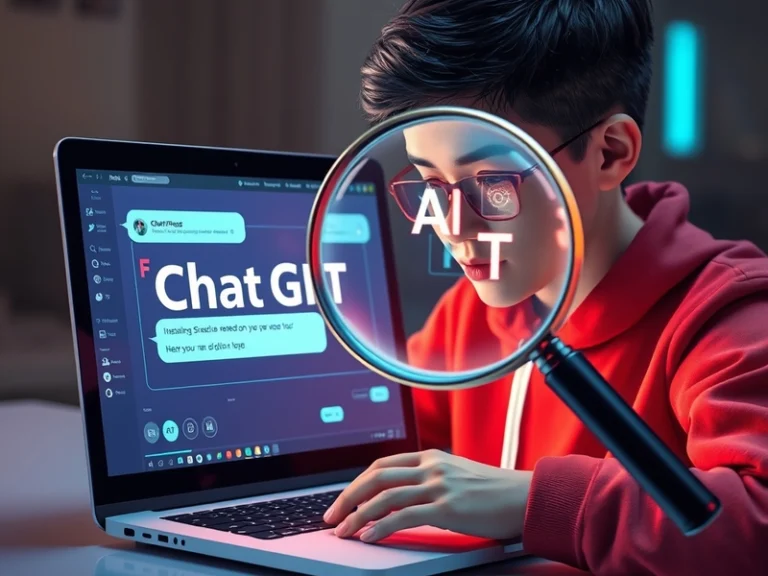
The proliferation of advanced generative AI models like OpenAI’s ChatGPT has introduced a complex new dynamic into academic integrity, not only enabling new forms of academic misconduct but also offering novel avenues for its detection, effectively allowing AI to “snitch” on its own use.
Since its public release in late 2022, ChatGPT quickly became a powerful tool for students seeking to generate essays, summarize texts, solve complex problems, or even write code. Its ability to produce coherent, contextually relevant, and often grammatically flawless text in moments presented an unprecedented challenge to traditional assessment methods. Educators worldwide grappled with how to distinguish genuinely student-produced work from AI-generated content, fearing an erosion of learning outcomes and fair evaluation.
The Mechanisms of AI-Assisted Detection
The notion of AI “snitching” on AI isn’t about ChatGPT actively reporting users, but rather about the inherent characteristics of AI-generated content and the development of specialized tools designed to identify these characteristics. Several mechanisms contribute to this:
- AI Detection Software: Companies like Turnitin quickly integrated AI writing detection capabilities into their plagiarism checking platforms. Independent tools such as GPTZero also emerged, specifically designed to analyze text for patterns indicative of large language model (LLM) generation. These tools often rely on metrics like “perplexity” (how predictable the next word is) and “burstiness” (the variation in sentence length and structure). AI-generated text often exhibits lower perplexity and less burstiness than human writing, tending towards more uniform phrasing and predictable word choices.
- Stylometric Analysis: Even without dedicated detection software, human instructors can sometimes identify AI-generated text through stylistic analysis. Common tells include an overly formal or generic tone, a lack of personal voice or unique insights, repetition of phrases, or the inclusion of information that is technically correct but lacks critical depth or nuance expected from a student. AI models, while powerful, often converge on common linguistic patterns that can become recognizable over time.
- Inconsistencies and Errors: While LLMs are impressive, they are not infallible. They can “hallucinate” facts, misinterpret complex prompts, or produce subtly incorrect arguments. When students rely solely on AI for assignments, these errors can serve as red flags, especially if the student cannot articulate or defend the AI-generated content during a follow-up discussion.
- Metadata and Digital Footprints: In some institutional settings, the use of AI tools might leave digital traces or require specific browser extensions or applications. While this is less about the AI itself “snitching,” it highlights how digital environments can provide evidence of AI tool usage. Furthermore, if a student interacts with an LLM in a way that implies prior AI use for an assignment (e.g., asking “how can I rephrase this AI-generated essay to avoid detection?”), these subsequent interactions, if discoverable, could also serve as evidence.
Implications for Academic Integrity and Pedagogy
The emergence of AI as both a cheating tool and a detection mechanism has profound implications for academic integrity:
The Arms Race Dynamic
There’s an ongoing “arms race” between AI generation and AI detection. As AI models become more sophisticated, capable of producing text with higher perplexity and burstiness, detection tools must also evolve. This creates a challenging environment for institutions, as the reliability and accuracy of detection tools are constantly under scrutiny. False positives, where genuinely human-written content is flagged as AI-generated, are a significant concern, potentially leading to unfair accusations and eroding trust.
Rethinking Assessment
Many educators are moving beyond simply trying to detect AI and are instead redesigning assignments to mitigate the incentive or ability to use AI for cheating. This shift includes:
- Process-Oriented Assignments: Requiring students to submit outlines, drafts, annotated bibliographies, or reflective journals that document their thought process, making it harder to simply drop in an AI-generated final product.
- In-Class Assessments: Shifting towards more in-class essays, exams, and presentations where AI tools are not accessible.
- Personalization and Specificity: Designing prompts that require highly specific, personal experiences, local knowledge, or recent classroom discussions that AI models would struggle to replicate accurately without direct human input.
- Oral Examinations and Viva Voce: Using one-on-one discussions to assess a student’s understanding and ability to articulate their work, making it impossible for AI to generate responses in real-time.
- Focus on Critical Thinking and Synthesis: Emphasizing tasks that require deeper analysis, critical evaluation, and synthesis of information rather than mere information recall or summary, pushing students beyond what current LLMs can autonomously achieve at a high level.
Ethical Considerations and Policy Development
Institutions are grappling with developing clear, fair policies regarding AI use. This includes defining what constitutes acceptable AI assistance versus academic misconduct, educating students on responsible AI use, and ensuring that detection methods are transparent and robust enough to avoid erroneous accusations. The ethical implications of using AI to monitor student work, particularly concerning data privacy and the potential for bias in detection algorithms, are also central to these discussions.
The phenomenon of AI revealing its own use underscores a fundamental shift in education. While AI tools present significant challenges to traditional academic integrity, they also compel a re-evaluation of pedagogical practices, pushing educators to design more resilient and meaningful learning experiences that prioritize genuine understanding and critical engagement over rote production.