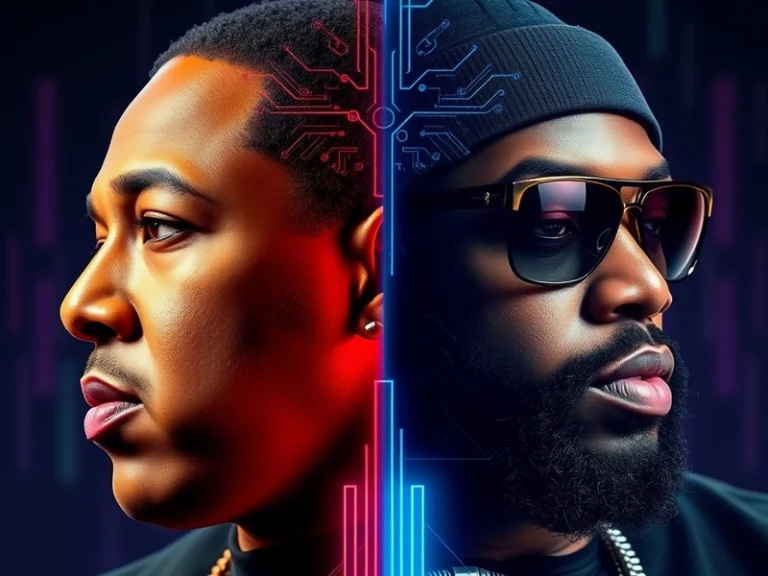
Dr. Dre and Ice Cube, two titans of hip-hop, have articulated distinct yet equally significant concerns regarding the burgeoning role of artificial intelligence in the music industry, highlighting a complex debate over creativity, intellectual property, and artistic integrity. While both legends acknowledge AI’s potential, their public statements reveal a divergence in their primary anxieties, reflecting their unique legacies and contributions to music.
Dr. Dre: The Soul of the Machine
For Dr. Dre, whose career is synonymous with meticulous sound production and an unparalleled ear for sonic quality, the discussion around AI often centers on the intangible elements of music: emotion, soul, and the human touch. Known for crafting groundbreaking albums like N.W.A.’s *Straight Outta Compton* and his own *The Chronic*, Dre’s production philosophy has always emphasized raw feeling and authenticity.
In recent interviews, Dr. Dre has expressed skepticism about AI’s capacity to replicate the nuanced emotional depth that defines truly impactful music. His concerns often revolve around the idea that while AI can generate technically proficient compositions or mimic vocal styles, it inherently lacks the lived experience, passion, and “soul” that human artists infuse into their work. This perspective posits AI as a sophisticated tool that can enhance or augment, but ultimately cannot replace, the core human element vital to genuine artistic expression. For a producer whose career was built on hours in the studio, perfecting every beat and melody to evoke a specific feeling, the notion of an algorithm achieving that same emotional resonance is a profound challenge to his artistic ethos.
Ice Cube: Protecting the Creator’s Rights
Ice Cube, a lyrical pioneer, actor, and entrepreneur, approaches the AI discussion with a focus firmly rooted in intellectual property rights, artist compensation, and the economic implications for creators. As a founding member of N.W.A. and a prolific solo artist known for his incisive social commentary, Cube has consistently advocated for artists’ autonomy and fair treatment within the industry.
Cube has been vocal about the need for robust legal frameworks and regulations to protect artists from unauthorized AI exploitation. His primary worry is the potential for AI models to be trained on existing musical works, voices, and likenesses without explicit consent or fair compensation, effectively “stealing” an artist’s identity and labor. This concern extends to the proliferation of AI-generated tracks that mimic established artists, potentially diluting their brand and revenue streams. Ice Cube’s stance underscores a broader industry anxiety about copyright infringement in the age of generative AI, pushing for legislative action that ensures artists retain control over their creative output and are adequately compensated for its use, even by algorithmic entities.
Contrasting Concerns, Shared Stakes
The differing emphasis from Dr. Dre and Ice Cube illustrates two critical facets of the ongoing debate surrounding AI in music:
- Artistic Integrity vs. Economic Rights: Dr. Dre’s perspective highlights the potential degradation of artistic quality and emotional authenticity if AI replaces human creativity. Ice Cube’s argument champions the economic and legal protections necessary for artists to maintain livelihoods and control their intellectual property in an AI-driven landscape.
- The “What” vs. The “How”: Dre is concerned with *what* AI-generated music will lack (soul, emotion). Cube is concerned with *how* AI is developed and deployed (unauthorized training, lack of compensation).
Both perspectives are crucial as the music industry grapples with rapid technological advancements. Generative AI tools like Google’s Lyria, Stability AI’s Stable Audio, and various vocal synthesis platforms are becoming increasingly sophisticated, capable of generating everything from instrumental tracks to eerily accurate vocal imitations. This capability, while offering new creative avenues, also presents significant challenges:
The Dual Nature of AI in Music
On one hand, AI offers powerful new tools for musicians and producers:
- Creative Assistance: AI can aid in composition, arrangement, and mastering, speeding up workflows and offering new sonic palettes.
- Accessibility: Tools that simplify music creation can democratize production, allowing more individuals to experiment with sound.
- Innovation: AI can generate novel sounds and structures that might not emerge from traditional human composition.
On the other hand, the ethical and legal challenges are profound:
- Copyright Infringement: The use of copyrighted material to train AI models without licenses remains a contentious issue, exemplified by lawsuits against AI developers.
- Voice Cloning and Deepfakes: Unauthorized replication of artists’ voices, as seen in instances involving AI-generated tracks mimicking artists like Drake and The Weeknd, raises serious questions about identity and control.
- Artist Compensation: Establishing fair compensation models for artists whose work is used to train AI or whose likenesses are generated by AI is a complex, unresolved problem.
- Value of Human Artistry: The proliferation of AI-generated content could devalue human-created music, making it harder for emerging artists to stand out or earn a living.
Major industry players, including Universal Music Group (UMG), have taken strong stances against unauthorized AI use, issuing takedown notices for AI-generated tracks and advocating for stricter regulations. Artists’ unions and advocacy groups are also pushing for legislation that addresses AI’s impact on creative professionals, seeking to codify rights around voice, likeness, and intellectual property.
The dialogue initiated by figures like Dr. Dre and Ice Cube underscores that the integration of AI into music is not merely a technical evolution but a fundamental reevaluation of artistic value, ownership, and the very definition of creativity. Their contrasting concerns serve as a vital reminder that while technology advances, the core human questions about art and fairness remain paramount.