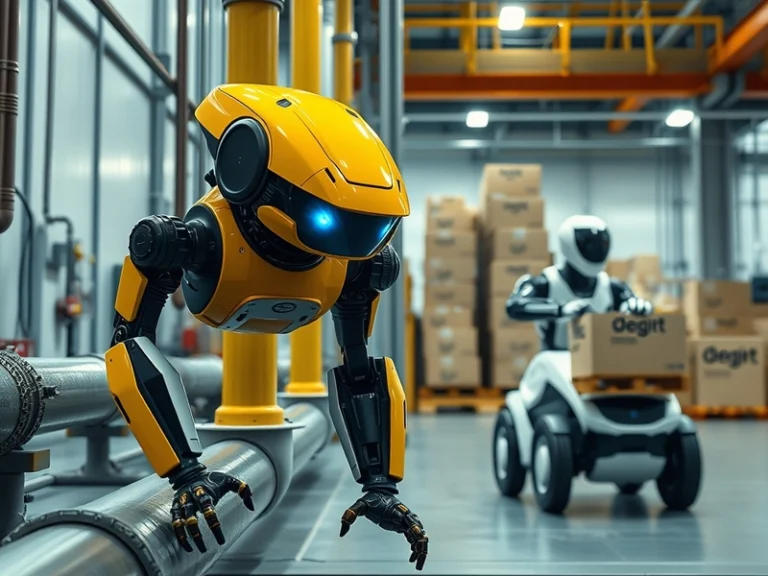
The advanced robotics field is increasingly witnessing a pivotal shift, as machines once celebrated for their athletic prowess and dynamic demonstrations are now being deployed in practical, industrial settings, moving from the laboratory and competition stage to real-world utility. This transition is exemplified by companies like Boston Dynamics and Agility Robotics, whose highly agile robots are finding roles in logistics, inspection, and hazardous environments.
From “Track Star” Demonstrations to Practicality
For years, the public’s perception of cutting-edge robotics was largely shaped by captivating viral videos. Robots like Boston Dynamics’ bipedal Atlas, demonstrating parkour, backflips, and complex manipulation tasks, pushed the boundaries of what was thought possible for autonomous machines. While these feats were undeniably impressive, showcasing advanced control algorithms, sophisticated hardware, and robust AI, they often existed in controlled environments as proof-of-concept demonstrations. The “Bolt-Beating Robot” moniker, while perhaps a hyperbole for any specific machine, aptly captured the spirit of these research endeavors: to achieve human-like or even superhuman agility and speed. These demonstrations served a crucial role, attracting talent, inspiring research, and proving the feasibility of highly dynamic robotic movement.
However, the challenge has always been translating these high-performance capabilities into reliable, cost-effective, and adaptable solutions for industrial needs. An agile robot performing a perfect backflip is one thing; a robot consistently navigating a cluttered warehouse, inspecting critical infrastructure, or assisting human workers day in and day out is another. The latter demands not just peak performance in ideal conditions, but resilience, long operational cycles, ease of programming, and safety in unpredictable environments.
The Shift to Industrial Applications
The shift from demonstration to deployment is now tangible. Boston Dynamics’ quadrupedal robot, Spot, which gained initial fame for its dog-like agility and ability to traverse difficult terrain, is a prime example. While not a bipedal “track star” in the vein of Atlas, its dynamic stability and robust navigation capabilities made it a strong candidate for industrial applications.
Spot robots are now commercially available and deployed across various sectors:
- Industrial Inspection: In energy facilities, construction sites, and manufacturing plants, Spot is used for routine inspections, monitoring equipment, detecting anomalies, and collecting data in hazardous or difficult-to-access areas. Companies like BP have utilized Spot for remote inspection of offshore platforms, reducing human exposure to risk.
- Public Safety: Law enforcement and emergency services have adopted Spot for reconnaissance in dangerous situations, such as bomb disposal or hostage scenarios, providing real-time situational awareness without risking human lives.
- Construction Progress Monitoring: On construction sites, Spot can autonomously navigate and capture 3D scans, photos, and video, providing architects and project managers with up-to-date progress reports and identifying potential issues early.
Another significant player in this transition is Agility Robotics with its bipedal robot, Digit. Unlike Atlas, which remains primarily a research platform, Digit was designed from the ground up with logistics and warehouse automation in mind. Its bipedal form factor allows it to navigate environments designed for humans, such as aisles, stairs, and doorways, and to interact with common industrial equipment like carts and shelves. Digit is being tested in various capacities, including moving totes and packages within distribution centers, working alongside human employees to streamline material handling.
Enabling Technologies and Future Outlook
This leap from high-performance spectacle to practical utility is underpinned by several key technological advancements:
- Enhanced Perception and AI: Modern robots integrate advanced sensors like LiDAR, stereo cameras, and force sensors, coupled with sophisticated AI algorithms for simultaneous localization and mapping (SLAM), object recognition, and predictive control. This allows them to perceive and adapt to dynamic, unstructured environments.
- Robust Control Systems: The control systems have evolved to handle complex dynamics, ensuring stability and precise movement even when encountering unexpected obstacles or terrain variations. This is crucial for reliable operation outside a controlled lab setting.
- Improved Battery Technology: Advances in battery density and power management systems extend operational times, making robots viable for longer shifts without frequent recharging.
- Modularity and Ease of Integration: Robots are increasingly designed with modular payloads, open APIs, and user-friendly interfaces, allowing businesses to customize them for specific tasks and integrate them seamlessly into existing workflows.
While the initial focus was on demonstrating raw capability, the current emphasis is on reliability, safety, and return on investment. The cost of these advanced robots, while still substantial, is gradually becoming more accessible, and their ability to perform dull, dirty, or dangerous jobs makes them an increasingly attractive investment. As these technologies mature, the presence of agile, intelligent robots performing a wider array of industrial tasks is set to become a common sight, marking a true coming-of-age for advanced robotics.