Researchers at Cornell University are leveraging advanced machine learning techniques to unravel the intricate mechanisms behind cancer, focusing on identifying crucial “cellular switches” that drive disease progression. This work represents a significant intersection of artificial intelligence and biology, aiming to transform our understanding of disease pathways and pave the way for more targeted interventions.
The complexity of cancer at a molecular level is immense. Millions of genetic, epigenetic, and proteomic data points are generated from patient samples, encompassing gene expression levels, protein interactions, DNA methylation patterns, and more. Traditionally, biologists have relied on hypothesis-driven research and laborious experimental validation to identify key players in disease. However, the sheer volume and dimensionality of modern biological datasets often exceed the capacity for human analysis, making it challenging to discern subtle, non-linear relationships that might govern cellular behavior.
This is where machine learning offers a powerful paradigm shift. AI models excel at sifting through vast, complex datasets to identify patterns, correlations, and predictive features that might otherwise remain hidden. For cancer research, this means moving beyond individual gene mutations to understanding the dynamic networks of molecular interactions that collectively dictate whether a cell remains healthy or becomes cancerous.
Unpacking Biological Complexity with AI
The application of machine learning in discovering cellular switches involves several key methodologies:
- Pattern Recognition: Algorithms like deep neural networks can analyze high-dimensional genomic and proteomic data to identify complex patterns indicative of disease states or specific cellular behaviors. These patterns might involve the coordinated upregulation or downregulation of multiple genes, rather than a single aberrant marker.
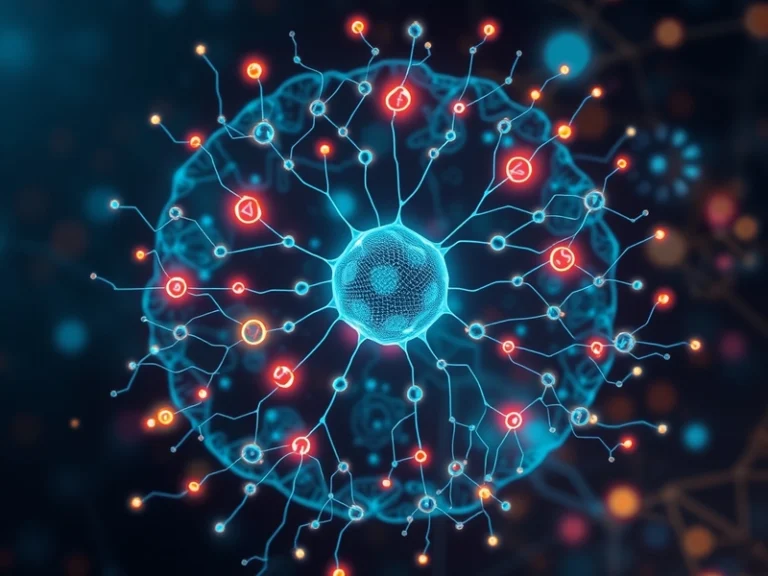
- Network Inference and Analysis: Many cellular processes are governed by intricate regulatory networks. Machine learning, particularly graph neural networks, can be used to infer these networks from observational data, identifying central nodes or “hubs” that act as critical control points – the cellular switches. Disrupting these hubs can have cascading effects on the entire network.
- Feature Selection and Dimensionality Reduction: Biological datasets often contain many features that are irrelevant or redundant. AI techniques can help pinpoint the most informative genes, proteins, or regulatory elements that are truly predictive of disease, reducing noise and focusing research efforts.
- Predictive Modeling: Beyond identifying switches, ML models can be trained to predict the impact of altering these switches, or to forecast disease progression, patient response to therapy, or even susceptibility to certain cancer types based on an individual’s molecular profile.
The “cellular switches” in question are often specific genes, transcription factors, signaling proteins, or microRNAs whose activity can dramatically alter a cell’s fate. For instance, a particular transcription factor might act as a switch, turning on a cascade of genes that promote cell proliferation, while another might suppress tumor growth. Identifying these switches is crucial because they represent potential therapeutic targets. If researchers can understand what turns these switches on or off in cancer cells, they can develop drugs to precisely manipulate them, ideally without harming healthy cells.
Researchers at institutions like Cornell are leveraging a diverse array of biological data types. This includes bulk and single-cell RNA sequencing data to measure gene expression, ATAC-seq for chromatin accessibility, ChIP-seq for transcription factor binding, and mass spectrometry data for protein abundance and post-translational modifications. Integrating these disparate data sources is another challenge where AI proves invaluable, allowing for a more holistic view of cellular states.
Challenges and the Path Forward
Despite the immense promise, the application of AI in discovering cellular switches is not without its hurdles. One significant challenge lies in the quality and heterogeneity of biological data. Noise, missing values, and batch effects can confound even the most sophisticated algorithms. Furthermore, the “black box” nature of some complex deep learning models can make it difficult for biologists to interpret the underlying biological mechanisms discovered by the AI, hindering the generation of testable hypotheses.
Another critical aspect is the distinction between correlation and causation. While AI can identify strong correlations between molecular patterns and disease states, experimental validation in wet labs remains indispensable to establish causal relationships. This often involves techniques like CRISPR-Cas9 gene editing to precisely manipulate identified switches and observe their effects on cell behavior in controlled environments.
The work emerging from Cornell and other leading research institutions underscores a broader shift towards interdisciplinary collaboration. Computational biologists, machine learning engineers, and experimental oncologists are working hand-in-hand to bridge the gap between abstract algorithms and tangible biological insights. By effectively harnessing the power of AI, these teams are accelerating the pace of discovery, moving closer to a future where cancer diagnosis is earlier, treatments are more precise, and personalized medicine becomes a widespread reality.