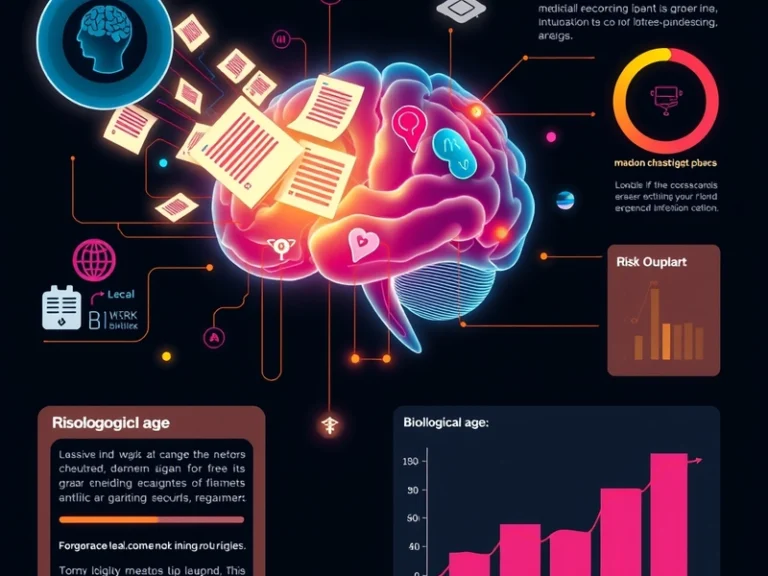
Artificial intelligence is increasingly being deployed to analyze complex medical records, enabling the estimation of a patient’s biological age and the prediction of future health risks with a growing degree of accuracy. This capability moves beyond simple chronological age, offering a more nuanced understanding of an individual’s physiological state and potential health trajectory.
Unlike chronological age, which simply counts the years since birth, biological age reflects the functional and structural integrity of an individual’s tissues and organs. It’s a measure of how well a person’s body is aging at a cellular and systemic level. For example, a 50-year-old individual might have a biological age of 40 due to healthy lifestyle choices and genetics, while another 50-year-old might exhibit a biological age of 60 due to various health factors. This discrepancy is where AI finds its utility, by identifying the subtle markers that distinguish these different aging processes.
How AI Uncovers Biological Age
The core of this AI application lies in advanced machine learning models, particularly deep learning, which are trained on vast datasets of electronic health records (EHRs). These models are adept at identifying intricate patterns and correlations within multimodal data that are often imperceptible to human analysis alone. The process typically involves several key steps:
- Data Collection and Aggregation: AI systems ingest a wide array of de-identified patient data from EHRs. This includes demographic information, detailed medical history, diagnoses (e.g., ICD-10 codes), medication lists, and lifestyle indicators if available.
- Biomarker Extraction: The models focus on various biological markers. These can range from routine blood test results (e.g., cholesterol levels, glucose, C-reactive protein, white blood cell count, liver and kidney function tests) to more specialized measurements. Imaging data, such as MRI or CT scans, can also provide structural insights into organ health.
- Pattern Recognition and Model Training: Deep learning algorithms, often convolutional neural networks (CNNs) for imaging data or recurrent neural networks (RNNs) and transformer models for time-series clinical data, learn to associate specific combinations and trends in these biomarkers with known health outcomes and chronological age. The models are trained to predict chronological age from these biological markers, and the residual error or divergence from actual age often serves as a proxy for biological age.
- Risk Stratification: Beyond estimating biological age, the models are further trained to correlate these biological age estimates with the likelihood of developing various age-related diseases, such as cardiovascular disease, type 2 diabetes, certain cancers, and neurodegenerative conditions like Alzheimer’s disease.
Researchers at institutions like Stanford University and Google Health have published studies exploring the use of AI to predict health outcomes and age-related conditions from EHR data, demonstrating the feasibility and potential impact of these approaches. While specific commercial products are still emerging and undergoing rigorous validation, the foundational research consistently points towards the efficacy of AI in this domain.
The Value Proposition: Personalized Health and Proactive Care
The ability of AI to accurately assess biological age and forecast health risks holds significant promise for transforming healthcare:
Personalized Medicine
By understanding a patient’s true physiological age, healthcare providers can move towards more personalized treatment plans and preventative strategies. Instead of applying blanket guidelines based solely on chronological age, interventions can be tailored to an individual’s actual biological state. This could mean recommending specific screenings earlier for someone with an accelerated biological age or deferring certain interventions for those whose bodies are aging more slowly.
Early Disease Detection and Prevention
One of the most compelling benefits is the potential for early detection of disease risk. If AI identifies a significant disparity between a patient’s chronological and biological age, it can flag them as being at higher risk for age-related conditions before symptoms even appear. This early warning system allows for proactive lifestyle modifications, targeted diagnostic tests, and preventative treatments, potentially delaying or even preventing the onset of serious illnesses.
Optimized Clinical Trials and Drug Development
In pharmaceutical research, AI-derived biological age could help identify more homogeneous patient cohorts for clinical trials. By selecting participants based on their biological aging profile, researchers might be able to more accurately assess drug efficacy and develop therapies that target specific aging mechanisms, rather than relying solely on chronological age as an inclusion criterion.
Challenges and Ethical Considerations
While the potential benefits are substantial, the deployment of AI in determining biological age also presents several challenges and ethical dilemmas that warrant careful consideration:
- Data Privacy and Security: The use of extensive medical records necessitates robust data governance, anonymization techniques, and stringent cybersecurity measures to protect sensitive patient information from breaches and misuse.
- Algorithmic Bias: AI models are only as unbiased as the data they are trained on. If training datasets do not adequately represent diverse populations, the models could perpetuate or even amplify existing health disparities, leading to inaccurate biological age assessments or risk predictions for certain demographic groups.
- Interpretability and Explainability: Many deep learning models operate as “black boxes,” making it difficult for clinicians to understand precisely why a particular biological age or risk prediction was generated. For clinical adoption, explainable AI (XAI) is crucial, allowing healthcare professionals to trust and validate the model’s outputs.
- Ethical Implications: The knowledge of one’s biological age could have profound personal and societal implications. Questions arise regarding how this information might be used by insurance companies, employers, or even for personal decision-making, and what protections are needed to prevent discrimination or undue psychological burden.
- Regulatory Oversight: As these AI tools become more sophisticated, regulatory bodies such as the U.S. Food and Drug Administration (FDA) will need to establish clear guidelines for their validation, approval, and safe deployment in clinical settings, ensuring accuracy, reliability, and patient safety.
The integration of AI into medical record analysis for biological age determination is a rapidly evolving field. As research progresses and computational capabilities advance, these tools are poised to become an increasingly integral part of personalized medicine, offering unprecedented insights into individual health and aging processes.