The ambitious long-term objective of interstellar exploration, particularly the quest to reach Alpha Centauri, humanity’s closest stellar neighbor, is increasingly leveraging artificial intelligence across multiple critical domains, transforming theoretical pathways into tangible engineering challenges.
While a direct, AI-piloted mission to Alpha Centauri remains a distant prospect, AI is proving indispensable in laying the groundwork for such endeavors. From discerning distant exoplanets to optimizing propulsion concepts and enabling autonomous mission operations, AI is becoming a foundational technology for the journey ahead.
Charting the Cosmos: AI in Exoplanet Discovery
One of the initial hurdles for interstellar travel is identifying viable targets. The Alpha Centauri system, comprising three stars including Proxima Centauri with its known exoplanet Proxima Centauri b, is a primary candidate. AI and machine learning algorithms are crucial in sifting through the immense datasets generated by space telescopes like NASA’s Kepler and Transiting Exoplanet Survey Satellite (TESS), and the James Webb Space Telescope (JWST).
- Data Analysis: AI systems can detect subtle dips in starlight (transits) or minute wobbles in stellar motion (radial velocity) that indicate the presence of exoplanets, often identifying patterns that might elude human observers. This capability is vital for confirming and characterizing planets within systems like Alpha Centauri.
- Atmospheric Characterization: Post-detection, AI assists in analyzing spectroscopic data from instruments like the JWST to infer the atmospheric compositions of these distant worlds, searching for biosignatures or conditions suitable for life.
This automated analysis accelerates the pace of discovery and refines our understanding of potential destinations, helping to prioritize targets for future missions.
Engineering the Journey: Propulsion and Mission Design
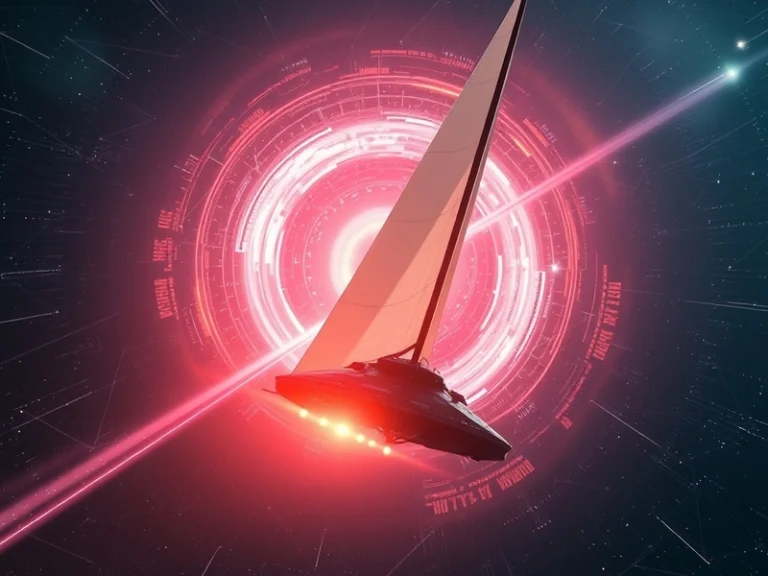
Reaching Alpha Centauri, located approximately 4.37 light-years away, within a human lifetime demands propulsion technologies far beyond current capabilities. Initiatives like Breakthrough Starshot, co-founded by Yuri Milner and Stephen Hawking, envision sending gram-scale “nanocraft” propelled by powerful ground-based lasers to a fraction of the speed of light. AI plays a critical role in optimizing such radical concepts:
- Light Sail Optimization: Designing ultra-lightweight, highly reflective light sails capable of withstanding immense laser power and navigating interstellar dust requires intricate simulations. AI can explore vast parameter spaces for sail materials, shapes, and deployment strategies to maximize efficiency and resilience.
- Trajectory Planning: Interstellar trajectories are complex, accounting for gravitational fields, relativistic effects, and potential hazards. AI algorithms can model and optimize paths for minimal travel time, energy expenditure, and risk avoidance, a task that becomes exponentially harder with increasing mission complexity and duration.
- Advanced Propulsion Research: Beyond light sails, AI is also contributing to the theoretical and experimental work on other advanced propulsion systems, such as fusion propulsion. Machine learning models assist in predicting plasma behavior in fusion reactors, a necessary step towards harnessing the power for interstellar voyages.
Autonomous Operations for Deep Space Probes
An interstellar mission would span decades or even centuries, making real-time human command and control impractical due to vast distances and light-speed communication delays. Future probes must be highly autonomous. AI is foundational for:
- Self-Navigation and Course Correction: Probes will need to autonomously detect and avoid interstellar obstacles, perform precise trajectory adjustments, and navigate complex stellar systems without human intervention. Technologies developed for NASA’s Mars rovers, such as the autonomous navigation capabilities on Perseverance, represent early precursors to this level of autonomy.
- Intelligent Data Acquisition: Onboard AI systems can analyze scientific data in real-time, prioritizing what to transmit back to Earth, compressing information efficiently, and even making decisions on which experiments to run based on unexpected discoveries. This ensures that the most valuable data is captured and sent, even with limited bandwidth.
- Fault Detection and Resilience: The harsh environment of deep space demands robust systems. AI can monitor spacecraft health, detect anomalies, diagnose failures, and initiate self-repair or recovery protocols, extending the operational lifespan of a probe far beyond what’s currently possible.
As humanity continues to gaze at Alpha Centauri, the role of artificial intelligence in every facet of future interstellar exploration will only grow. It is not merely a tool but an integral partner in solving the monumental challenges posed by venturing beyond our solar system, transforming audacious dreams into achievable engineering goals.