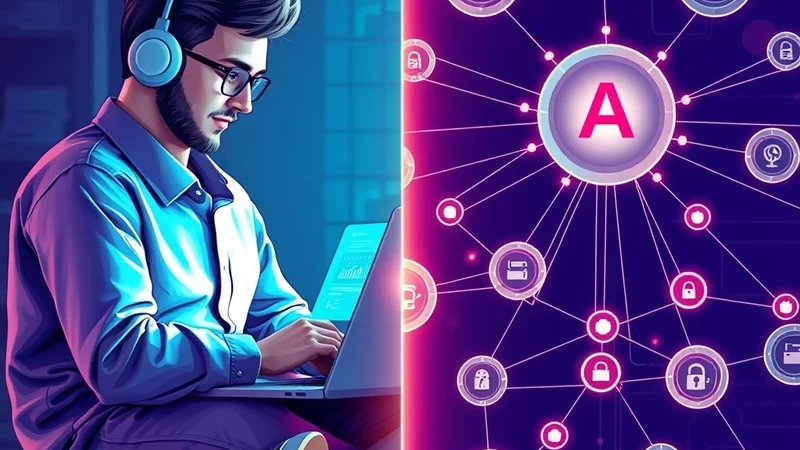
The integration of artificial intelligence into daily workflows is profoundly reshaping the professional landscape for tech workers, influencing their roles, required skills, and overall workplace dynamics. This transformation is not merely about adopting new tools, but about a fundamental shift in how tech professionals perceive their value, productivity, and future in an increasingly AI-driven environment.
The New Co-worker: AI as an Augmentation Tool
For many in the technology sector, AI has rapidly transitioned from a theoretical concept to a practical co-worker. Tools leveraging large language models (LLMs) and machine learning are now commonplace, assisting with tasks ranging from code generation and debugging to data analysis and content creation. This widespread adoption has led to a dominant perception among many tech workers that AI serves primarily as an augmentation tool rather than a direct replacement.
Common applications of AI in tech roles include:
- Code Completion and Generation: Platforms like GitHub Copilot assist developers by suggesting lines of code, functions, or even entire blocks based on context, significantly speeding up development cycles.
- Automated Testing and Debugging: AI-powered tools can identify potential bugs, suggest fixes, and generate test cases, reducing the manual effort involved in quality assurance.
- Data Analysis and Insights: AI algorithms can process vast datasets, identifying patterns and generating reports that would take human analysts considerably longer, enabling faster decision-making.
- Content and Documentation Generation: LLMs can draft technical documentation, summarize research papers, or generate boilerplate code comments, freeing up engineers for more complex problem-solving.
- Customer Support and IT Operations: AI chatbots and intelligent automation handle routine queries and system monitoring, allowing human staff to focus on critical incidents and complex issues.
This augmentation often leads to a perception of enhanced productivity. Developers report spending less time on repetitive coding tasks, allowing them to dedicate more focus to architectural design, complex problem-solving, and creative innovation. Data scientists can iterate through models more quickly, and IT professionals can manage infrastructure with greater efficiency.
A Shifting Skill Landscape
The rise of AI has necessitated a re-evaluation of essential skills for tech workers. While foundational programming, analytical, and problem-solving abilities remain critical, new competencies are emerging as paramount. Tech professionals are increasingly finding that their value lies not just in their ability to execute tasks, but in their capacity to effectively interact with, guide, and critically evaluate AI systems.
Key skills gaining prominence include:
- Prompt Engineering: The ability to craft precise, effective prompts to elicit desired outputs from generative AI models is becoming a crucial skill for developers, data analysts, and even designers.
- AI Output Validation and Oversight: Tech workers must develop strong critical thinking to assess the accuracy, relevance, and potential biases of AI-generated content or code. Relying solely on AI outputs without human verification can lead to errors or security vulnerabilities.
- Understanding AI Limitations and Capabilities: A deep understanding of what AI can and cannot do, its underlying principles, and its potential failure modes is essential for responsible and effective integration.
- Ethical AI Application: As AI becomes more powerful, tech workers are increasingly expected to consider the ethical implications of their work, ensuring fairness, transparency, and privacy in AI system design and deployment.
- Interdisciplinary Collaboration: With AI automating routine tasks, human collaboration often shifts to higher-level strategic discussions, requiring strong communication and teamwork skills across different domains.
This shift underscores a move away from purely execution-focused roles towards ones that emphasize oversight, strategic thinking, and human-AI collaboration.
Navigating the Undercurrents: Concerns and Challenges
Despite the perceived benefits, the integration of AI is not without its anxieties and challenges within the tech workforce. Concerns about job security, the reliability of AI, and the potential for skill degradation are frequently discussed.
Prominent challenges and concerns include:
- Job Displacement Fears: While many view AI as an augmentative tool, a significant segment of the workforce, particularly those in more standardized or entry-level roles, harbors concerns about job displacement. The efficiency gains brought by AI could lead to a reduction in demand for certain types of manual or repetitive tech tasks.
- “AI Hallucinations” and Quality Control: Generative AI models, while powerful, can produce factually incorrect or nonsensical outputs—colloquially known as “hallucinations.” This necessitates rigorous human review, adding a layer of complexity to quality assurance processes and potentially slowing down workflows if not managed effectively.
- Maintaining Code Quality and Best Practices: While AI can generate code rapidly, ensuring that it adheres to established coding standards, security protocols, and architectural best practices requires human oversight and potential refactoring.
- Skill Degradation and Over-reliance: There is a concern that over-reliance on AI tools for fundamental tasks could lead to a degradation of core technical skills over time. For instance, developers might become less proficient in writing boilerplate code if AI always handles it.
- Data Privacy and Security: Using AI tools, especially those that process proprietary code or sensitive data, raises important questions about data privacy, intellectual property, and cybersecurity risks.
These concerns highlight the ongoing need for companies to develop clear policies around AI usage, invest in reskilling programs, and foster a culture of responsible AI adoption that balances efficiency with ethical considerations and human expertise.
The Evolving Tech Professional
The impact of AI on workplace dynamics in the tech sector is leading to a redefinition of what it means to be a tech professional. The role is evolving from one primarily focused on execution and manual coding to one that emphasizes critical thinking, strategic orchestration of AI tools, and the application of uniquely human attributes like creativity, empathy, and complex problem-solving. Tech workers are increasingly becoming “AI whisperers,” “AI validators,” and “AI architects,” leveraging intelligent systems to amplify their capabilities and tackle challenges previously deemed intractable. This ongoing transformation underscores a dynamic interplay where human ingenuity guides artificial intelligence, shaping the next era of technological innovation.