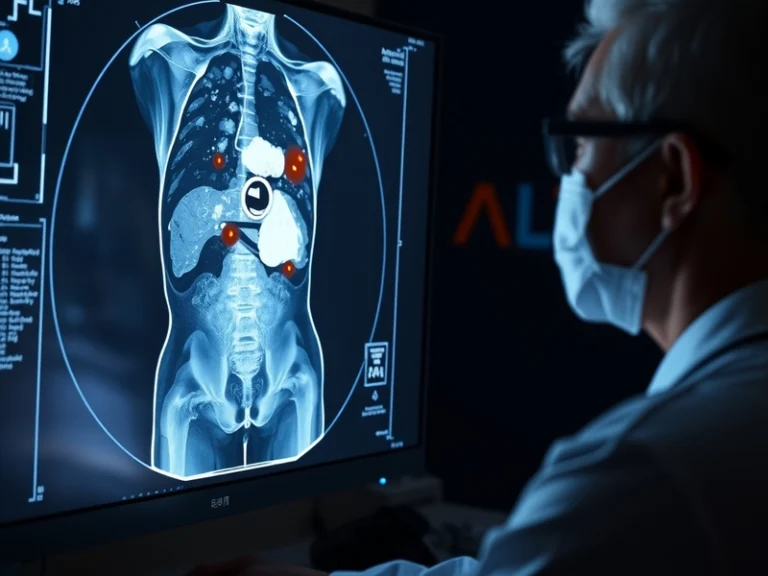
Alibaba has open-sourced an artificial intelligence model aimed at enhancing the diagnosis of abdominal conditions through medical imaging, signaling a strategic move to democratize advanced diagnostic tools in healthcare. This initiative seeks to empower medical professionals and researchers globally by providing access to sophisticated AI capabilities for analyzing complex radiological data.
The application of AI in medical imaging has emerged as a critical area of innovation, addressing the growing demand for accurate, consistent, and timely diagnoses. Radiologists and clinicians often face a high volume of images, such as CT scans, MRIs, and ultrasounds, which require meticulous examination to detect subtle anomalies indicative of various abdominal pathologies. Conditions ranging from tumors and inflammation to organ abnormalities and vascular issues can be challenging to identify early and consistently across diverse clinical settings. AI models, particularly those leveraging deep learning, offer the potential to augment human expertise by rapidly processing images, highlighting regions of interest, and quantifying changes that might otherwise be overlooked or require extensive manual analysis.
Alibaba’s Broader AI Commitment
Alibaba Group, through its cloud computing arm Alibaba Cloud and its research institute DAMO Academy, has consistently invested heavily in artificial intelligence research and development across various sectors. Their work spans natural language processing, computer vision, speech recognition, and intelligent decision-making, with many of these technologies finding applications in enterprise solutions, e-commerce, logistics, and smart cities. The company has also demonstrated a commitment to open science and open-source initiatives, frequently releasing datasets, frameworks, and models to foster innovation and collaboration within the global tech community. This latest open-source release in medical imaging aligns with this broader strategy, extending its impact into critical areas of public health.
The Impact of Open-Sourcing AI in Healthcare
Open-sourcing an AI model for medical diagnosis carries several significant implications, particularly in a field as sensitive and regulated as healthcare.
- Accelerated Adoption and Innovation: By making the model freely available, Alibaba enables a wider community of researchers, developers, and healthcare providers to integrate, test, and build upon the technology. This can accelerate the pace of innovation, allowing for rapid iteration and adaptation to diverse clinical needs and regional specificities.
- Democratization of Technology: High-end AI diagnostic tools often come with substantial costs and require significant computational resources. Open-sourcing can lower the barrier to entry for smaller hospitals, clinics, and research institutions, particularly in underserved regions, allowing them to leverage advanced AI capabilities without prohibitive licensing fees.
- Enhanced Transparency and Trust: In medical AI, the “black box” problem—where the decision-making process of an AI model is opaque—is a significant concern. Open-sourcing allows for greater scrutiny of the model’s architecture, algorithms, and training methodologies. This transparency can help build trust among clinicians and regulators, fostering a better understanding of the model’s strengths and limitations.
- Community-Driven Improvement: An open-source model can benefit from contributions from a global community of experts. Researchers can identify areas for improvement, suggest optimizations, and even contribute code to enhance the model’s performance, robustness, and generalizability across different patient populations and imaging modalities.
- Facilitating Research and Benchmarking: The availability of a well-documented, open-source model provides a standardized baseline for comparative research. This allows other researchers to benchmark new techniques against a known standard, fostering healthy competition and driving further advancements in the field.
Technical Considerations and Clinical Integration
While specific technical details of Alibaba’s newly open-sourced model are not publicly detailed, such AI systems typically employ sophisticated deep learning architectures, such as convolutional neural networks (CNNs), which are trained on vast datasets of annotated medical images. These models learn to identify patterns, segment organs, detect lesions, and quantify disease progression. For abdominal imaging, this could involve:
- Automated detection and characterization of liver lesions.
- Identification of inflammatory bowel disease indicators.
- Assessment of kidney abnormalities or pancreatic cysts.
- Measurement of organ volumes and fat distribution.
Integrating these AI tools into clinical workflows is a complex process. It requires careful consideration of data privacy, compliance with regulatory standards (such as HIPAA in the United States or GDPR in Europe), and rigorous clinical validation to ensure safety and efficacy in real-world settings. AI models are intended to be assistive tools, not replacements for human clinicians, and their deployment necessitates robust human oversight and clear guidelines for interpretation and decision-making.
Alibaba’s decision to open-source its AI model for abdominal medical imaging marks a significant contribution to the broader healthcare AI ecosystem. By fostering collaboration and democratizing access to advanced diagnostic capabilities, this initiative has the potential to accelerate research, improve diagnostic accuracy, and ultimately benefit patient care globally.