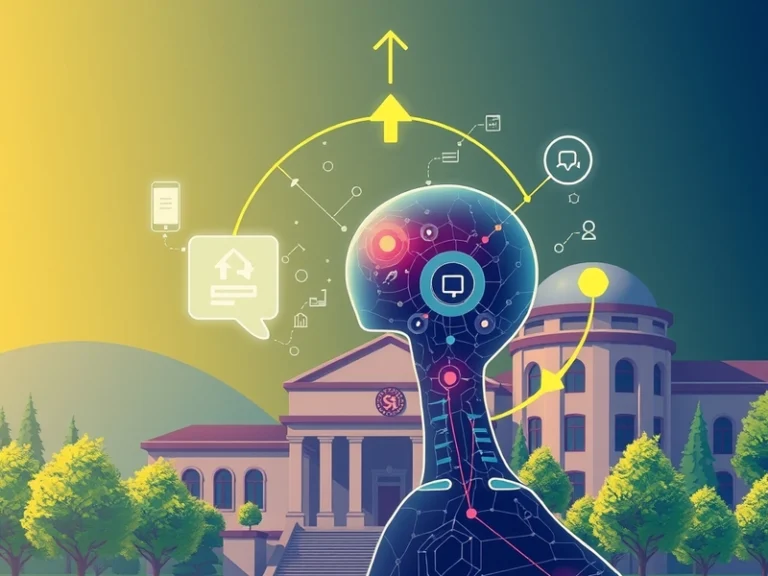
Researchers at Stanford University are significantly advancing the field of self-improving AI agents, focusing on how these systems can learn and adapt their strategies through sophisticated feedback loops.
The concept of an AI agent that can autonomously refine its own operational strategies marks a critical evolution beyond static, pre-programmed or even traditionally trained models. Instead of merely executing a set of instructions or applying a fixed policy learned during an initial training phase, self-improving agents are designed to continuously evaluate their performance, identify shortcomings, and modify their internal mechanisms or decision-making processes in real-time. This capability is paramount for AI systems operating in dynamic, unpredictable environments where pre-computation of every possible scenario is infeasible.
The Mechanism of Feedback Loops
At the core of self-improvement lies the feedback loop. For AI agents, this typically involves several stages:
- Execution: The agent performs an action or a sequence of actions in its environment.
- Observation: The agent perceives the outcome of its actions and the resulting state of the environment. This might involve sensory data, task completion metrics, or external rewards/penalties.
- Evaluation: The observed outcomes are compared against desired goals or benchmarks. This evaluation often involves an internal “critic” or a reward function that quantifies the success or failure of the agent’s strategy.
- Adaptation: Based on the evaluation, the agent modifies its internal model, policy, or strategy to improve future performance. This adaptation can range from adjusting parameters in a neural network to altering the very structure of its decision-making logic.
These loops are not always simple. They can be nested, multi-modal, and involve various forms of feedback, including direct environmental signals, human input, or even introspective self-reflection where the agent simulates outcomes or analyzes its own internal states.
Reinforcement Learning and Meta-Learning Architectures
Much of Stanford’s work in this area builds upon advanced principles of reinforcement learning (RL), where agents learn optimal policies by maximizing cumulative rewards through trial and error. However, self-improving agents push beyond standard RL by incorporating meta-learning capabilities—the ability to “learn to learn.” This means the agent doesn’t just learn a specific task; it learns how to acquire new skills or adapt its learning process itself, making it more efficient at tackling novel problems or changing environments.
Key areas of focus include:
- Robust Reward Design: Developing reward functions that accurately guide agents towards desired complex behaviors without leading to unintended side effects or local optima.
- Efficient Exploration: Strategies for agents to explore their environment effectively to discover new, better strategies without wasting excessive computational resources or incurring high risks.
- Generalization Across Tasks: Enabling agents to apply learned self-improvement strategies to a wide range of tasks, rather than being confined to the specific domain they were trained in.
- Long-Term Memory and Knowledge Transfer: Mechanisms for agents to retain and leverage past experiences and learned strategies across extended periods and diverse scenarios.
Implications for AI Systems
The development of truly self-improving AI agents has profound implications for a multitude of applications. In robotics, for instance, a robot could adapt its manipulation strategies to handle novel objects or navigate unforeseen terrain without human intervention. In autonomous vehicles, agents could learn from near-misses or unusual traffic patterns to enhance safety protocols. For complex scientific simulations or drug discovery, agents could iteratively refine experimental designs based on real-time data, accelerating research.
Stanford’s contributions to this field are particularly significant given its long-standing history of innovation in AI, robotics, and machine learning. Researchers at the university have consistently pushed the boundaries of what autonomous systems can achieve, from foundational work in planning and reasoning to cutting-edge research in multi-agent systems and deep reinforcement learning. Their current efforts underscore a broader shift in AI research toward creating more autonomous, resilient, and adaptable intelligent systems.
While the promise is immense, challenges remain. Ensuring the safety and reliability of agents that can autonomously change their behavior is paramount. Debugging and understanding the internal logic of such agents can be complex, and the computational resources required for continuous self-improvement can be substantial. Nevertheless, the ongoing research at institutions like Stanford suggests a future where AI systems are not just intelligent, but also inherently adaptive and capable of evolving their own intelligence.