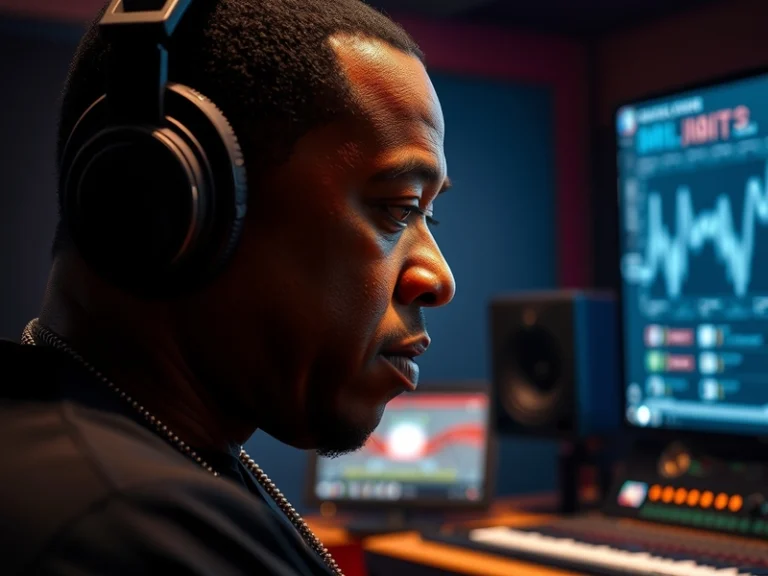
Legendary music producer and artist Dr. Dre has publicly affirmed his embrace of artificial intelligence tools in music production, highlighting their potential to reshape the creative process and workflow for artists. This endorsement from one of music’s most influential and meticulous producers signals a significant moment for AI integration within the industry, moving it from speculative innovation to a practical tool for established hitmakers.
Dr. Dre, renowned for his groundbreaking work with N.W.A, Death Row Records, and Aftermath Entertainment, and for shaping the sound of hip-hop and popular music for decades, has always been an innovator in the studio. His signature sound is characterized by crisp drums, deep basslines, and meticulously crafted arrangements. His willingness to integrate AI into his process underscores a pragmatic approach to technology, viewing it as an extension of the producer’s toolkit rather than a replacement for human creativity.
During a November 2023 interview on Kevin Hart’s show Hart to Heart, Dr. Dre elaborated on his use of AI, specifically mentioning its utility in “cleaning up sounds” and generally making the production process “a lot easier.” This perspective aligns with current applications of AI in audio engineering, which often focus on enhancing existing material and streamlining complex tasks.
AI’s Role in Dr. Dre’s Production Philosophy
For a producer like Dr. Dre, whose work is synonymous with sonic perfection and intricate layering, AI’s utility likely extends across several key areas of the music production pipeline:
- Audio Restoration and Enhancement: Dr. Dre’s extensive use of samples throughout his career means dealing with audio from diverse sources and varying quality. AI-powered tools excel at noise reduction, de-reverberation, de-essing, and transient shaping, allowing producers to clean up raw audio, isolate elements, and enhance clarity. Products like iZotope’s RX suite offer advanced algorithms for spectral repair and dialogue isolation, which can be invaluable for refining samples or recorded vocals.
- Mixing and Mastering Assistance: AI-driven plugins and services are increasingly prevalent in the mixing and mastering stages. Tools can analyze a track’s dynamics, frequency balance, and stereo image, then suggest optimal settings for equalization, compression, and limiting. While a human engineer retains final creative control, AI can provide a sophisticated starting point or highlight areas for improvement, potentially accelerating the often-time-consuming process of achieving a polished, radio-ready sound. Services like LANDR, for instance, offer AI-powered mastering that provides quick, professional-sounding results.
- Creative Augmentation and Idea Generation: Beyond technical cleanup, AI can serve as a creative partner. Generative AI models can suggest melodic phrases, chord progressions, or drum patterns based on specified parameters. While Dr. Dre’s compositional prowess is undeniable, AI could offer fresh perspectives, help break creative blocks, or quickly generate variations on an idea, allowing for rapid prototyping and iteration in the studio.
- Workflow Optimization: Many aspects of music production involve repetitive or time-intensive tasks. AI can automate these, from intelligently tagging and organizing vast sample libraries to setting up initial mix templates based on genre analysis. This efficiency allows artists and producers to dedicate more time to the purely creative aspects of their work.
Implications for the Music Industry
Dr. Dre’s public embrace of AI carries significant weight. Historically, new technologies in music have often faced skepticism, only to become indispensable. From the advent of synthesizers and drum machines to digital audio workstations (DAWs) like Pro Tools and Logic Pro, each technological leap has reshaped the industry. Dre himself was an early adopter and master of digital sampling and sequencing with tools like the Akai MPC.
His endorsement helps to normalize AI as a legitimate and powerful tool, potentially encouraging other established artists and producers to explore its capabilities. This could accelerate the development and adoption of AI tools, driving innovation in audio software and hardware. It also frames AI not as a threat to artistic integrity, but as a sophisticated instrument that can augment human skill and vision.
However, the rapid integration of AI also raises ongoing discussions around copyright, authorship, and the ethical use of synthetic media. As AI models become more sophisticated at generating original music or mimicking existing styles, questions about intellectual property and the definition of “original work” will continue to evolve. For now, Dr. Dre’s approach appears to position AI primarily as a utility for refinement and efficiency, rather than a generative engine for entire compositions.
Dr. Dre’s perspective suggests that for seasoned professionals, AI is another powerful instrument in the studio, much like a new synthesizer or a groundbreaking microphone. It’s a tool to be mastered, integrated, and wielded to achieve an artistic vision, rather than a replacement for the unique human touch that defines legendary music.