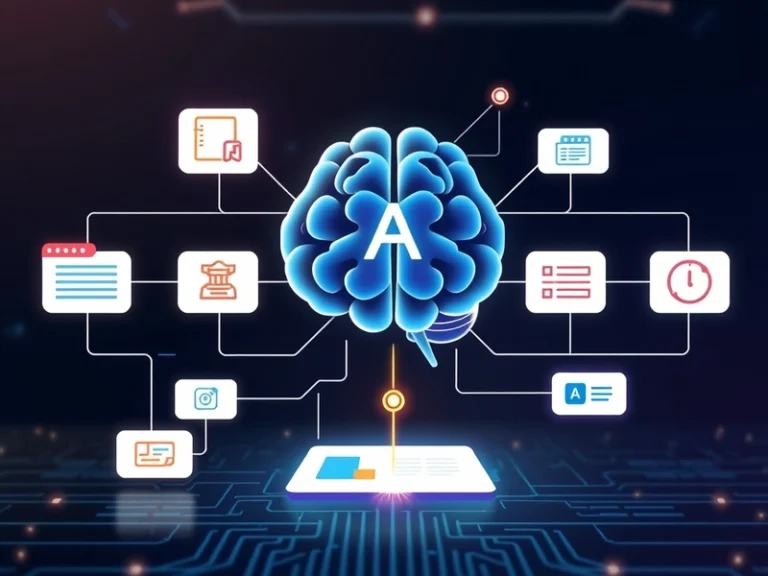
While xAI has not publicly announced a specific version designated as Grok 4.6, the capabilities implied by such a designation—advanced functionality in generating and self-checking project outcomes—represent a significant frontier in artificial intelligence development, one that cutting-edge models like Grok are actively exploring. The pursuit of AI systems capable of not just creating but also validating their own work is a critical step towards more autonomous and reliable AI agents.
The vision of an AI that can autonomously generate complex project outcomes, from software code to architectural designs or strategic plans, has long been a goal in the field. Current large language models (LLMs) have demonstrated impressive abilities in generating various forms of content and code based on prompts. However, the step from generation to reliable, executable, and validated output requires a sophisticated layer of self-assessment and correction.
AI-Driven Project Generation: Beyond Simple Prompts
Modern LLMs, including xAI’s Grok, are increasingly being employed in generative tasks that extend beyond simple text completion. These include:
- Code Generation: From writing functions in Python to entire web application components, LLMs can translate natural language requirements into functional code.
- Content Creation: Generating reports, marketing copy, technical documentation, and even creative prose.
- Design and Planning: Assisting in UI/UX design, drafting project plans, or outlining research methodologies.
The challenge with these outputs often lies in their reliability and correctness. A generated piece of code might contain subtle bugs, a marketing report might misinterpret data, or a project plan might overlook critical dependencies. This is where the concept of “self-checking” becomes indispensable.
The Imperative of Self-Correction and Validation
For an AI to move beyond being a sophisticated assistant to a truly autonomous agent, it must possess mechanisms to evaluate its own output against defined criteria or external feedback. This involves several advanced techniques:
- Internal Consistency Checks: The AI can be prompted to review its own generated output for logical flaws, contradictions, or adherence to initial constraints. For example, after generating code, it might perform a static analysis or dry run through its logic.
- Tool Use and External Verification: Advanced LLMs can be integrated with external tools to validate their work. For instance, a model generating code might use a compiler or interpreter to check for syntax errors and runtime exceptions. A model generating a report might query a database or API to cross-reference facts.
- Iterative Refinement through Feedback Loops: Instead of a single-shot generation, the AI can engage in a multi-step process. It generates an output, evaluates it, identifies areas for improvement, and then revises the output. This loop can be driven by internal reasoning or by comparing its output against a set of test cases or success metrics.
- Multi-Agent Architectures: Some research explores using multiple AI agents, where one agent generates an outcome and another (or several others) act as critics or validators, identifying weaknesses or suggesting improvements. This mimics a collaborative human team environment.
Models like Grok, known for their ability to access real-time information and engage in more dynamic reasoning, are well-positioned to leverage these self-checking mechanisms. The capacity to tap into current events or external data sources can significantly enhance an AI’s ability to validate the factual accuracy and relevance of its generated project outcomes.
Implications for AI Development and Real-World Applications
The development of AI systems with robust generation and self-checking capabilities holds profound implications:
- Increased Autonomy: Such systems could take on more complex tasks with less human oversight, moving from task execution to problem-solving.
- Enhanced Reliability: By automatically identifying and correcting errors, the quality and trustworthiness of AI-generated content and code would significantly improve.
- Faster Iteration Cycles: In software development, design, and research, AI could accelerate the prototyping and testing phases, leading to quicker innovation.
- Reduced Human Burden: Automating parts of the QA and verification process would free up human experts to focus on higher-level strategic work.
However, significant challenges remain. Ensuring the AI’s “understanding” of project goals aligns perfectly with human intent, preventing the propagation of subtle biases or hallucinations, and managing the computational resources required for iterative self-correction are active areas of research. As the AI landscape continues to evolve, the push towards models that can not only create but also critically evaluate their own creations will be a defining characteristic of the next generation of intelligent systems.