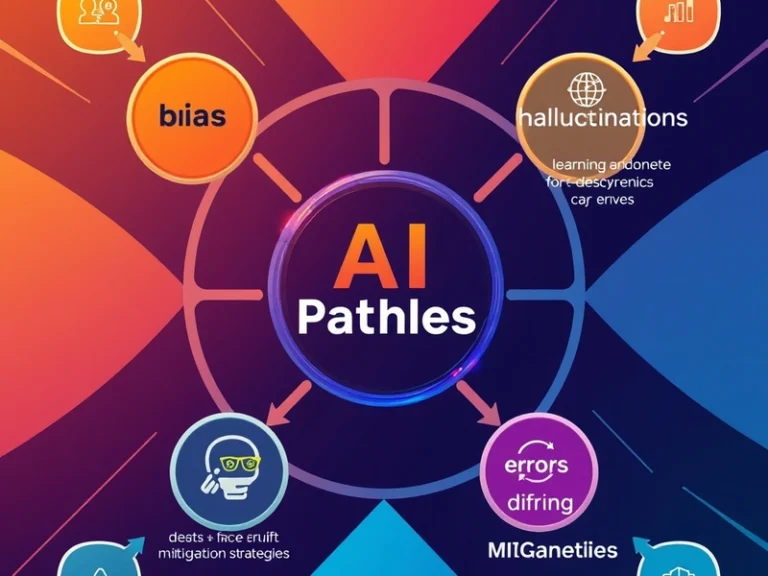
A new free learning course, titled “Understanding AI Missteps,” has been introduced, aiming to equip learners with insights into the common pitfalls and failures encountered in artificial intelligence systems.
As AI systems, particularly large language models (LLMs) and complex machine learning algorithms, become increasingly integrated into critical applications—from content generation to decision support—their inherent complexities introduce a range of potential errors. These missteps can vary widely, impacting the reliability, fairness, and overall trustworthiness of AI systems.
Common Categories of AI Missteps
Understanding the nature of these failures is crucial for developers, deployers, and users alike. The course likely addresses several prominent categories of AI missteps:
- Hallucinations: A frequent challenge with generative AI, where models produce plausible-sounding but factually incorrect or entirely fabricated information. These can range from minor inaccuracies to significant misinformation.
- Algorithmic Bias: AI systems learning and perpetuating biases present in their training data. This can lead to unfair or discriminatory outcomes in areas such as hiring, loan applications, or even criminal justice, reflecting societal biases rather than objective truth.
- Factual Errors and Inconsistencies: Beyond outright hallucinations, models can struggle with factual recall or logical consistency, providing contradictory statements or failing to accurately process specific information.
- Lack of Robustness and Adversarial Vulnerabilities: The susceptibility of AI models to subtle, often imperceptible, changes in input data that can lead to drastically different and incorrect outputs. This raises concerns for system security and reliability in adversarial environments.
- Overgeneralization or Underfitting: Models that either fail to generalize effectively to new, unseen data (underfitting) or are too specific to their training data and thus perform poorly in varied real-world scenarios (overgeneralization).
- Ethical and Societal Impacts: Missteps extending beyond purely technical errors to include unintended social consequences, privacy breaches, or misuse of AI capabilities due to poor design or deployment.
Addressing Missteps: Strategies and Learning Objectives
A core objective of such a course would be to dissect the root causes of these failures and explore effective mitigation strategies. Potential areas of focus could include:
- Data Quality and Curation: Emphasizing the critical role of clean, diverse, and representative training data in preventing bias and improving model accuracy. This involves techniques for identifying and addressing data imbalances or noise.
- Model Architecture and Training: Examining how different model architectures and training methodologies can influence susceptibility to errors, and exploring methods for more robust model design and evaluation.
- Explainable AI (XAI): Introducing concepts and techniques that allow developers and users to understand why an AI system made a particular decision or produced a specific output, thereby aiding in diagnosis and debugging of missteps.
- Robust Testing and Validation: Moving beyond standard accuracy metrics to incorporate more comprehensive testing protocols, including adversarial testing and stress testing, to uncover hidden vulnerabilities.
- Ethical AI Frameworks: Discussing the importance of integrating ethical considerations throughout the AI development lifecycle, from design to deployment, to anticipate and prevent harmful outcomes.
- Human-in-the-Loop Systems: Exploring how human oversight and intervention can complement AI systems, particularly in critical applications, to catch errors and ensure accountability.
Who Benefits?
This type of educational resource holds value for a broad audience invested in the responsible development and deployment of AI:
- AI Developers and Engineers: To build more robust, fair, and secure systems from the ground up.
- Data Scientists: To better understand the profound implications of their data choices and preprocessing techniques.
- Product Managers: To anticipate potential risks, manage user expectations, and design more resilient AI-powered products.
- Researchers and Academics: To inform future work on AI safety, reliability, and ethical governance.
- Policy Makers and Ethicists: To develop informed regulations, guidelines, and frameworks for AI.
- General Users and Stakeholders: To foster a more critical and informed understanding of AI capabilities and limitations in their daily lives and professions.
The availability of free educational content like “Understanding AI Missteps” underscores a growing recognition within the AI community of the urgent need for greater transparency, accountability, and reliability. As AI systems become more ubiquitous and impactful, a shared, in-depth understanding of their limitations and how to effectively address them is crucial. By demystifying the causes of AI failures, such courses contribute significantly to the collective effort to build more dependable and beneficial artificial intelligence for society.