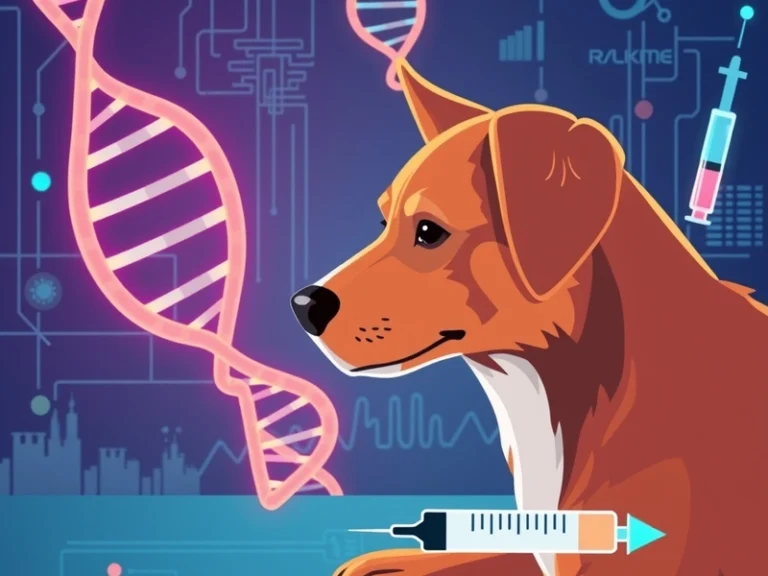
Artificial intelligence is being leveraged to design personalized messenger RNA (mRNA) cancer vaccines for dogs, marking a significant step forward in veterinary oncology and the application of computational genomics in medicine.
The development of personalized cancer vaccines for canines addresses a critical need. Cancer is a leading cause of death in dogs, affecting approximately one in four at some point in their lives. Many canine cancers, such as osteosarcoma, lymphoma, and melanoma, share genetic and biological similarities with human cancers, making dogs valuable models for studying disease progression and treatment responses. The ability to create highly specific, individualized treatments offers a promising avenue for improving outcomes for companion animals, while also potentially informing future human therapeutic strategies.
The Science of Personalized Cancer Vaccines
Unlike traditional vaccines that target infectious agents, cancer vaccines aim to train the immune system to recognize and attack cancer cells. The challenge lies in the fact that cancer cells originate from the body’s own cells and often evade immune surveillance. Personalized cancer vaccines overcome this by targeting neoantigens – novel proteins or protein fragments that are unique to tumor cells and arise from somatic mutations within the cancer’s DNA. Because these neoantigens are not present in healthy tissue, they can be ideal targets for an immune response without causing widespread autoimmune reactions.
mRNA vaccine technology, famously utilized during the COVID-19 pandemic, provides an agile platform for delivering these neoantigen instructions. Instead of injecting the neoantigens themselves, mRNA vaccines deliver genetic code that instructs the body’s cells to produce the specific neoantigen proteins. The immune system then recognizes these newly produced proteins as foreign, mounts a targeted response, and develops a “memory” to fight any cancer cells expressing them.
AI and Computational Genomics: Powering Precision
The creation of personalized mRNA cancer vaccines is a complex, multi-step process that relies heavily on computational genomics and, increasingly, advanced AI algorithms. Here’s how these technologies converge to enable such precision medicine:
- Tumor and Germline Sequencing: The process begins by obtaining tissue samples from a dog’s tumor and a healthy tissue sample (germline). These samples undergo whole-exome or whole-genome sequencing to map their complete genetic code.
- Somatic Mutation Identification: Computational genomics pipelines compare the tumor genome to the healthy germline genome. This comparison identifies somatic mutations – genetic alterations present only in the cancer cells. These mutations are the potential source of neoantigens.
- Neoantigen Prediction: This is a critical step where AI plays a pivotal role. Not all somatic mutations lead to immunogenic neoantigens. Machine learning models, trained on vast datasets of known mutations and immune responses, predict which specific mutations are likely to result in a protein fragment (peptide) that can bind to the dog’s major histocompatibility complex (MHC) molecules. MHC molecules present antigens on the cell surface, signaling to T-cells. Accurate MHC binding prediction is essential for triggering an effective T-cell response.
- Immunogenicity Scoring: Beyond just binding, AI algorithms can further score predicted neoantigens based on their likelihood of eliciting a strong immune response. Factors like peptide sequence, predicted binding affinity, and structural characteristics are analyzed to prioritize the most promising neoantigens for inclusion in the vaccine.
- mRNA Design and Optimization: Once a panel of optimal neoantigens is selected, their corresponding mRNA sequences must be designed. AI-driven tools assist in optimizing these mRNA sequences for stability, efficient translation into protein within the host cell, and reduced immunogenicity of the mRNA itself (to prevent premature degradation or unwanted innate immune responses).
By automating and refining these computationally intensive tasks, AI significantly accelerates the design process, allowing for the rapid turnaround necessary for personalized treatments. The ability of machine learning to identify subtle patterns in genomic data and predict complex biological interactions far surpasses what manual analysis could achieve, making these vaccines both feasible and highly targeted.
Implications for Veterinary and Human Medicine
The application of AI-designed personalized mRNA cancer vaccines in dogs holds profound implications. For veterinary medicine, it offers a novel, highly specific therapeutic option for cancers that are often difficult to treat with conventional methods like chemotherapy or radiation alone. By stimulating a dog’s own immune system, these vaccines could lead to more durable responses and potentially fewer side effects compared to systemic treatments.
Furthermore, the success of such approaches in canine patients could pave the way for advancements in human oncology. Given the biological similarities in cancer development and immune systems between dogs and humans, insights gained from canine clinical trials can directly inform human cancer research. The iterative refinement of AI algorithms for neoantigen prediction and mRNA design in veterinary settings could accelerate the development and optimization of similar personalized therapies for human cancer patients, bringing precision medicine closer to a broader reality.
While still an evolving field, the integration of AI and computational genomics in creating personalized mRNA cancer vaccines for dogs represents a powerful convergence of advanced technology and biological understanding, promising a future of more effective and tailored treatments for cancer across species.