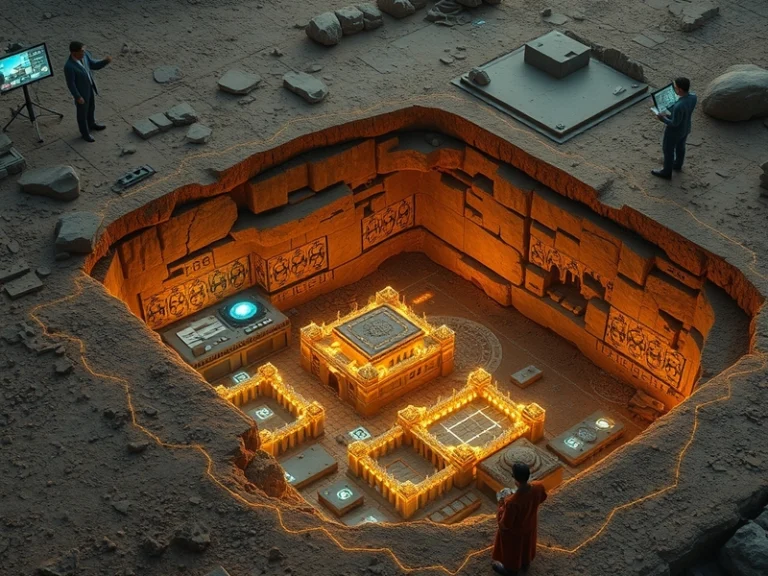
Archaeologists are increasingly leveraging artificial intelligence systems, specifically those trained on meticulously crafted simulated archaeological sites, to identify subtle features and patterns that might otherwise elude human observation in real-world data.
The challenge of archaeological discovery is multifaceted. Sites are often vast, buried, and obscured by centuries of natural and human activity. Traditional methods, while foundational, can be time-consuming, labor-intensive, and sometimes limited by the sheer volume and complexity of the data collected from remote sensing techniques like LiDAR, ground-penetrating radar (GPR), and aerial photography. This is where AI offers a compelling new avenue, particularly when conventional training data—large, labeled datasets of real archaeological features—is scarce.
The innovative approach centers on generating synthetic archaeological landscapes. Researchers create detailed digital models of ancient settlements, burial mounds, agricultural systems, and road networks, embedding them within simulated environments that mimic natural processes like erosion, vegetation growth, and sediment deposition. These simulations can vary parameters such such as the depth of burial, the material composition of structures, and the quality of the ‘survey’ data, producing a virtually endless supply of training examples. Each simulated scenario comes with a perfect “ground truth”—the exact location and nature of every buried feature—which is invaluable for supervised learning.
By training AI models, often sophisticated deep learning architectures like convolutional neural networks (CNNs), on these synthetic datasets, the systems learn to recognize the characteristic signatures of archaeological features under various conditions. This process allows the AI to develop a robust understanding of what a buried wall, a faint ditch, or a cluster of artifacts might look like in different types of remote sensing data, even when those features are highly degraded or obscured.
Once trained, these AI models can then be deployed to analyze real-world archaeological survey data. They sift through massive datasets from drone surveys, satellite imagery, and geophysical prospecting, flagging anomalies and potential features that align with the patterns they learned from the simulations. This capability is not about replacing human archaeologists but augmenting their ability to process information, prioritize areas for further investigation, and make discoveries more efficiently and non-invasively.
Advantages of AI in Archaeology
- Enhanced Detection: AI can identify patterns and anomalies that are too subtle or complex for the human eye to consistently discern across vast datasets.
- Increased Efficiency: Automating the initial analysis of remote sensing data significantly reduces the time and resources required, allowing archaeologists to focus on interpretation and excavation.
- Reduced Bias: AI models, when properly trained, can apply consistent criteria across all data, potentially reducing subjective biases inherent in human interpretation.
- Non-Invasive Exploration: By improving the accuracy of remote sensing interpretation, AI helps guide targeted excavations, minimizing disturbance to sensitive sites.
- Data Integration: AI can process and integrate diverse data types (e.g., LiDAR, GPR, magnetic surveys) to create a more comprehensive picture of subsurface features.
Current Limitations and Future Directions
While promising, the methodology faces challenges. The primary concern is the “reality gap”—how well do simulated ruins truly reflect the infinite complexity and unpredictability of actual archaeological sites? Factors like unique geological conditions, unusual preservation states, and unexpected human interventions are difficult to fully replicate synthetically. Therefore, human expert validation remains critical to interpret AI findings and prevent false positives.
Further research is focusing on making simulations more realistic, incorporating greater geological and environmental variability. There is also an emphasis on active learning approaches, where archaeologists provide feedback on AI-identified features, allowing the models to continuously refine their understanding of real-world data. The integration of these AI tools with advanced visualization platforms and geographic information systems (GIS) is also enhancing their utility, providing archaeologists with powerful new lenses through which to view and interpret the past. The future of archaeological discovery increasingly appears to be a collaborative endeavor between human expertise and intelligent computational systems.