Artificial intelligence tools are increasingly streamlining everyday tasks across a multitude of professional and personal domains, fundamentally shifting how individuals and organizations approach productivity.
The proliferation of accessible AI applications, particularly those leveraging large language models (LLMs) and advanced machine learning algorithms, has moved AI from specialized research labs into the hands of a broader user base. These tools are not merely automating simple, repetitive functions but are augmenting human capabilities in complex areas like content creation, data analysis, and software development.
AI in Communication and Content Creation
One of the most immediate impacts of AI is seen in communication and content generation. Tools powered by sophisticated LLMs can draft emails, summarize lengthy documents, generate marketing copy, and even assist in scriptwriting. This capability significantly reduces the time spent on initial drafts and can help overcome writer’s block, allowing users to focus on refining and personalizing the output.
- Writing Assistance: Platforms like OpenAI’s ChatGPT, Google’s Gemini, and Microsoft Copilot offer conversational interfaces that can generate text, translate languages, and answer complex queries, serving as powerful co-pilots for writers, marketers, and researchers.
- Meeting Summarization: Applications such as Zoom AI Companion and Otter.ai leverage AI to transcribe meetings in real-time and provide concise summaries, identifying key decisions and action items. This eliminates the need for manual note-taking and ensures critical information is captured.
- Email Management: AI-powered features within email clients can categorize incoming messages, suggest quick replies, and even draft full responses based on context, helping users manage overflowing inboxes more efficiently.
Enhancing Data Analysis and Information Retrieval
AI is also revolutionizing how individuals interact with and derive insights from data. Complex datasets that once required extensive manual processing or specialized statistical knowledge can now be analyzed with greater speed and accuracy through AI-driven tools.
For instance, AI can swiftly process vast amounts of unstructured text, extracting key entities, sentiments, and relationships. This is invaluable for market research, legal discovery, and academic literature reviews. Business intelligence platforms are integrating AI to provide more intuitive data visualization, predictive analytics, and automated report generation, making data-driven decision-making more accessible to non-technical users.
Creative Augmentation Across Disciplines
Beyond text and data, AI is making significant inroads into creative fields, acting as an assistant rather than a replacement. Artists, designers, and musicians are leveraging AI to explore new ideas and accelerate their creative workflows.
- Generative Art and Design: Tools like Midjourney, DALL-E 3, and Stable Diffusion allow users to generate images from text prompts, offering a rapid way to visualize concepts, create mood boards, or produce unique graphical assets. Graphic designers can use AI to automate repetitive tasks like background removal or image upscaling within software like Adobe Photoshop and Illustrator.
- Music Composition: AI-powered platforms can assist in generating melodies, harmonies, and even full compositions, providing inspiration or completing musical ideas based on user input.
- Video Production: AI is being used for automated video editing tasks, such as scene detection, object tracking, and even generating synthetic voiceovers or translating subtitles, streamlining post-production processes.
AI in Software Development and Personal Productivity
The impact of AI extends to highly technical domains and personal organization. Developers are finding AI indispensable for accelerating their coding processes, while everyday users benefit from smarter personal assistants.
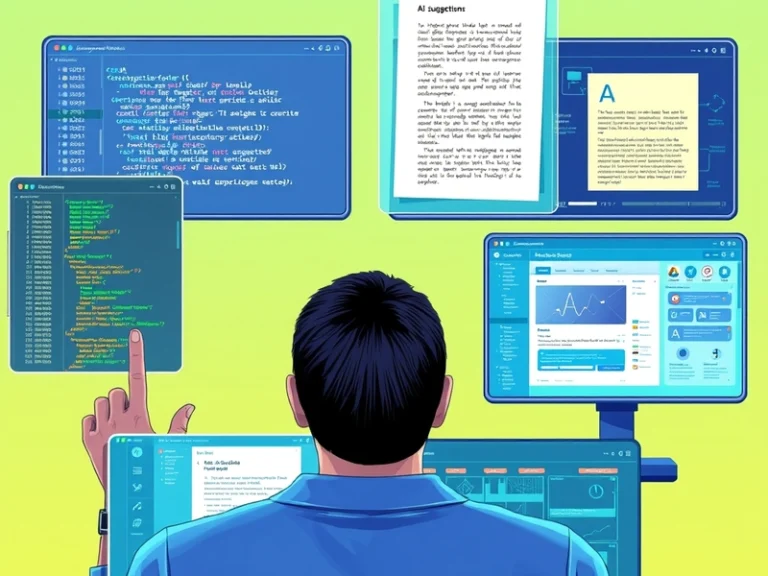
GitHub Copilot, for example, uses AI to suggest lines of code or entire functions as developers type, trained on vast repositories of public code. This not only speeds up development but can also help in learning new languages or APIs and identifying potential errors. AI is also being integrated into integrated development environments (IDEs) for smarter debugging and code refactoring suggestions.
On the personal front, AI is enhancing digital assistants like Apple’s Siri, Google Assistant, and Amazon Alexa, making them more capable of understanding complex commands, managing schedules, and integrating with smart home devices. Productivity applications like Notion AI and Evernote are incorporating AI to summarize notes, generate ideas, and organize information more intelligently, turning unstructured thoughts into actionable insights.
Considerations for Integration
While the benefits of these AI tools are evident, their effective integration requires mindful consideration. Issues such as data privacy, the potential for algorithmic bias, and the need for human oversight remain critical. Users and organizations must understand the limitations of current AI models and ensure that human judgment remains central, especially in tasks requiring nuanced understanding, ethical reasoning, or creative originality.
The ongoing evolution of AI promises even more sophisticated tools that will continue to redefine the boundaries of productivity. As these technologies mature, they are poised to become even more deeply embedded in the fabric of daily work and life, fostering environments where human creativity and strategic thinking can flourish, unburdened by mundane and repetitive tasks.