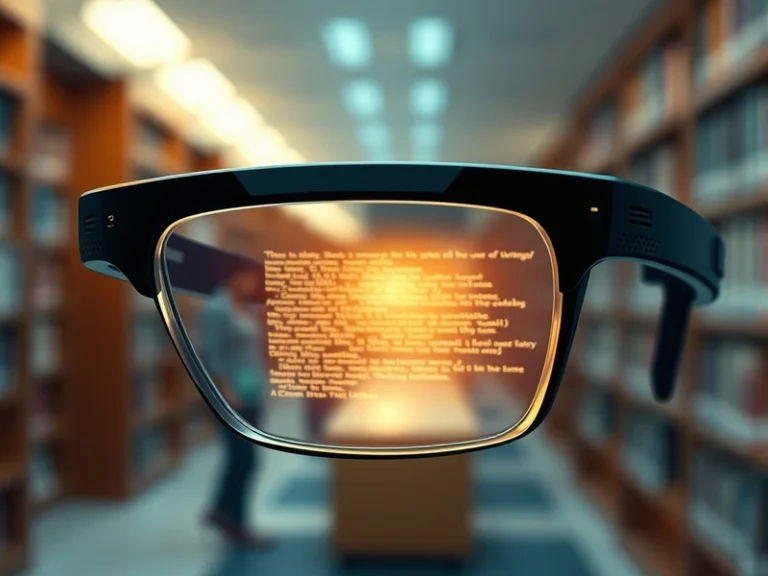
Innovative eyewear designed to convert subtle mouth movements into text, enabling silent communication in various environments, is rapidly advancing from research labs toward practical application. This emerging category of “subvocal glasses” represents a significant stride in human-computer interaction, aiming to provide a discreet and efficient method of input without the need for audible speech.
The core concept behind subvocal glasses builds upon decades of research into silent speech interfaces. Unlike traditional voice recognition systems that process audible sound waves, these devices analyze the minute muscle movements associated with speech, even when no sound is produced. When an individual silently “speaks” words, their vocal cords do not vibrate, but the muscles in their larynx, tongue, and lips still undertake distinct, measurable movements. It is these subtle bio-signals that subvocal systems aim to capture and interpret.
Typically, the technology in such glasses employs a combination of sensors and sophisticated artificial intelligence. Depending on the specific approach, these sensors might include:
- Electromyography (EMG) sensors: These detect the electrical impulses generated by muscle contractions in the jaw, throat, or face. While highly accurate, integrating these discreetly into eyewear requires careful design.
- Optical sensors: Small cameras or infrared sensors positioned within or around the glasses frame can track minute movements of the lips and other facial features associated with articulation. This method avoids direct skin contact but relies on advanced computer vision algorithms.
- Acoustic sensors: In some hybrid approaches, extremely sensitive microphones might pick up faint, inaudible sounds or vibrations within the skull or throat, though this is less common for purely “silent” speech.
Once these bio-signals are captured, they are fed into machine learning models. These models are trained on vast datasets of silent speech patterns, learning to correlate specific muscle movements or visual cues with corresponding words and phrases. The AI’s task is to decipher these patterns in real-time and translate them into text, which can then be displayed on a small screen integrated into the glasses, transmitted to a paired smartphone, or used as input for other smart devices.
Potential Applications and Advantages
The promise of subvocal glasses extends across a wide range of scenarios, offering distinct advantages over current communication methods:
- Public and Quiet Environments: Imagine silently composing a message or searching the web in a library, a crowded café, or during a conference without disturbing others or being overheard.
- Accessibility: For individuals with vocal impairments or those who have lost the ability to speak due, for instance, to medical conditions, this technology could provide a new, intuitive means of communication.
- Discreet Communication: In fields requiring stealth or secure communication, such as law enforcement, security, or military operations, subvocal input could allow for silent command and control.
- Enhanced Productivity: Professionals in high-concentration environments, like surgeons or industrial workers, could issue commands or record observations without interrupting their physical tasks or needing to speak aloud.
- Hands-Free Device Control: Interacting with augmented reality interfaces, smart home devices, or other connected technologies could become more seamless and intuitive, simply by “thinking” what to say.
Challenges and Future Directions
While the potential is significant, several technical and practical challenges must be addressed for subvocal glasses to achieve widespread adoption. Key among these are:
- Accuracy and Reliability: The system must be highly accurate in distinguishing intended speech from involuntary movements or environmental noise. False positives or misinterpretations would severely limit usability.
- Latency: For natural communication, the conversion from silent speech to text needs to be nearly instantaneous. Any noticeable delay would disrupt the user experience.
- User Training and Personalization: Individual speech patterns and muscle movements vary. Effective systems may require an initial training period for each user to achieve optimal performance, and ongoing adaptation to changes in speech habits.
- Miniaturization and Power Efficiency: Integrating the necessary sensors, processing units, and power sources into a comfortable, aesthetically pleasing, and lightweight pair of glasses presents a significant engineering challenge. Efficient on-device processing is crucial to avoid reliance on constant cloud connectivity and to extend battery life.
- Privacy and Ethics: While not recording audible sound, the ability to interpret unspoken thoughts raises new questions about data privacy and the potential for misuse, albeit in a more limited scope than direct thought-reading interfaces.
The development of subvocal glasses represents a fascinating intersection of wearable technology, advanced sensor design, and machine learning. As AI models become more sophisticated and hardware miniaturizes, these devices could fundamentally alter how we interact with technology and each other, ushering in an era of truly silent and seamless communication.