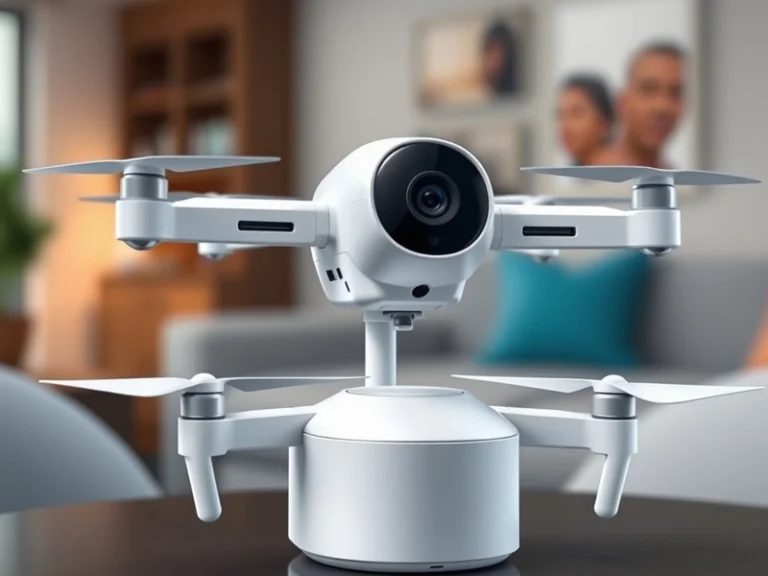
Ring, an Amazon company, introduced its Always Home Cam, an autonomous indoor drone designed to provide dynamic home security surveillance, marking a significant step in integrating flying robotics with smart home solutions.
The Always Home Cam: A New Perspective on Home Security
Unlike traditional fixed security cameras that offer a static view of a particular area, the Always Home Cam is a compact, self-flying device that can navigate pre-programmed paths within a home. When not in use, the drone rests in a charging dock, its camera physically blocked for privacy. Upon detecting an event flagged by other Ring sensors or in response to a user’s command, the Always Home Cam can autonomously take flight to investigate, providing a live video feed to the homeowner’s smartphone.
This approach fundamentally shifts the paradigm of home security from passive monitoring of specific zones to active, on-demand investigation across an entire indoor space. Instead of installing multiple cameras to cover every angle, a single Always Home Cam can potentially provide comprehensive coverage by moving to the point of interest.
Beyond Fixed Views: Advantages of a Flying Camera
The integration of drone technology offers several distinct advantages in a home security context:
- Dynamic Coverage: A single drone can cover multiple rooms and angles, eliminating blind spots inherent in fixed camera setups. If an alarm triggers in the kitchen, the drone can fly there directly, rather than relying on a camera placed in a hallway.
- Active Investigation: Instead of simply recording an event, the drone can actively move towards the source of a disturbance, providing closer views or different perspectives that might be crucial for identification.
- Reduced Hardware Clutter: Theoretically, a single drone system could replace several fixed cameras, simplifying installation and reducing the number of devices mounted throughout a home.
- Customizable Patrols: Users can program specific flight paths, allowing the drone to perform routine security checks of designated areas at scheduled times.
AI and Autonomous Operation
The “smart” in smart home security drones like the Always Home Cam is heavily reliant on artificial intelligence and machine learning. At its core, the drone must possess robust capabilities for:
- Autonomous Navigation: The drone needs to understand its environment, map out safe flight paths, and avoid obstacles such as furniture, walls, and even pets. This involves a combination of sensors (e.g., ultrasonic, optical) and AI algorithms for simultaneous localization and mapping (SLAM).
- Object Detection and Recognition: While the primary trigger might come from a separate sensor, the drone’s onboard camera system, powered by computer vision AI, can be used to identify specific objects or activities. For instance, it could differentiate between a family member, an unfamiliar person, or an animal, and alert the homeowner accordingly.
- Anomaly Detection: Beyond simple object recognition, advanced AI can learn normal patterns of activity within a home and flag anything unusual. This could range from an open window that is typically closed to an object being moved from its usual place.
- Power Management: AI plays a role in optimizing flight paths and returning to the charging dock efficiently, ensuring the device is ready when needed.
The aim is to create a system that is not just reactive but intelligently responsive, minimizing false alarms while providing critical information when genuine threats arise.
Navigating Privacy Concerns
The introduction of a flying camera into private spaces inevitably sparks discussions around data collection, surveillance, and the potential for misuse. Ring has addressed these concerns with specific design choices for the Always Home Cam:
- Indoor Use Only: The device is designed for indoor operation, limiting its scope to the homeowner’s private property.
- Physical Camera Blocker: When docked and not in flight, the camera is physically covered, offering a clear visual cue that it is not recording.
- Audible Flight: The drone is designed to be intentionally audible when flying, ensuring that occupants are aware of its movement and recording status. This transparency aims to foster trust and prevent covert surveillance.
Despite these measures, the concept of a camera that can move freely within a home raises broader questions about the comfort level with pervasive surveillance technology. For many, the convenience and enhanced security offered by such a device must be weighed against the potential erosion of personal privacy, even within their own homes. The data collected by such devices, and how it is stored, secured, and potentially accessed by third parties, remains a critical point of consideration for consumers and regulators alike.
The Future of AI in Home Security
The Always Home Cam represents a bold step towards a more dynamic and AI-driven future for home security. While still a niche product, its existence demonstrates the increasing sophistication of AI and robotics available for consumer applications. As AI capabilities improve, particularly in areas like autonomous navigation, advanced object recognition, and predictive analytics, we can expect to see more innovative solutions emerge in the smart home space. These advancements promise not only enhanced security but also greater convenience and peace of mind, provided the industry can effectively address the accompanying privacy and ethical challenges.