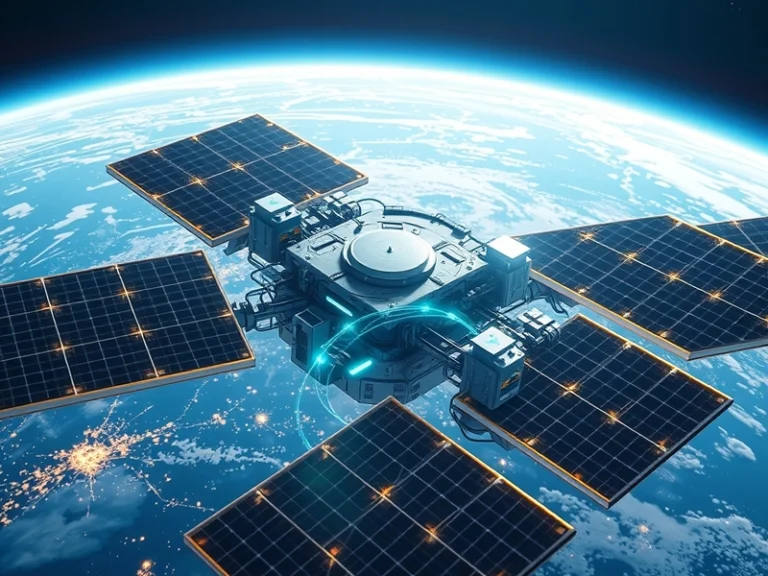
The deployment of advanced AI processing units aboard orbital platforms is accelerating, with a growing focus on leveraging their capabilities to enhance the efficiency and resilience of space-based solar energy collection and distribution systems. While the concept of space-based solar power (SBSP) has existed for decades, recent advancements in AI chip technology are providing new avenues to overcome its complex engineering and operational challenges, moving the vision closer to reality.
The Promise of AI for Space-Based Solar Power
Harnessing solar energy in space presents unique opportunities, such as continuous sunlight availability and no atmospheric interference, but also significant hurdles. AI chips are emerging as critical enablers for future SBSP systems by offering capabilities for:
- Optimal Panel Orientation and Tracking: AI algorithms can analyze real-time telemetry, solar flux, and orbital mechanics to dynamically adjust solar panel arrays, ensuring maximum energy capture regardless of spacecraft attitude or position. This goes beyond simple sun-tracking, incorporating predictive models for shading and degradation.
- Autonomous Power Management: In large-scale SBSP arrays, managing power generation, storage, and distribution is an immense task. AI can autonomously balance loads, predict power demands, optimize battery charging cycles, and reroute power in response to subsystem failures or environmental changes.
- Fault Detection and Self-Healing: Space environments are harsh, leading to component degradation and potential failures. Onboard AI can continuously monitor system health, detect anomalies, diagnose faults, and even initiate self-repair or reconfiguration protocols without ground intervention, significantly improving system uptime and longevity.
- Precise Energy Transmission: For SBSP to deliver power to Earth, highly accurate microwave or laser beam steering is essential. AI can process sensor data to maintain precise beam alignment, compensating for atmospheric turbulence, spacecraft jitter, and ground receiver movement, ensuring efficient and safe energy delivery.
- Predictive Maintenance: By analyzing performance data over time, AI can identify subtle trends indicating potential component failures before they occur, allowing for proactive adjustments or planning for future maintenance, thereby extending the operational life of expensive space assets.
Hardware in Orbit: Enabling AI at the Edge
The ability to perform complex AI inference directly on orbit, often referred to as “edge AI in space,” is driven by the evolution of radiation-hardened and radiation-tolerant processing hardware. Deploying AI capabilities at the source of data generation reduces latency and bandwidth requirements for communication with Earth, crucial for autonomous operations.
Several types of AI-capable hardware are already being deployed or tested in space environments:
- Radiation-Hardened FPGAs: Field-Programmable Gate Arrays (FPGAs) from companies like AMD (which acquired Xilinx) have long been staples in space missions due to their reconfigurability and resilience to radiation. Modern FPGAs, such as AMD’s Versal Adaptive Compute Acceleration Platforms (ACAPs), integrate dedicated AI engines and offer significant compute power for deep learning inference, making them ideal for adaptable, high-performance AI tasks in space.
- Specialized AI Accelerators: Dedicated neural processing units (NPUs) or vision processing units (VPUs) are designed for highly efficient AI inference. For instance, the Intel Movidius Myriad 2 VPU was famously used on the European Space Agency’s (ESA) PhiSat-1 mission in 2020 to autonomously detect and filter cloudy images, demonstrating the viability of compact, low-power AI accelerators for edge processing in Low Earth Orbit (LEO).
- Commercial Off-The-Shelf (COTS) Processors: While not inherently radiation-hardened, some missions experiment with commercial-grade processors in shielded environments. HPE’s Spaceborne Computer-2, for example, has been operating on the International Space Station (ISS) since 2021, demonstrating the potential for COTS hardware to perform AI workloads, including image processing and scientific simulations, in a relatively protected orbital environment. NVIDIA Jetson modules have also been tested in various space-related contexts for edge AI applications.
Challenges for AI Chips in the Cosmos
Despite the immense potential, deploying and operating AI chips in space comes with significant challenges that require specialized engineering:
- Radiation Effects: Space radiation, comprising high-energy protons and heavy ions, can cause Single Event Upsets (SEUs) that flip bits in memory or registers, leading to computational errors. It can also cause Total Ionizing Dose (TID) degradation, gradually damaging electronics over time. AI chips must be designed with radiation-hardening techniques, error correction codes, and robust fault-tolerant architectures.
- Power Efficiency: Spacecraft power budgets are often extremely constrained. AI accelerators, especially those performing complex inference, can be power-hungry. Designing highly efficient AI hardware and algorithms that can operate within strict power envelopes is crucial.
- Thermal Management: The vacuum of space and extreme temperature variations (from direct sunlight to deep shadow) pose significant thermal management challenges. AI chips generate heat, which must be dissipated effectively to ensure stable operation and longevity, often requiring passive cooling solutions or complex thermal control systems.
- Reliability and Autonomy: Once deployed, AI systems in space must operate with minimal human intervention. This demands exceptional software and hardware reliability, robust onboard learning capabilities (if applicable), and the ability to autonomously adapt to unforeseen circumstances without relying on constant ground communication.
The integration of advanced AI chip technology into orbital platforms marks a pivotal shift in how humanity approaches space-based solar energy. As research continues and more radiation-tolerant, power-efficient AI hardware becomes available, these intelligent systems will play an increasingly vital role in realizing the long-held dream of harvesting the sun’s boundless energy from above.