AI Uncovers Ancient Texts Lost for Millennia
In a remarkable fusion of artificial intelligence and archaeology, researchers have harnessed cutting-edge technology to read ancient scrolls that have remained buried for centuries. This groundbreaking achievement not only sheds light on our historical past but also showcases the potential of AI in the field of historical research.
The Discovery of the Herculaneum Papyri
The journey began with the discovery of the Herculaneum Papyri, a collection of scrolls unearthed from the ruins of Herculaneum, an ancient Roman town buried by the eruption of Mount Vesuvius in 79 AD. These scrolls, charred and fragile, were thought to be unreadable due to their delicate state. Traditional methods of examination, which included careful unrolling and physical analysis, posed significant risks of further damage.
AI Technology at Work
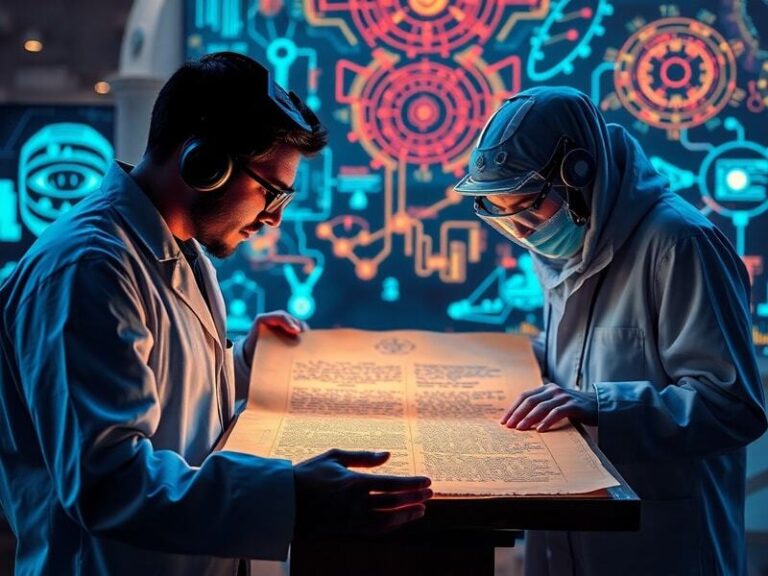
To tackle this challenge, researchers turned to machine learning and advanced imaging techniques. The key innovation involved the use of hyperspectral imaging, which captures images across different wavelengths of light. This technology enables researchers to identify subtle differences in the materials used in the scrolls, allowing for the differentiation between the ink and the papyrus.
Once the images were captured, AI algorithms were employed to analyze the data. These algorithms were trained to recognize patterns and text structures, enabling them to decipher the hidden writings without physically damaging the scrolls. The combination of hyperspectral imaging and AI analysis has led to unprecedented access to texts that have been lost for millennia.
Practical Insights and Industry Implications
The implications of this technology extend beyond archaeology. The ability to read ancient texts using AI could revolutionize several fields:
- Historical Research: New texts can provide insights into ancient cultures, philosophy, and daily life, reshaping our understanding of history.
- Text Recovery: AI methods can be applied to other damaged artifacts, enabling scholars to recover lost works across various civilizations.
- Interdisciplinary Collaboration: The convergence of AI, history, and material science fosters collaboration among diverse fields, leading to innovative solutions.
- Educational Opportunities: Enhanced access to ancient texts can enrich educational curricula, providing students with primary sources from history.
Future Possibilities
The successful application of AI to read the Herculaneum Papyri is just the beginning. Future advancements in this technology could lead to:
- Improved Algorithms: Continued refinement of AI algorithms will allow for even greater accuracy in text recognition and interpretation.
- Broader Applications: Techniques developed for ancient scrolls could be applied to manuscripts, books, and other historical documents that are too fragile for traditional examination methods.
- Enhanced Imaging Techniques: Future imaging technologies may provide even more detailed analysis, revealing texts that were previously thought to be illegible.
- Global Collaboration: Researchers and institutions worldwide can collaborate on major projects, sharing data and findings to further advance archaeological and historical studies.
Conclusion
The intersection of AI and archaeology is paving the way for a new era of discovery. The ability to read ancient texts that have been lost for centuries not only deepens our understanding of history but also demonstrates the transformative power of technology. As machine learning and imaging techniques continue to evolve, we can anticipate even more groundbreaking revelations waiting to be uncovered.