While a dedicated product named “Google Pics: The AI Image Editor” has not been formally announced as a standalone offering by Google, the company has deeply integrated advanced artificial intelligence capabilities into its existing photography ecosystem, fundamentally transforming how users interact with and enhance their images.
Google has been a pioneer in leveraging AI for image manipulation, weaving sophisticated machine learning models into its widely used products like Google Photos and its Pixel line of smartphones. These integrations provide powerful, accessible editing tools that often rely on complex neural networks operating behind a simple user interface.
AI-Powered Features in Google’s Existing Ecosystem
Google’s approach to AI image editing has primarily focused on enhancing user experience and democratizing advanced photographic techniques. Many of these features are available directly within the Google Photos application or are exclusive to Pixel devices, leveraging custom hardware like the Google Tensor chip.
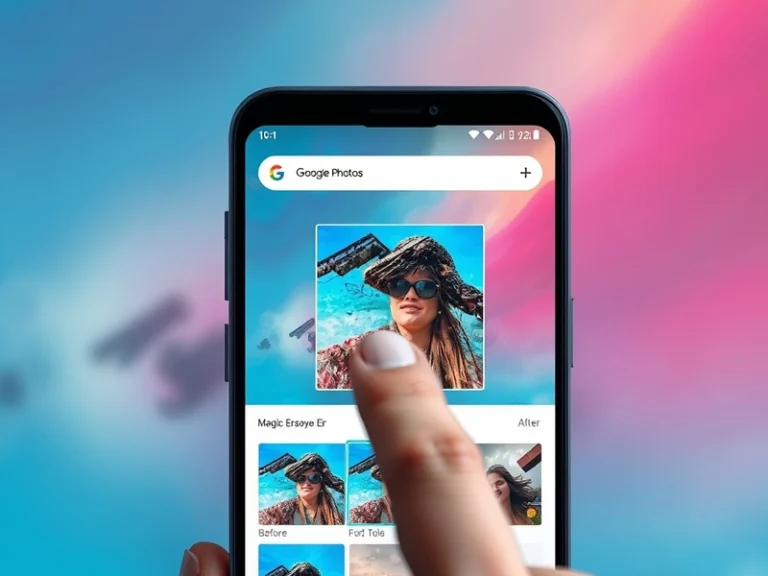
- Magic Eraser: Introduced with the Pixel 6, Magic Eraser allows users to effortlessly remove unwanted objects or people from photos. This feature employs sophisticated semantic segmentation and inpainting models to identify elements and seamlessly fill the background, creating a clean image.
- Photo Unblur: Another Pixel-exclusive feature, Photo Unblur uses machine learning to sharpen blurry images, whether they were captured on a Pixel phone or an older device. It analyzes motion blur and other artifacts to reconstruct clearer details.
- Portrait Light: Available in Google Photos, Portrait Light enables users to adjust the position and intensity of light on a subject’s face after a photo has been taken. This uses depth mapping and lighting models to simulate studio-quality lighting.
- Sky Suggestions and Color Pop: Google Photos frequently suggests AI-driven enhancements, such as adjusting the sky in a landscape photo or desaturating the background to make a subject “pop” with color. These are examples of AI understanding image content and applying context-aware edits.
- Generative AI in Photos: More recently, Google has begun incorporating generative AI capabilities, allowing users to move subjects, extend backgrounds, and create entirely new elements within images directly from text prompts. These features, often powered by models like Imagen or those within the Gemini family, represent a significant leap towards more flexible and creative AI-driven editing.
The Underlying Technology
The magic behind these AI editing capabilities lies in several core machine learning techniques:
- Semantic Segmentation: This technique allows AI models to identify and delineate different objects and regions within an image (e.g., distinguishing a person from the background, or a sky from a building). This is crucial for tools like Magic Eraser.
- Generative Adversarial Networks (GANs) and Diffusion Models: These advanced architectures are at the heart of creating new image content, whether it’s filling in a removed object (inpainting), extending an image beyond its original borders (outpainting), or generating entirely new images from text prompts. Diffusion models, in particular, have shown remarkable results in generating high-quality, diverse images.
- Computer Vision: Object detection, facial recognition, and scene understanding are fundamental computer vision tasks that allow Google’s AI to understand the content of a photo and suggest relevant edits.
- On-Device Processing: For Pixel devices, the dedicated Tensor Processing Unit (TPU) within the Tensor chip enables many of these complex AI operations to run directly on the phone, improving speed, privacy, and efficiency without relying solely on cloud processing.
Impact on Users and the Creative Landscape
Google’s integration of AI into image editing has several profound implications:
- Accessibility: Complex editing tasks that once required specialized software and significant expertise are now available to anyone with a smartphone, lowering the barrier to entry for high-quality image manipulation.
- Creative Augmentation: AI tools serve as creative assistants, helping users achieve desired artistic effects or fix imperfections with minimal effort, allowing them to focus more on the creative vision rather than technical execution.
- Efficiency: Repetitive or time-consuming edits can be automated or significantly sped up by AI, benefiting both casual users and professional photographers.
- Ethical Considerations: As AI-generated and AI-edited images become more sophisticated, discussions around authenticity, deepfakes, and responsible use of these powerful tools become increasingly important. Google, alongside other industry players, is exploring methods for content provenance and watermarking to address these concerns.
While the specific branding “Google Pics” may not represent a new, standalone product, Google’s continuous investment in AI for image editing underscores a clear strategic direction. The company is committed to pushing the boundaries of what’s possible with computational photography, making advanced tools more intuitive and widely available across its ecosystem.