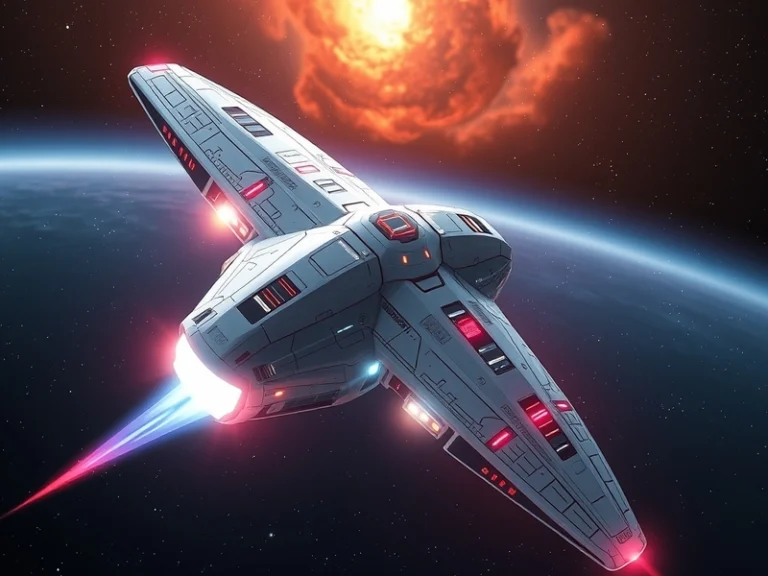
While the direct launch of an interstellar probe remains a distant prospect, the foundational role of artificial intelligence in overcoming the monumental challenges of such a journey is becoming increasingly evident, with AI technologies now being integrated into critical aspects of deep-space exploration and mission planning. The sheer scale of interstellar distances and the duration of such voyages necessitate capabilities far beyond current human-controlled missions, making AI an indispensable partner in charting a course to another star.
Interstellar travel presents an array of unprecedented hurdles. Probes would traverse unimaginable distances, potentially taking centuries or millennia to reach even the closest star systems. This extreme remoteness means real-time human intervention is impossible due to light-speed communication delays. Furthermore, these craft would need to operate autonomously in harsh, unknown environments, make complex scientific decisions independently, and maintain their operational integrity for timescales far exceeding any current mission. AI is emerging as the key to addressing these fundamental challenges.
Navigating the Void: Autonomous Systems
For missions traveling light-years from Earth, human operators cannot provide real-time guidance. A signal traveling to Proxima Centauri, for instance, would take over four years to arrive, and another four years for a response to return. This necessitates highly sophisticated onboard autonomy, a domain where AI is rapidly advancing.
Current deep-space missions are already leveraging AI for increased independence:
- Mars Rovers: NASA’s Perseverance and Curiosity rovers utilize AI for advanced autonomous navigation, known as AutoNav. This allows them to analyze terrain, identify hazards, and plot safe paths much faster than if every movement had to be uplinked from Earth. They also employ AI for scientific target selection, such as the Autonomous Exploration for Gathering Increased Science (AEGIS) system, which helps identify geological features of interest for closer inspection.
- Europa Clipper: The upcoming Europa Clipper mission to Jupiter’s icy moon will feature advanced autonomy to navigate its complex, high-radiation environment. Its systems will make rapid decisions about data collection and spacecraft maneuvers, minimizing reliance on delayed commands from Earth.
For interstellar probes, this autonomy must extend to self-repair, resource management, and even adapting mission objectives based on unexpected discoveries. AI-powered decision-making will enable probes to react to unforeseen events, optimize their trajectory, and conduct scientific experiments with minimal human oversight over centuries.
Decoding the Cosmos: Data Analysis and Scientific Discovery
The volume of data generated by future interstellar probes, not to mention current astronomical observatories, is immense. Sifting through this deluge to identify faint signals, classify objects, and make groundbreaking discoveries is a task increasingly handled by AI.
AI algorithms are already crucial in:
- Exoplanet Detection: Machine learning models analyze vast datasets from missions like NASA’s Kepler and TESS space telescopes, identifying subtle dips in starlight that indicate the presence of exoplanets. These algorithms can process data far more efficiently and reliably than human researchers alone, accelerating the pace of exoplanet discovery and characterization.
- Astronomical Surveys: AI assists in classifying galaxies, quasars, and other celestial objects from sky surveys, helping astronomers understand the large-scale structure and evolution of the universe.
- Anomaly Detection: For interstellar missions, AI could be programmed to detect unexpected phenomena or signatures of life, prioritizing data transmission for the most scientifically valuable observations, even if those observations were not part of the original mission plan.
This capability will be vital for probes exploring unknown star systems, allowing them to autonomously prioritize data collection and transmit the most significant findings back to Earth across vast distances.
Engineering the Future: Propulsion and Materials Innovation
Reaching another star within a reasonable timeframe requires revolutionary propulsion systems and materials capable of withstanding extreme conditions for millennia. AI is playing an increasingly important role in accelerating the design and optimization of these cutting-edge technologies.
* **Advanced Propulsion:** Concepts like fusion drives, antimatter propulsion, and laser-driven light sails (such as those envisioned by Breakthrough Starshot) involve incredibly complex physics and engineering challenges. AI-driven simulation and optimization tools can explore vast design spaces, testing countless configurations and parameters far beyond human capacity. Machine learning can identify optimal designs for engines, fuel systems, and power sources that maximize efficiency and minimize mass.
* **Novel Materials:** Interstellar probes will demand materials with unprecedented properties: extreme lightness, radiation resistance, thermal stability, and durability over geological timescales. AI, particularly generative AI and machine learning in materials science, can accelerate the discovery and design of new alloys, composites, and coatings. By predicting material properties based on atomic structure and simulating performance under extreme conditions, AI can dramatically shorten the development cycle for the components necessary for interstellar flight.
The Long Haul: Mission Resilience and Longevity
A mission lasting centuries demands unprecedented levels of resilience and self-sufficiency. AI will be critical for maintaining the health and functionality of an interstellar probe over its incredibly long operational lifespan.
* **Predictive Maintenance and Self-Repair:** AI systems could continuously monitor the probe’s internal systems, predicting potential failures before they occur and initiating automated repairs using onboard robotics or 3D printing capabilities. This would include diagnosing component degradation, reconfiguring systems to bypass failures, and even fabricating replacement parts.
* **Resource Management:** For potential crewed interstellar missions, or even highly complex robotic ones, AI would manage closed-loop life support systems, optimize power usage, and efficiently utilize any collected in-situ resources.
* **Long-Term System Health:** AI could oversee the deep-sleep states necessary for long transit periods, waking up systems only when required and performing routine diagnostics and maintenance to ensure the probe remains operational for its entire journey.
While the concept of an interstellar journey remains firmly in the realm of future exploration, the incremental yet profound advancements in artificial intelligence are steadily laying the groundwork. From enabling autonomous navigation across cosmic voids to accelerating the design of revolutionary propulsion systems, AI is proving to be not just a tool, but a fundamental prerequisite for humanity’s eventual reach for the stars. The ongoing integration of AI into current deep-space missions serves as a proving ground, preparing us for the monumental leap to interstellar travel.