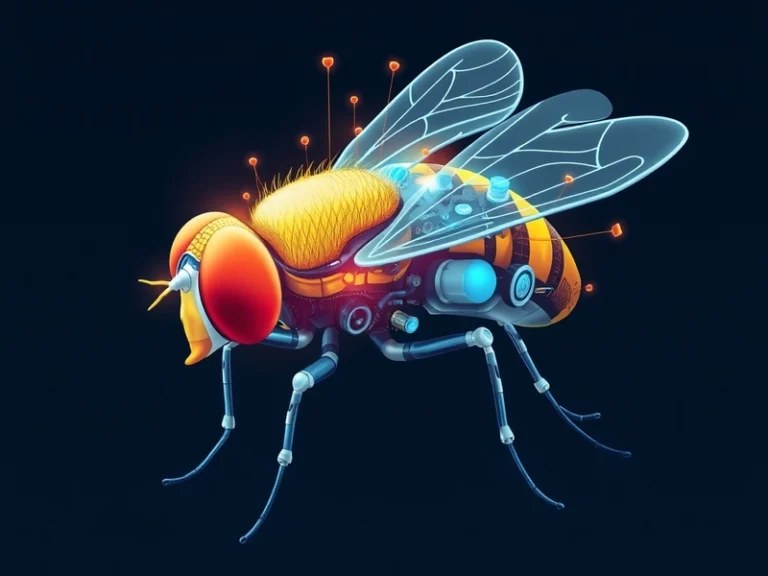
Researchers are increasingly turning to the meticulously mapped connectome of the Drosophila melanogaster fruit fly brain to inform the development of more efficient and robust embodied artificial intelligence systems.
A connectome is essentially a comprehensive map of all neural connections within a brain, detailing how neurons are wired together. Understanding this intricate wiring diagram offers profound insights into how biological brains process information, learn, and control behavior. For AI researchers, particularly those focused on agents that interact with the physical world, the fly brain presents a compelling case study: a compact, energy-efficient system capable of remarkably complex behaviors like navigation, flight control, and decision-making.
A seminal achievement in this field was the release of the Drosophila melanogaster hemibrain connectome, a detailed map covering tens of thousands of neurons and millions of synaptic connections within a significant portion of the adult fly’s brain. This monumental effort, spearheaded by institutions like the Janelia Research Campus of the Howard Hughes Medical Institute (HHMI) in collaboration with Google, provides an unprecedented blueprint of a functional biological brain. Unlike the human brain with its estimated 86 billion neurons, the fruit fly brain, with roughly 100,000 neurons, offers a tractable scale for comprehensive mapping and analysis, while still exhibiting rich behavioral complexity.
Why the Fly Brain Matters for AI
The fruit fly’s neural architecture offers several key lessons for AI development:
- Efficiency and Compactness: Despite its small size, the fly brain performs sophisticated computations with minimal energy consumption. This stands in stark contrast to many large-scale AI models that demand significant computational resources and power. Studying its design principles could lead to more efficient AI hardware and algorithms.
- Robustness: Biological systems are inherently robust to noise, damage, and variability in sensory input. The fly’s ability to navigate complex environments, often in challenging conditions, suggests underlying neural architectures that are resilient.
- Embodied Intelligence: Flies are prime examples of embodied intelligence, where perception, decision-making, and action are tightly coupled within a physical body. Their neural circuits are specifically adapted for real-time interaction with the physical world, making them highly relevant for robotic systems.
- Navigation and Motor Control: Flies exhibit sophisticated navigation strategies, including path integration, obstacle avoidance, and visually guided flight. The connectome reveals the specific circuits underlying these behaviors, offering direct inspiration for autonomous navigation systems in robotics.
Translating Connectome Insights to Embodied AI
The detailed maps provided by the Drosophila connectome are not merely static diagrams; they are dynamic blueprints for understanding computation. Researchers are exploring various avenues to translate these biological insights into artificial intelligence:
-
Bio-Inspired Algorithms and Architectures: By analyzing the wiring patterns, cell types, and synaptic strengths within the fly brain, AI researchers can design novel neural network architectures. For instance, identified circuits for visual processing, such as those involved in motion detection or object recognition, can inspire algorithms that are more robust and efficient than current approaches.
The fly’s central complex, a brain region implicated in navigation, spatial memory, and decision-making, has been a particular focus. Its highly structured, recurrent connectivity patterns are being explored for their potential to implement biologically plausible navigation controllers in robots.
-
Neuromorphic Computing: The connectome provides a direct blueprint for neuromorphic hardware, which aims to mimic the brain’s structure and function directly in silicon. Instead of traditional CPU architectures, neuromorphic chips, such as those developed by Intel (Loihi) or IBM (TrueNorth), are designed to process information in a massively parallel, event-driven manner, similar to biological neurons. The precise connectivity data from the fly brain can guide the design of these chips, potentially leading to more energy-efficient and brain-like computation.
-
Understanding Learning and Adaptation: While the connectome represents a largely fixed wiring diagram, biological brains are also capable of learning and adaptation. Researchers are investigating how plasticity mechanisms might operate within these fixed circuits, and how such mechanisms could be incorporated into AI systems to enable more flexible and adaptive behavior in embodied agents.
-
Simulating Whole-Brain Function: The relatively small size of the fly brain makes it feasible to simulate large portions, or even the entirety, of its neural activity. These simulations allow researchers to test hypotheses about circuit function and observe emergent behaviors, providing a computational sandbox for developing and validating bio-inspired AI models before deployment on physical robots.
The ongoing research at institutions worldwide highlights a growing recognition that biological intelligence, refined over millions of years of evolution, offers invaluable principles for building next-generation AI. By dissecting the intricate architecture of the fruit fly brain, scientists are not just advancing neuroscience; they are actively laying groundwork for embodied AI systems that are more intelligent, efficient, and capable of navigating our complex world.